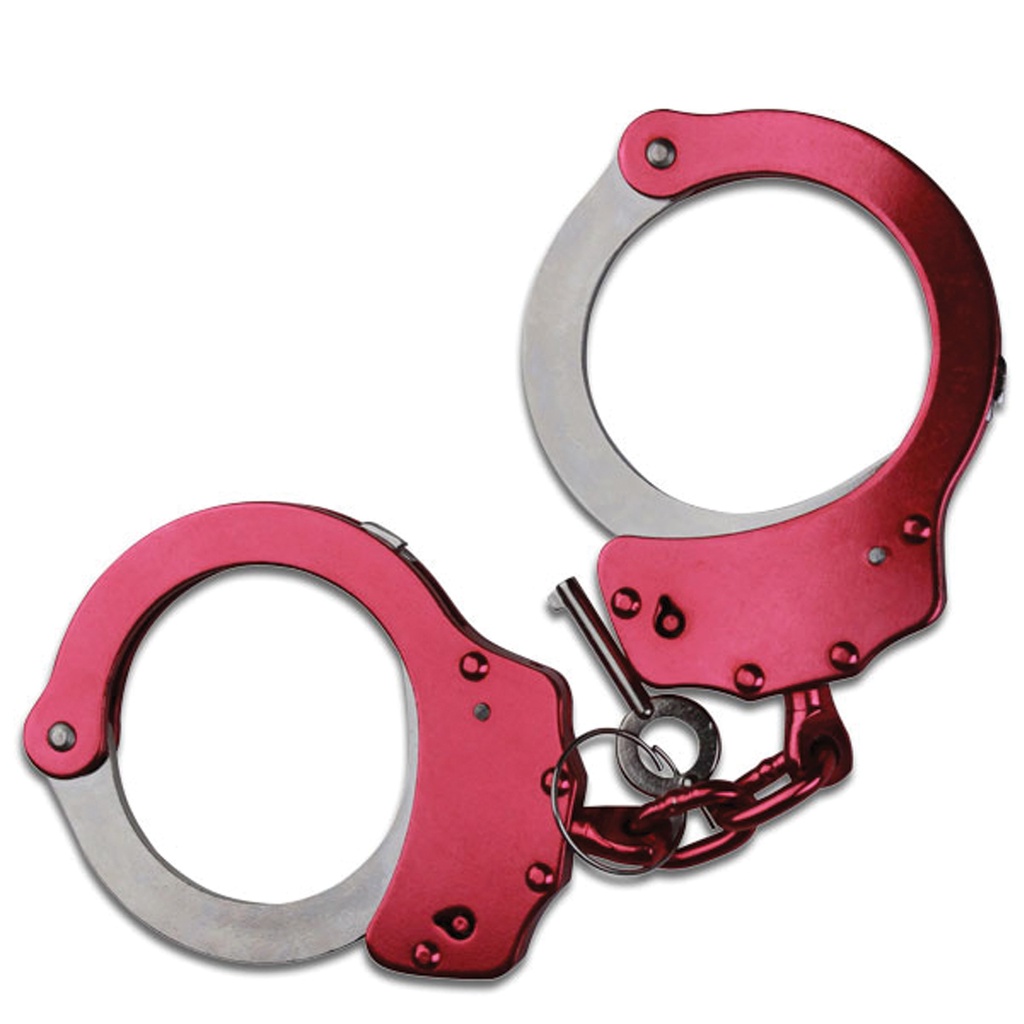
Signal Sentinel High-Visibility Restraint Handcuffs - Pink Chrome
15 sold in last 24 hours
This isn’t a toy pair of cuffs; it’s a professional disc-style double-lock restraint with a high-visibility pink chrome finish that changes the tone of control. Smooth ratchet action, universal keyway, and chrome-plated steel give you proven mechanics in a package that reads calm instead of confrontational. Trainers, transport officers, and retailers get hardware that works like the real thing, looks like control, and instantly stands out on the belt or in the display case.
Not a Knife, Still a Tool: Why Serious Gear Buyers Respect These Handcuffs
If you’re the kind of buyer who cares about how an automatic knife deploys, you care about mechanism in everything you carry. These aren’t novelty cuffs – they’re professional-style, disc double-lock handcuffs in a high-visibility pink chrome finish, built for trainers, transport officers, and gear retailers who refuse to stock junk. The same way you can feel a quality automatic action, you can feel the difference in smooth ratchet engagement and positive lockout on these restraints.
Control That Looks Like Control: High-Visibility Handcuffs for Sale
Functionally, this is a classic swing-through, ratcheting cuff set with chrome-plated steel bodies and a short double-link connector chain. Visually, the pink chrome shells change the conversation. On the street or in the training room, high-visibility restraints de-escalate before you ever close a cuff. Everyone in the room can see what’s happening, and more importantly, there’s no mistaking these for an off-duty souvenir or a prop.
The pink chrome finish also pulls real duty work: quick visual ID on a crowded belt or gear wall, easier accountability during classes, and instant separation from standard duty silver. For retailers, that color is a silent salesperson – people see them, walk over, and pick them up.
Mechanics Matter: Disc-Style Double Lock You Can Trust
Automatic knife enthusiasts obsess over clean deployment and solid lockup. With restraints, the equivalent is smooth ratchet action and a reliable double-lock system. These handcuffs use a disc-style double lock on each cuff body, giving you tactile, repeatable engagement every time.
Disc Double-Lock: Why It Matters in Real Use
A disc-style double lock isn’t marketing fluff – it’s a safety and control feature. Once the cuffs are applied and tensioned correctly, engaging the disc lock prevents the ratchet arm from tightening further under movement or pressure. That protects the subject’s wrists from over-tightening injuries and protects the officer or trainer from claims of negligent restraint.
The mechanism here is designed around a universal keyway, so you’re not locked into proprietary keys. The included key seats cleanly, engages the disc, and gives you consistent feedback – the kind of repeatable feel serious gear users expect from any mechanism they trust.
Smooth Ratchet Action: The Equivalent of a Clean Knife Pivot
The swing-through arms on these cuffs track cleanly through the pawl with minimal grit or hesitation. That’s your pivot and detent, in knife terms. When you’re applying restraints, you want a ratchet that glides into place and bites decisively, not one that hangs, skips teeth, or feels like stamped pot metal. Chrome-plated steel construction and properly finished teeth give you that smooth, confident closure.
Training, Transport, and Retail: Who These Cuffs Are Really For
These handcuffs sit in the same category as a well-made production automatic knife: not custom art, but absolutely worth owning if you care about the mechanics. They’re built for three main use cases:
- Training environments where visibility, de-escalation, and clear control are non-negotiable.
- Transport scenarios where officers want full mechanical reliability but prefer a less aggressive visual signature.
- Retail displays where high-visibility gear with real hardware construction moves faster than generic, indistinguishable models.
The short double-link chain keeps movement controlled without feeling overly rigid, and the rounded cuff edges reduce hot spots and bite during application. It’s the same philosophy as a good EDC automatic knife: performance first, with ergonomics that keep you from fighting your own gear.
Legal & Policy Reality: Handcuffs vs. Automatic Knife Concerns
Unlike an automatic knife, OTF, or switchblade, handcuffs don’t fall under the same weapon-specific statutes in most U.S. jurisdictions. However, that doesn’t mean they’re a free-for-all. Where automatic knife laws often focus on blade length, deployment method, and concealed carry, restraint devices tend to be governed by policies, misuse statutes, and impersonation laws.
If you’re a civilian, carrying professional-style handcuffs without a legitimate purpose can draw the wrong kind of attention, especially if paired with other law-enforcement-style gear. Many jurisdictions also have specific penalties for unlawful restraint or for impersonating an officer, and cuffs can become part of that conversation quickly. If you’re agency, security, or training staff, you’re typically covered by your organization’s policies – but it’s still your responsibility to know where and how you’re allowed to apply restraints.
The short version: while automatic knife legal frameworks are often about possession and carry, handcuff risks tend to revolve around use and context. Know your local laws, know your role, and treat professional restraints with the same respect you give a serious blade.
What Buyers Ask Before Purchasing an Automatic Knife
You came here for serious gear, and most of our customers are also shopping for an automatic knife for sale alongside cuffs, batons, and other duty or training hardware. These are the questions that come up over and over.
Are automatic knives legal?
In the U.S., federal law (notably the Switchblade Knife Act) limits interstate commerce and mailing of automatic knives and switchblades, especially across state lines and into federal jurisdictions. That said, many states now allow ownership and carry of an automatic knife, OTF, or similar mechanism, often with conditions about age, intent, or location.
Legality is primarily state and sometimes city driven. Some states allow automatic knives for EDC with few restrictions; others limit them to law enforcement, military, or emergency personnel; a few still prohibit them outright. If you’re asking whether an automatic knife is legal to carry where you live, you need to check your specific state and local codes, and remember that "legal to own" is not always the same as "legal to conceal" or "legal to carry everywhere." Nothing here is legal advice – do your homework before you buy automatic knife models for everyday carry.
What’s the difference between an automatic knife, OTF, and a switchblade?
Mechanically, an automatic knife is any knife that deploys its blade via a spring or stored energy system when you activate a button, lever, or similar control. Most side-opening autos fall into this category. An OTF (out-the-front) is a specific automatic design where the blade travels linearly out of the front of the handle, rather than pivoting from the side – it can be single-action (auto out, manual in) or double-action (auto out and auto in).
Switchblade is a legal and cultural term that usually refers to automatic knives broadly, especially in statutes. In enthusiast circles, we tend to say "automatic" or "OTF" when we’re being precise about mechanisms. All three terms cluster together in search and law, but not all automatic knives are OTFs, and not every jurisdiction uses the word switchblade the same way. When you’re shopping automatic knives for sale, pay attention to whether you’re looking at side-opening autos, OTF autos, or manual/assisted mechanisms mis-labeled by lazy marketing.
What makes this pair of handcuffs worth buying?
For the same reason a serious buyer doesn’t grab the cheapest automatic knife on a pegboard. Mechanically, you’re getting a disc-style double lock with a universal keyway, smooth ratchet engagement, and chrome-plated steel bodies – features that separate real restraint hardware from costume-grade junk. The pink chrome finish isn’t a gimmick; it’s a deliberate high-visibility signal that supports training, de-escalation, and quick gear identification.
If you train others, transport subjects, run a security operation, or stock gear for people who do, these cuffs hit the sweet spot: professional mechanism, controlled movement, and a visual profile that reads deliberate and thoughtful instead of aggressive. They’re the restraint equivalent of a well-spec’d production auto – not flashy for its own sake, but clearly built for users who understand the difference.
Why Serious Gear People Pair These Cuffs with a Quality Automatic Knife
Enthusiasts who obsess over an automatic knife for sale aren’t just collecting blades; they’re curating a system. A double-action automatic knife, a reliable OTF, or a tight-locking side-opener is only part of the equation. The rest is control, restraint, and how you manage encounters from first contact to final resolution.
These pink chrome disc double-lock handcuffs slot into that system cleanly: professional mechanics, deliberate visibility, and a design that acknowledges the real-world psychology of control. You don’t buy gear like this by accident. You buy it because you understand exactly what it does, why it works, and how it fits alongside the automatic knives you already trust.
If that’s how you think about your tools, you’re the buyer this product was built for.