Silent Prowl Compact Cat Self-Defense Keychain - Silver
11 sold in last 24 hours
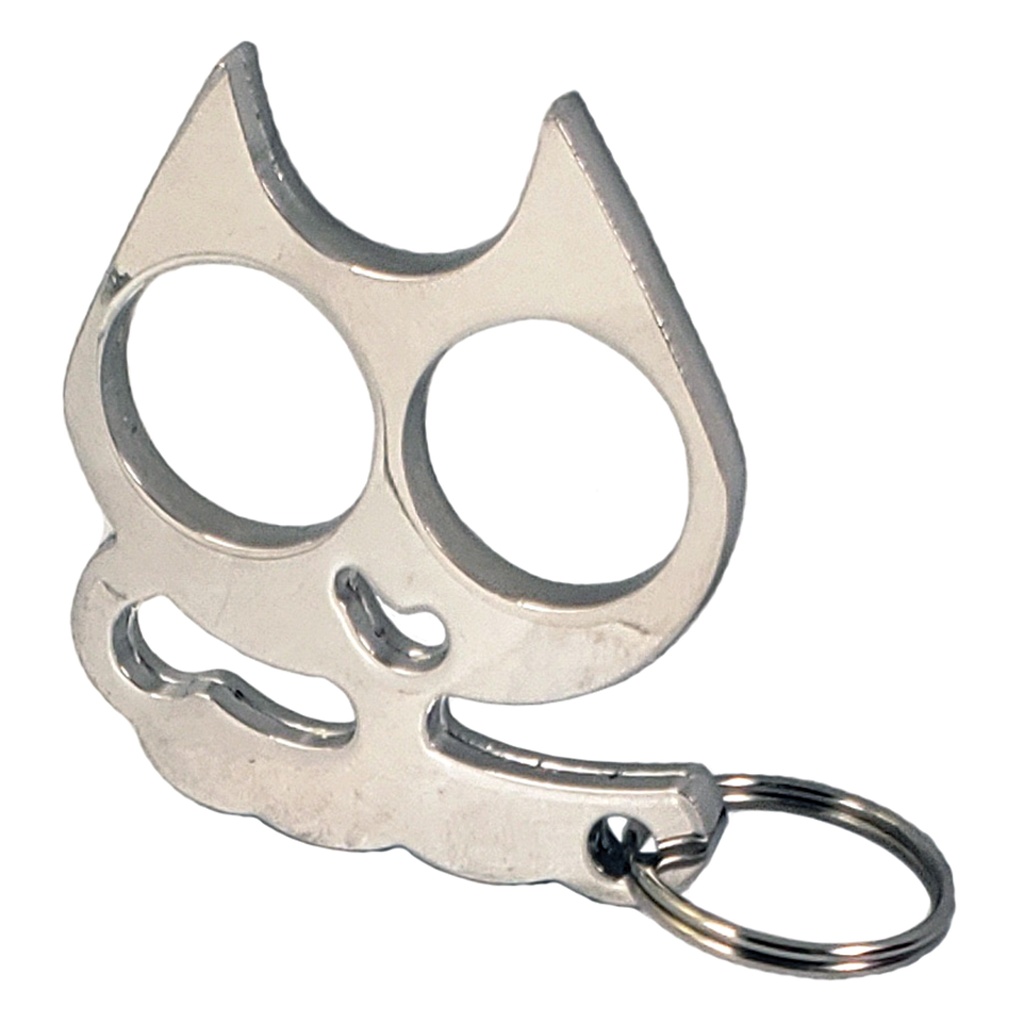
A self-defense tool only works if it’s actually on you. The Silent Prowl Compact Cat Self-Defense Keychain locks two fingers through the eyes for a secure grip while the pointed ears focus your strike. At roughly 2 x 2.5 inches, it rides on your keyring without bulk or noise, but fills your hand with instant confidence when you need it. Polished silver, solid, and purpose-built—nothing tactical-looking, just a discreet edge to your everyday carry.
Compact Confidence, Always in Hand
The Silent Prowl Compact Cat Self-Defense Keychain - Silver exists for one reason: the tool that’s with you beats the one left at home. This isn’t a gimmicky charm. It’s a rigid, impact-focused cat keychain designed to lock into your grip, add structure to your hand, and turn a moment of surprise into a moment of control.
At about 2 x 2.5 inches, it disappears on your keyring. But the moment you slide your fingers through the eye openings, the profile changes from cute silhouette to serious compliance tool. Two solid finger rings, two pointed ears—simple geometry, applied with intent.
Defense Keychain for Sale That You’ll Actually Carry
Most self-defense gear dies in a drawer. This defense keychain is built to live on your keys. The flat body rides flush against other keys, the polished silver finish blends with hardware instead of screaming "weapon," and the integrated keyring attachment keeps it where it belongs—ready, not showcased.
This is everyday carry thinking applied to a non-blade tool: make it compact, non-intimidating, fast to index, and brutally simple to deploy under stress.
How the Cat Keychain Design Works in the Real World
Strip away the novelty and you’re left with straightforward physics. The Silent Prowl Compact Cat Self-Defense Keychain uses three design fundamentals:
Dual Finger Rings for Retention and Control
The two circular eye cutouts aren’t just decoration. They’re finger rings. Slide your index and middle fingers through and the tool anchors to your hand. That retention matters when adrenaline spikes and your grip wants to fail. With your fingers locked in, it’s much harder for someone to strip it away or knock it loose.
The lower arc of the cat’s head sits into the palm as a subtle rest, distributing force and giving you a consistent index point: grab keys, find the curve, punch forward—same motion, every time.
Cat Ear Points to Focus Force
The pointed ears do what any focused impact surface does: they take the power of your swing and concentrate it into a smaller surface area. Instead of a broad, glancing impact from your knuckles, you get a more directed strike against soft targets. No moving parts, no reliance on edge retention—just leverage and geometry.
Material, Finish, and Why It Feels Solid
While this isn’t a blade and doesn’t live in the same steel conversations as automatic knives, the same design discipline applies. You want rigidity, edge definition on the ears, and enough thickness that the tool doesn’t flex under load.
The polished silver metallic finish does double duty: it visually reads like a normal key accessory while keeping edges smooth enough to carry comfortably but defined enough for contact. The solid-body construction resists bending, and the flat faces make it easy to orient by feel in a pocket or bag.
EDC Reality: How It Carries and Deploys
This keychain is built for one-handed deployment under pressure. Clip it to your existing keyring, drop the bundle into pocket or bag, and forget it until you need it. The corner-mounted split ring keeps the cat silhouette hanging at a predictable angle. When your hand wraps around your keys, you find the ears by feel, slide fingers through the eyes, and you’re immediately in a ready position.
No buttons, no safeties, no unfolding sequence. In self-defense, reducing the number of decisions between recognition and action is not marketing—it’s survival design.
Legal Context: Where a Defense Keychain Fits In
This is not an automatic knife, switchblade, or OTF mechanism. It’s a rigid impact tool shaped like a keychain accessory. That generally places it in a different legal category than blades or spring-activated weapons. However, some jurisdictions regulate "knuckles," impact tools, or disguised weapons, and a cat self-defense keychain can fall under those rules depending on how the law is written.
Here’s the bottom line: laws vary widely by state, city, and even campus or workplace. Before carrying any self-defense tool—blade or non-blade—check your local statutes and any policies that apply to where you live, work, or go to school. When in doubt, verify with up-to-date local legal resources rather than assumptions.
What Buyers Ask Before Purchasing an Automatic Knife
Even though this product is a defense keychain and not an automatic knife, most serious buyers live in the same EDC ecosystem—automatic knives, OTFs, switchblades, and impact tools all ride in the same pockets. So the common questions still matter.
Are automatic knives legal?
Under U.S. federal law, automatic knives (often called switchblades) are restricted primarily in interstate commerce, import, and certain federal jurisdictions, but federal law does not create a blanket ban on ownership. The real control lives at the state and local level. Some states allow automatic knives and OTFs with few restrictions; others limit blade length, carry type (open vs concealed), or restrict them entirely.
If you’re buying an automatic knife for EDC, you need to check your specific state statutes and any local ordinances. Look for terms like "switchblade," "automatic knife," or "spring-actuated" in your code. What’s perfectly fine in one state can be a problem across a border. When you add a defense keychain or any other tool to your carry, treat the legal research with the same respect you give blade steel or action type.
What’s the difference between an automatic knife, OTF, and a switchblade?
The terminology gets sloppy in casual use, but if you care about gear, words matter:
- Automatic knife: A knife where the blade opens via a stored-energy mechanism (usually a spring) with the press of a button, lever, or similar control. Most side-opening autos fall here.
- OTF (Out-the-Front): A subcategory of automatic where the blade deploys linearly out the front of the handle. Double-action OTFs both extend and retract the blade using the same slide or switch; single-action OTFs auto-deploy but require manual retraction.
- Switchblade: In legal language, this usually covers automatic knives broadly—any blade that opens automatically by a button, spring, or other mechanism. In collector circles, people often say "switchblade" when they mean "automatic," but serious buyers keep the mechanism distinctions clear.
The Silent Prowl Compact Cat Self-Defense Keychain is none of the above—no blade, no action, no spring. It’s an impact tool that complements an automatic knife carry rather than replacing it.
What makes this self-defense keychain worth buying?
Three things justify this piece in a serious EDC rotation:
- Always-on carry: It hides in plain sight on your keyring, meaning your odds of actually having it when you need it are high.
- Simple, stress-proof design: No deployment sequence, no fine motor skills—grab keys, index the shape, lock fingers in, and you’re immediately in a stronger position than empty hands.
- Discreet but purposeful profile: The cat silhouette dials down visual aggression while still giving you defined impact points and solid retention.
If you already obsess over the action of your automatic knife or the lockup on your folders, this keychain speaks the same language: function over flash, engineering over gimmicks, carry reliability over drawer jewelry.
For Buyers Who Take Everyday Carry Seriously
The Silent Prowl Compact Cat Self-Defense Keychain - Silver is for the same mindset that chooses a tuned automatic knife over a loose, rattling gas-station special. You’re not looking for cosplay gear—you’re building a carry setup that actually works under pressure.
Pair this with a reliable automatic or OTF, and you’ve covered two very different problems with tools that share one principle: if it’s on you, it can help you. If it isn’t, it’s just a picture on a product page.
If you’re the kind of buyer who knows your mechanisms, researches your laws, and curates what earns pocket space, this compact cat keychain deserves a spot on your ring.