Silent Watch Discreet Cat-Ear Defense Keychain - Red
3 sold in last 24 hours
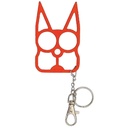
This isn’t a toy—it’s a Silent Watch discreet cat-ear defense keychain built to vanish into everyday carry until you actually need it. Slip two fingers through the rings and those pointed ears lock into alignment, giving you instant, directional control in a panic. The bright red metal silhouette rides unnoticed on your keyring, easy to grab, hard to drop, and always exactly where you left it when seconds matter.
Silent Watch Discreet Cat-Ear Defense Keychain - Red
Real self-defense gear doesn’t have to look tactical to work. The Silent Watch cat-ear defense keychain is a flat red metal cat silhouette that lives quietly on your keys until the moment you thread your fingers through and feel those pointed ears line up. Then it stops being cute and starts being control.
Everyday Carry That Doesn’t Broadcast It’s Defensive
Most obvious self-defense tools never get carried. They’re too bulky, too aggressive-looking, or too awkward for real daily use. This cat-ear defense keychain is the opposite: slim, smooth, and visually disarming. At a glance, it’s a fun red cat charm. In hand, it’s a rigid impact tool that gives you leverage, indexing, and repeatable grip under stress.
The twin circular cutouts act as finger rings—large enough for quick access, tight enough to prevent twist or slip. The rectangular lower edge and smooth surface let it ride in a pocket or bag without snagging, while the bright red color makes your keys easy to spot when you’re digging at the bottom of a backpack at night.
Design That Turns Grip Into Control
Mechanically, this defense keychain is simple, but simple doesn’t mean accidental. The geometry is the point. Two large finger rings serve as an instant indexing system: you don’t have to think about orientation; the cat ears tell you exactly where the force is going. Once your fingers are through, the handle profile locks against your palm, giving you a fixed alignment between your hand and the impact points.
Why the Cat-Ear Shape Actually Works
The exaggerated pointed ears aren’t decoration—they’re deliberate. By extending above the knuckles, each point becomes an extension of your natural strike line. In a high-adrenaline situation where fine motor skills vanish, you’re not trying to form a perfect fist or remember some complicated grip. You grab, squeeze, and the tool does the alignment work for you.
The flat, rigid metal frame spreads the load across your fingers and palm instead of concentrating it where it can injure you. That’s the difference between random novelty and a defense keychain that’s designed to be used if it has to be.
Keyring Hardware Built for Real Carry
The Silent Watch cat-ear defense keychain comes ready to live where it should—on your keys. A short metal chain connects the cat silhouette to a split keyring, with a silver-tone snap hook included. Clip it to a belt loop, inside a bag, or directly onto a lanyard. It’s compact and flat enough not to dominate your carry, but substantial enough that you can find it by feel.
Personal Safety That Stays Low-Profile
There’s a reason discreet defense tools have gained traction with students, commuters, and late-shift workers: overt weapons escalate situations and attract the wrong kind of attention. This red cat-ear keychain leans the other way. The kawaii-style cat face softens the visual impact, letting you carry a functional tool without announcing it.
The bright red finish is dual-purpose: it reads playful and stylish, but it also makes your keys easier to locate in low light. In a parking garage or on a crowded train platform, you don’t want to be rummaging. You want to see it, hook it with a finger, and be ready.
Understanding the Legal and Practical Context
Unlike an automatic knife, OTF, or switchblade, a cat-ear defense keychain is a blunt impact tool, not a bladed weapon. That difference matters in both perception and legal treatment. Many jurisdictions treat keychain self-defense tools differently from knives, but laws still vary widely by state, city, and even campus or workplace policy.
Some areas have restrictions on "knuckle" or "brass knuckle" style items, and certain cat-ear self-defense designs can fall under those definitions. This red metal silhouette is clearly a keychain accessory, but it’s still a force-multiplying tool. The responsible move is to check your local and state regulations—and any institutional rules—before you carry it.
Bottom line: it’s on you to know your local laws. This keychain gives you a discreet option for personal safety, but legality is never one-size-fits-all.
What Buyers Ask Before Purchasing an Automatic Knife
Are automatic knives legal?
In the U.S., automatic knife legality is a mix of federal and state rules. Federally, the 1958 Switchblade Knife Act restricts interstate commerce in automatic knives and switchblades with some exemptions—for example, for military, law enforcement, and certain occupational use—but it doesn’t directly tell you what you can carry in your pocket day to day. That’s handled at the state and sometimes local level.
Some states allow automatic knives and OTFs for everyday carry, some limit blade length, some restrict concealed carry, and a few still ban them outright. If you’re looking at any automatic knife for sale, you need to read your specific state statutes and, if you’re in a city with aggressive local ordinances, check those too. Also pay attention to where you’re going: courthouses, schools, federal buildings, and some workplaces have their own bans, regardless of state law.
What’s the difference between an automatic knife, OTF, and a switchblade?
Mechanically, an automatic knife is any knife where the blade opens under spring pressure when you press a button, lever, or similar actuator in the handle. Most side-opening automatics pivot the blade out from a closed position along a hinge, like a traditional folder with a motor strapped to it.
OTF—out-the-front—knives are a specific subset of automatics where the blade travels linearly out the front of the handle instead of swinging on a pivot. A double-action OTF both deploys and retracts under spring pressure via the same control, while a single-action OTF only fires out automatically and must be manually reset.
"Switchblade" is essentially the older legal and cultural term that was used in laws like the Switchblade Knife Act. In most modern enthusiast discussions, it’s used interchangeably with automatic knife, but serious buyers and makers tend to talk in terms of automatic, OTF, side-opener, and specific mechanisms rather than that catch-all label.
What makes this automatic knife worth buying?
For this product, the answer is: it isn’t an automatic knife at all—it’s a defensive keychain designed for people who either can’t carry a blade, don’t want to, or want something even more discreet to complement their primary EDC. Its value is in the geometry and carry reality: twin finger rings for locked-in control, extended impact points that orient themselves without thought, and a flat red metal profile that blends into normal life until it’s needed.
Collectors and serious EDC enthusiasts often pair an automatic knife with a low-profile tool exactly like this. The knife handles cutting, the cat-ear keychain is for situations where showing steel might not be the right answer—or where a knife isn’t allowed at all.
For Carriers Who Take Their Tools Seriously
If you’re the kind of person who thinks about deployment, indexing, and how a tool actually lives in your real day, this Silent Watch discreet cat-ear defense keychain fits the mindset. It’s not a gimmick; it’s a purpose-built, always-there option that complements the rest of your carry without competing with it. You choose a serious automatic knife for sale when you want precision cutting and fast deployment. You choose this when you also want a quiet, non-bladed layer of protection that rides on your keys and doesn’t ask for attention until the exact moment you need it.