Skeleton Flow Tanto Butterfly Knife - Satin Silver
12 sold in last 24 hours
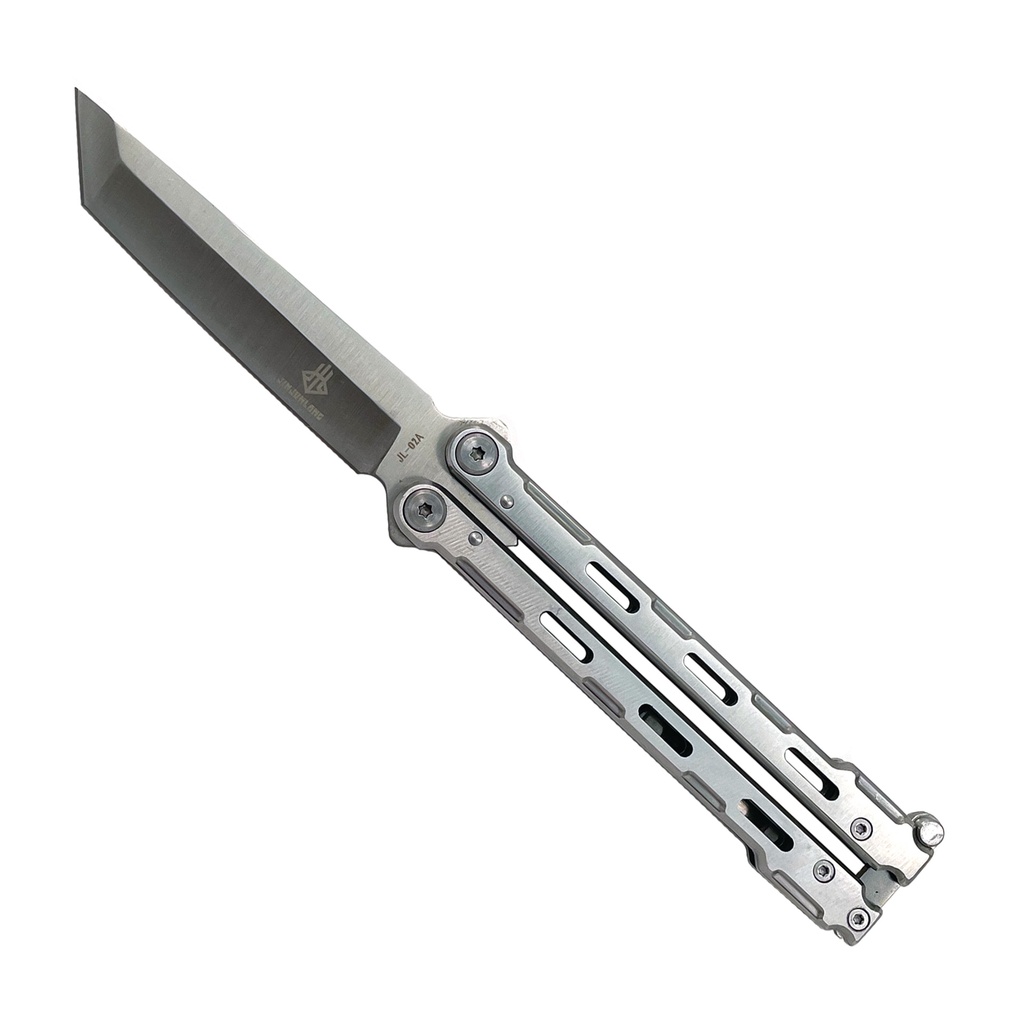
This isn’t a toy-store balisong. The Skeleton Flow Tanto Butterfly Knife brings CNC-machined stainless throughout, a tanto profile, and teflon-bushed pivots that make every opening feel tuned, not lucky. The larger star-bit hardware keeps the action tight and serviceable, while the skeletonized handles balance the 3.5" blade for real flipping, not just posing. If you appreciate a butterfly knife that feels engineered instead of stamped, this all-silver workhorse earns its place in your rotation.
Skeleton Flow Tanto Butterfly Knife - Satin Silver
The 420C Butterfly Knife in satin silver is what happens when a factory stops treating balisongs like novelty toys and starts treating them like actual mechanisms. Full stainless construction, tanto profile, teflon bushings, and oversized star-bit pivots put this squarely in the “built to be flipped” category, not the “break it in a weekend” tier.
Automatic Knife for Sale? No. Purpose-Built Butterfly Knife That Flips Like One Should.
Let’s be precise about terminology. This is not an automatic knife, not an OTF, and not a push-button switchblade. It’s a butterfly knife—also called a balisong—with a manually rotated handle system and a latch. You provide the power; the engineering makes sure it feels right.
Where a true automatic knife for sale uses a spring to fire the blade from the handle, this knife leans on tuned pivots and teflon bushings to give you that same satisfying, repeatable deployment—but through skill instead of a coil spring. If you’re already into automatics and OTFs, this scratches the same mechanical itch in a different way: less button, more technique.
Mechanics That Matter: Bushings, Pivots, Balance
A butterfly knife lives or dies on action quality. Blade steel and aesthetics are secondary if the handles bind or the pivot play is sloppy. This JL-pattern 420C Butterfly Knife nails the fundamentals that experienced flippers actually care about.
Teflon Bushings for Consistent, Low-Friction Flips
Look at the tiny, even gap between blade and handles: that’s the tell. Teflon bushings sit between tang and handle, giving you permanent lubricity without needing to drown the thing in oil. The result is a smooth, controlled swing that doesn’t chatter and doesn’t feel gritty, even after a solid practice session.
Compared to cheap washer-only balisongs, you get less stick at the start of the swing and better repeatability. That’s what you want when you’re drilling openings and closings; the knife should teach your muscle memory, not fight it.
Oversized Star-Bit Pivots You Can Actually Tune
The big star-bit (Torx-style) pivots aren’t decoration. Larger hardware means more thread engagement and better torque transmission when you’re dialing in tension. Too tight and any balisong feels dead; too loose and you’re living in lateral play city. This knife gives you the hardware you need to hit the sweet spot and keep it there.
For a serious buyer who maintains autos and OTFs, that serviceability matters. You wouldn’t buy an automatic knife for sale that you couldn’t tune—same logic here.
Balisong Steel and Geometry: 420 Stainless, American Tanto
The blade is ground from stainless 420-series steel, set up for easy maintenance and plenty of corrosion resistance. It’s not pretending to be a boutique powdered steel—and that’s fine. On a butterfly knife that’s going to see repetitive drops, edge touches, and the occasional sidewalk encounter, easy resharpening beats exotic hardness.
The American tanto profile with a defined secondary point brings some tactical flavor into what is otherwise a clean, minimalist build. That strong tip and long straight edge give you plenty of flat real estate for simple stone or rod work, and the satin finish with visible grind lines gives it that honest, machined look collectors appreciate.
Skeletonized Stainless Handles: Weight Where You Want It
Both handles are stainless steel with elongated cutouts. This isn’t random decoration; it’s how you keep a 6.35 oz all-metal balisong from feeling like a crowbar. Material removed from the handles shifts the balance closer to center, making rollovers and quick direction changes more controllable.
Closed, the knife sits at 4.75" with an 8.25" overall length open—solidly in the full-size category. It fills the hand the way a proper flipper should, with enough mass to carry momentum through tricks without feeling sluggish.
If You Collect Automatics, This Is the Balisong That Belongs Beside Them
Automatic knife collectors appreciate mechanism quality—lockup, timing, spring strength, alignment. This butterfly knife speaks the same language in a different dialect. Instead of spring timing, you’re paying attention to pivot tension. Instead of button placement, you’re feeling handle weight and latch behavior.
The latch closes with a positive snap, keeping the knife secure in the closed position without flopping around mid-flip. Paired with the teflon bushing system and precise machining, the overall impression is of a knife that’s meant to be used hard, not just photographed.
For the collector who already owns OTFs, side-opening autos, and maybe a few classic switchblades, adding a solid stainless balisong like this rounds out the mechanics section of the collection. It’s a different skill set, a different rhythm, but the same obsession with action quality.
Legal Context: Where a Butterfly Knife Sits Next to an Automatic Knife for Sale
Legally, this knife occupies an odd middle ground. Under U.S. federal law, the strict rules that cover shipping traditional switchblades across state lines are written for spring-driven automatics, not manual butterfly mechanisms. However, many states and local jurisdictions explicitly reference balisongs or interpret them under their existing switchblade or gravity knife statutes.
Translation: don’t assume that just because it’s not a button-fired automatic knife you’re clear to carry it everywhere. Some states treat a balisong more harshly than a typical folder, while others lump it in with general folding knives. Laws also differ on concealed versus open carry, blade length limits, and intent provisions.
Before you drop this into a pocket or glovebox, look up your state and local knife laws—specifically check for “balisong,” “butterfly knife,” “switchblade,” and “gravity knife” language. When in doubt, err on the side of keeping it a home, range, or private-property flipper rather than a daily public carry piece.
What Buyers Ask Before Purchasing an Automatic Knife
Are automatic knives legal?
In the U.S., automatic knives (true switchblades and most OTFs) are regulated by the Federal Switchblade Act, which restricts interstate commerce and mailing under certain conditions. Actual possession and carry, though, are almost entirely governed by state and local law. Some states allow autos and OTFs with few restrictions; others ban them outright or limit blade length, carry method, or who may own them.
This butterfly knife is not a spring-fired automatic knife, but many jurisdictions either name balisongs specifically or treat them like switchblades or gravity knives. Always check current statutes and recent case law where you live before carrying any automatic, OTF, switchblade, or butterfly knife in public.
What’s the difference between an automatic knife, OTF, and a switchblade?
“Switchblade” is the older umbrella term most people use for automatic knives. Mechanically, a modern automatic knife is any folding knife where an internal spring deploys the blade when you hit a button, lever, or hidden release. Most side-opening autos pivot out from the handle spine; OTF (out-the-front) knives drive the blade linearly out the front via a track and spring system, either single-action (needs manual reset) or double-action (fires and retracts from the same control).
This 420C Butterfly Knife is neither switchblade nor automatic. It has no deployment spring. The blade sits between two handles that rotate around pivots; you manipulate the handles manually to expose or cover the edge. For enthusiasts, autos and OTFs scratch the instant-deployment itch, while balisongs reward timing, feel, and manual control.
What makes this automatic knife worth buying?
Framed properly: what makes this butterfly knife worth buying to someone who already owns serious gear? Three things. First, the teflon bushing pivot system and oversized star-bit screws give it action you can actually tune and keep tuned, which most cheap balisongs can’t touch. Second, the full stainless, skeletonized build balances durability with flip-friendly weight distribution. Third, the clean satin tanto blade with visible machining isn’t pretending to be custom, but it has enough honest detail that you won’t be embarrassed to park it next to your automatics and OTFs.
For Enthusiasts Who Choose Mechanics Over Hype
If your idea of a good night is dialing in pivot tension on an OTF, comparing lockup on different side-opening autos, or arguing about bushing versus bearing systems, this butterfly knife belongs in that conversation. It’s not the loudest piece in the case, but it’s engineered correctly where it counts.
Whether you came here hunting an automatic knife for sale or you’re deliberately branching out into balisongs, the 420C Butterfly Knife in satin silver gives you honest materials, smart engineering, and an action that rewards practice. That’s what the serious side of this hobby is about.
| Blade Length (inches) | 3.5 |
| Overall Length (inches) | 8.25 |
| Closed Length (inches) | 4.75 |
| Weight (oz.) | 6.35 |
| Blade Color | Silver |
| Blade Finish | Satin |
| Blade Style | American Tanto |
| Blade Edge | Plain |
| Blade Material | Stainless steel |
| Handle Finish | Satin |
| Handle Material | Stainless steel |
| Theme | None |
| Latch Type | Latch |
| Is Trainer | No |