Stealth Lattice Quick‑Assist Pocket Knife - Black Aluminum
3 sold in last 24 hours
This is the assisted opening knife you reach for when you actually care how a blade deploys. The Stealth Lattice Quick‑Assist Pocket Knife runs a flipper‑driven spring assist that snaps the 3.5" dagger‑style blade into lockup with satisfying authority. The faceted black aluminum handle isn’t just for looks—it indexes naturally, bites into your grip, and carries low via a pocket clip. If you like your EDC fast, clean, and mechanically honest, this one earns its place in the rotation.
Stealth Lattice Quick‑Assist Pocket Knife – Built for Real EDC Use
The Stealth Lattice Quick‑Assist Pocket Knife is what happens when a budget‑friendly assisted opener is designed by someone who actually cares about action, grip, and carry. This is a spring‑assisted folding knife, not an automatic knife, not an OTF, and not a novelty "switchblade." It’s a fast, mechanically honest EDC built around a 3.5" dagger‑style blade and a faceted black aluminum handle that locks into the hand.
Action That Snaps Open, Not Just "Sort of" Opens
On a serious assisted opening knife, the difference between "fine" and "worth carrying" lives in the first half‑second of deployment. Here, the flipper tab and spring‑assist are tuned so the blade clears the detent cleanly, then rides the torsion assist into full lockup with a distinct, positive click. No lazy half‑opens, no mushy feeling at the pivot.
The liner lock engages the blade tang with solid surface contact, not just a fingertip of engagement. That gives you two things that matter in the real world: confidence under load and predictable wear over time. Thumb jimping on the spine lets you drive the point precisely instead of hunting for traction on a slick spine.
Why This Assisted Action Feels Better in Hand
Because the geometry works with you, not against you. The flipper tab is large enough to index under stress but compact enough not to snag in pocket. With a 4.5" closed length and roughly 8" overall, the knife hits the sweet spot where the assist has enough blade mass to work with, without feeling handle‑heavy or awkward.
Dagger‑Style Blade with Clean, Usable Grind
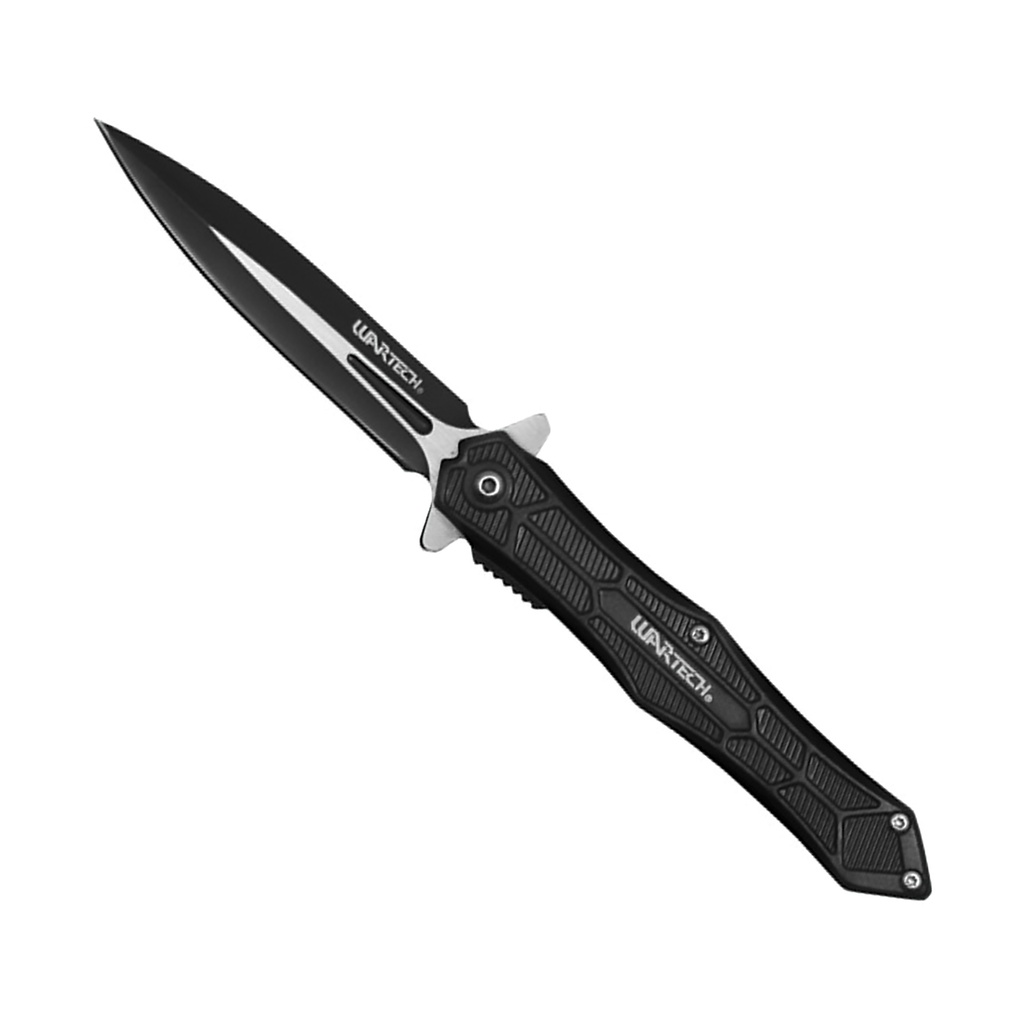
The two‑tone dagger‑inspired blade is more than an aggressive profile. You get a symmetrical spear point for precise tip work and an honest plain edge for day‑to‑day cutting. The contrast between the black primary surface and the bright edge line does something very simple and very useful: it makes the edge visible, which helps when you’re checking for flat spots or rolling during touch‑ups.
Steel is a straightforward working stainless—tough enough for boxes, strapping, and light utility, corrosion‑resistant enough for pocket sweat and bad weather if you give it basic care. It isn’t a boutique powder steel, and that’s fine; this is the kind of blade you’re not afraid to actually use. It sharpens quickly on basic stones and rewards you if you know how to keep a working edge instead of chasing mirror polishes.
Balanced for Real EDC Cutting Tasks
At this size, balance sits right around the pivot, where it belongs on a practical folder. That means tip control for piercing tasks and stable draw cuts without the blade wanting to dive or roll in your grip. The dagger profile gives you a strong central point for detailed work yet maintains enough belly to slice cleanly through tape, cord, and packaging.
Handle Geometry: Lattice Texture with Real Grip
The black aluminum handle is where the "Shadow Lattice" name earns its keep. The faceted geometry and lattice‑style texturing break up flat surfaces and give your fingers natural indexing points. That’s what keeps this from feeling like a generic slab‑sided assisted opener. The matte finish keeps glare down and sticks in the hand better than polished aluminum ever will.
Liner lock construction keeps the profile slim while giving a predictable, easy‑to‑tune lock interface. Torx hardware means you can actually service the knife—tighten the pivot if it loosens, tune tension, or strip it down for cleaning after a gritty week of use. A low‑profile pocket clip tucks the knife into your pocket without announcing itself from across the room.
Where This Assisted Opener Fits in a Collector’s Rotation
If your roll already holds high‑end autos and custom OTF knives, this Stealth Lattice Quick‑Assist Pocket Knife slots in as the guilt‑free user. It scratches that fast‑deployment itch without stepping into automatic territory, which can matter depending on where you live and how you carry. The dagger‑style blade and two‑tone finish give it enough presence that it doesn’t get lost next to bigger names, while the aluminum handle and clean lines make it a natural workhorse.
This is the knife you lend to a friend who "just needs to open a box" without sweating over scratches on a four‑figure auto. It’s also the knife that reminds you why spring‑assisted folders took off in the first place: they deliver much of the feel of an automatic knife’s snap without the same legal baggage.
Legal Context: Assisted Opening vs Automatic Knife
It’s important to be precise here. This Stealth Lattice is a spring‑assisted folding knife, not a true automatic knife. On an automatic or classic switchblade, pressing a button or other purely mechanical release deploys the blade under spring power. On an assisted opener, you start the opening manually—usually with a flipper tab or thumb stud—and once the blade moves past a certain point, the internal spring takes over and completes the opening.
Under U.S. federal law, automatic knives (switchblades) are regulated by the Federal Switchblade Act, which restricts interstate commerce and mailing of autos under certain conditions. Assisted opening knives like this one are generally treated as conventional folding knives because they still require manual initiation. That said, some states and localities blur the distinction or have their own definitions.
So while this assisted opener is typically more widely legal to carry than an automatic knife or OTF, it’s still on you to check your specific state and local laws. Pay attention to any rules about assisted mechanisms, blade length, and where you can carry. Laws evolve; when in doubt, read the current statute or talk to a local attorney rather than relying on rumor.
What Buyers Ask Before Purchasing an Automatic Knife
Are automatic knives legal?
In the U.S., automatic knives—often called switchblades—sit under a mix of federal and state rules. Federally, the Switchblade Act limits interstate shipment and sale of autos, with some exceptions for military, law enforcement, and certain uses. Day‑to‑day carry, however, is mostly governed at the state and local level. Some states have effectively legalized possession and carry of automatic knives; others restrict them by blade length, opening method, or where you can carry; a few still ban them outright.
This Stealth Lattice is a spring‑assisted folder, not an automatic knife, which usually places it in a friendlier legal category. Still, treat knife law like you would firearms law: check current state statutes, look for city or county ordinances, and don’t assume what’s fine in one jurisdiction is fine in the next.
What’s the difference between an automatic knife, OTF, and a switchblade?
Mechanically, an automatic knife uses a spring to drive the blade open when you press a button, lever, or similar control. A classic side‑opening switchblade is an automatic knife—the blade pivots out from the side just like a manual folder, but under spring power. Many collectors use "automatic" and "switchblade" interchangeably for side‑open autos.
OTF (out‑the‑front) knives are a specific subset of automatics where the blade travels in a track and shoots straight out the front of the handle. A double‑action OTF deploys and retracts the blade with the same slider; a single‑action OTF fires automatically but must be manually retracted. By contrast, a spring‑assisted knife like the Stealth Lattice still requires you to start the blade manually with a flipper; the internal spring only finishes the opening, which is why most laws treat it differently from both OTF and switchblade designs.
What makes this assisted opening knife worth buying?
Three things: deployment, geometry, and honesty of purpose. The assist is tuned to give you a decisive, repeatable snap without feeling like it’s fighting you. The 3.5" dagger‑style, two‑tone blade offers a sharp, controllable point and a clean working edge that actually cuts instead of just looking aggressive. And the faceted black aluminum handle with lattice texture gives you a grip profile you can live with all day—lightweight, low‑profile in pocket, and easy to service via Torx hardware.
If you already own autos and OTFs, this is the knife you beat up without regret. If you’re stepping up from cheap gas‑station folders, it’s a clear demonstration of what a properly tuned assisted opener feels like when it’s done right.
For Enthusiasts Who Choose Their EDC on Purpose
The Stealth Lattice Quick‑Assist Pocket Knife is for people who pay attention to how a blade actually opens, locks, and rides in the pocket. It sits comfortably alongside your automatic knives, OTFs, and manual folders as the deliberate, mechanically honest assisted opener you carry when you want speed without drama. If you choose your gear with intent, this one earns its slot.
| Blade Length (inches) | 3.5 |
| Overall Length (inches) | 8 |
| Closed Length (inches) | 4.5 |
| Blade Color | Black |
| Blade Finish | 2-tone |
| Blade Style | Dagger |
| Blade Edge | Plain |
| Blade Material | Steel |
| Handle Finish | Matte |
| Handle Material | Aluminum |
| Theme | None |
| Pocket Clip | Yes |
| Deployment Method | Spring-assisted |
| Lock Type | Liner lock |