Stealth Monolith Desk Knuckle Paperweight - Black Metal
8 sold in last 24 hours
You don’t buy this for decoration—you buy it for presence. The Stealth Monolith Desk Knuckle Paperweight brings a full 1/2-inch-thick, four-ring brass-knuckle silhouette in a clean black finish that feels like real hardware, not novelty. The weight keeps papers put, the geometry catches the eye, and the minimalist profile fits any tactical-leaning desk setup. Solid, balanced, and made to be handled, it’s a knuckle-style paperweight for buyers who like their gear with some attitude.
Stealth Monolith Desk Knuckle Paperweight - Black Metal
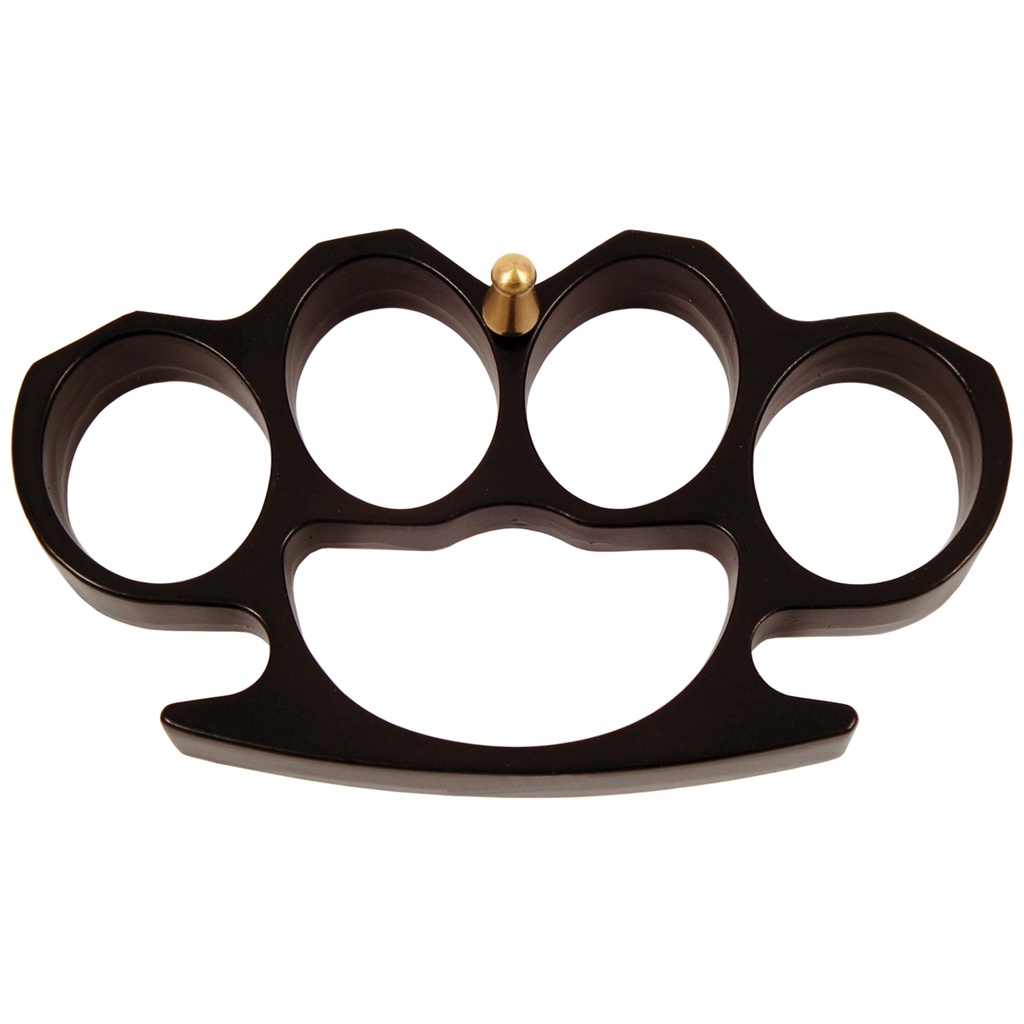
Some desk pieces are cute. This isn’t one of them. The Stealth Monolith Desk Knuckle Paperweight takes the classic four-ring brass knuckle profile, builds it out to a full 1/2-inch thickness, and finishes it in blackout black. The result is a low-key, hard-edged object that sits on a desk like it means it—no graphics, no gimmicks, just geometry, weight, and presence.
Why This Knuckle Paperweight Works on a Gear-Obsessed Desk
Even if you live in the world of automatic knives, OTFs, and switchblades, you still need something that stays put on the paperwork. This knuckle-style paperweight hits that niche. The four-ring silhouette instantly reads as tactical hardware, but the design is stripped down: a solid, single-piece construction with a flat palm bar, faceted outer contour, and smooth inner rings. It looks like it belongs next to titanium folders and machined EDC trays, not next to plastic office toys.
That 1/2-inch-thick profile is doing real work. More mass means more stability—drop it on a stack of documents and they’re not going anywhere with a stray gust from an AC vent. More importantly for enthusiasts, the heft feels honest in the hand. When you pick it up, it has that same satisfaction as a well-built automatic knife: no rattle, no flex, just solid metal.
Design Details That Make Collectors Pay Attention
This piece doesn’t shout, it just sits there and lets the lines do the talking. The four evenly spaced finger holes are cleanly rounded on the inside for a smooth grip, while the outer edge is faceted into a geometric, almost architectural contour. It’s where the “Monolith” name earns its keep—blocky, deliberate, and symmetrical.
The finish is a deep black, running from matte to semi-gloss depending on the light, which keeps reflections low and the profile sharp. A single brass-colored stud at the top center breaks the monochrome and adds a focal point. It’s a small detail, but it reads as deliberate—like a fastener head or alignment pin on hard-use gear. On a desk full of knurled pens, anodized clips, and stonewashed blades, it fits right in.
1/2-Inch Thickness: Why the Dimension Matters
Half an inch isn’t arbitrary. Go thinner and you lose that anchor feeling; the piece starts to feel like stamped sheet instead of a solid block. At 1/2 inch, you get enough cross-section to suggest durability and enough weight to matter without turning it into a brick. In the hand, that thickness gives your fingers a reassuring ledge at the palm bar and a secure, confident grip across all four rings.
Single-Piece Metal Construction
The Stealth Monolith is cut from a single piece of metal, which means no moving parts, no joints, and no alignment issues. For a paperweight, that translates to simplicity and reliability. For collectors, it means a clean silhouette with no hardware heads, rivets, or seams interrupting the design. You get a solid knuckle-style profile that feels like a purpose-built object instead of a costume prop.
How This Knuckle Paperweight Fits the Tactical + EDC World
Most people who pick this up are already gear people—automatic knife owners, OTF collectors, or switchblade enthusiasts who appreciate solid metal and clean lines. On a workbench or desk, it becomes part of that ecosystem. It’s something you can fidget with while you’re on a call, line up next to your favorite auto, or park on top of your notebook.
It’s also an easy story piece for retailers. One glance and customers know exactly what the silhouette references, but the black finish and minimalist design let you merchandise it as a desk paperweight or display accessory without overexplaining. It looks good next to blades, next to EDC trays, or in a case with tactical-inspired decor.
Legal Context: What This Knuckle Paperweight Is—and Isn’t
This item is sold and described as a paperweight. It uses a brass-knuckle-style four-ring profile, but it is not marketed or sold as a weapon. There is no blade, no automatic mechanism, no OTF action, and no switchblade function involved—just solid metal in a knuckle-shaped form used to hold papers in place or serve as a display piece.
That said, laws about brass knuckles and knuckle-style objects can be stricter than knife laws in some jurisdictions. In the United States, regulations vary widely from state to state and even city to city. Some areas treat metal knuckles as prohibited weapons regardless of how they’re marketed; others have no specific restriction. Before you add this to your desk or collection, it’s on you to check your local and state regulations regarding knuckles, knuckle-dusters, or similar devices.
Nothing here is legal advice. This product is offered as a novelty paperweight and display item only. If you’re already used to checking whether an automatic knife is legal to carry or whether a particular switchblade design is allowed in your state, apply that same due diligence here—verify your local rules and buy accordingly.
What Buyers Ask Before Purchasing an Automatic Knife
Even though this product is a knuckle-style paperweight, most of our customers live in the same ecosystem as automatic knife, OTF, and switchblade buyers. These are the questions that come up again and again when people shop for serious gear.
Are automatic knives legal?
In the United States, automatic knives (also called autos) are regulated under a mix of federal and state laws. Federal law (the Federal Switchblade Act) restricts interstate commerce in automatic knives—especially switchblades shipped across state lines—but it carves out exceptions for military, law enforcement, and certain one-armed users. The real deciding factor for most buyers is state law and sometimes local ordinances.
Some states allow automatic knives and OTF knives for general carry, some allow possession but restrict carry (for example, blade length limits or concealed carry bans), and others heavily restrict or outright prohibit traditional switchblades. Because these rules change and are interpreted differently over time, the only safe approach is to check current laws where you live and, when in doubt, consult an attorney or reliable legal resource. Never assume that just because you can buy an automatic knife online it’s automatically legal to carry in your pocket.
What’s the difference between an automatic knife, OTF, and a switchblade?
In enthusiast terms, an automatic knife is any knife where the blade opens under spring tension when you hit a button, push a lever, or depress a hidden release. You’re not manually rotating the blade open with a thumb stud or flipper—the mechanism does the work once you initiate it.
An OTF (out-the-front) knife is a specific type of automatic where the blade travels linearly out of the front of the handle. Most serious OTFs are automatic: you push a button or slider and the blade shoots forward under spring power. Double-action OTFs use the same control to both deploy and retract the blade.
A switchblade is mostly a legal and historical term that, in modern use, usually refers to side-opening automatic knives—the classic button-activated blade that swings out from the side of the handle. Legally, many jurisdictions use “switchblade” as an umbrella term covering both traditional side-opening autos and some OTF designs, which is why understanding mechanism and local definitions matters.
What makes this automatic knife worth buying?
Applied more broadly to serious gear, a piece is worth buying when the design, construction, and purpose all line up. For automatic knives, that means a reliable deployment, a strong lockup, a steel choice that matches how you actually use the blade, and a handle that doesn’t fight you in the hand. For a knuckle-style paperweight like the Stealth Monolith, the value shows up in the honest mass, the clean single-piece metal construction, and the minimalist execution that makes it feel like real kit instead of clutter.
If your desk already has a rotation of blades—maybe an automatic knife for EDC, an OTF in the display case, and a vintage switchblade you don’t loan to anyone—this paperweight slides right into that world. It’s a solid, understated object that signals the same thing your knives do: you care about how things are made.
For Enthusiasts Who Like Their Gear with Gravity
This isn’t a toy, and it doesn’t try to be. The Stealth Monolith Desk Knuckle Paperweight is for the same buyer who pores over action quality on an automatic knife for sale, debates OTF mechanisms with friends, and actually reads steel charts instead of skimming them. It brings that same energy to a simple desk object: solid metal, clean lines, and a profile that quietly tells the room you’re into serious hardware.
If that sounds like your corner of the world, this is the kind of piece you don’t have to explain to the right people—they’ll get it the second they pick it up.
| Theme | None |
| Thickness (inches) | 0.5 |
| Material | Metal |
| Color | Black |