Shadow Talon Rapid-Assist Karambit Knife - Midnight Black
7 sold in last 24 hours
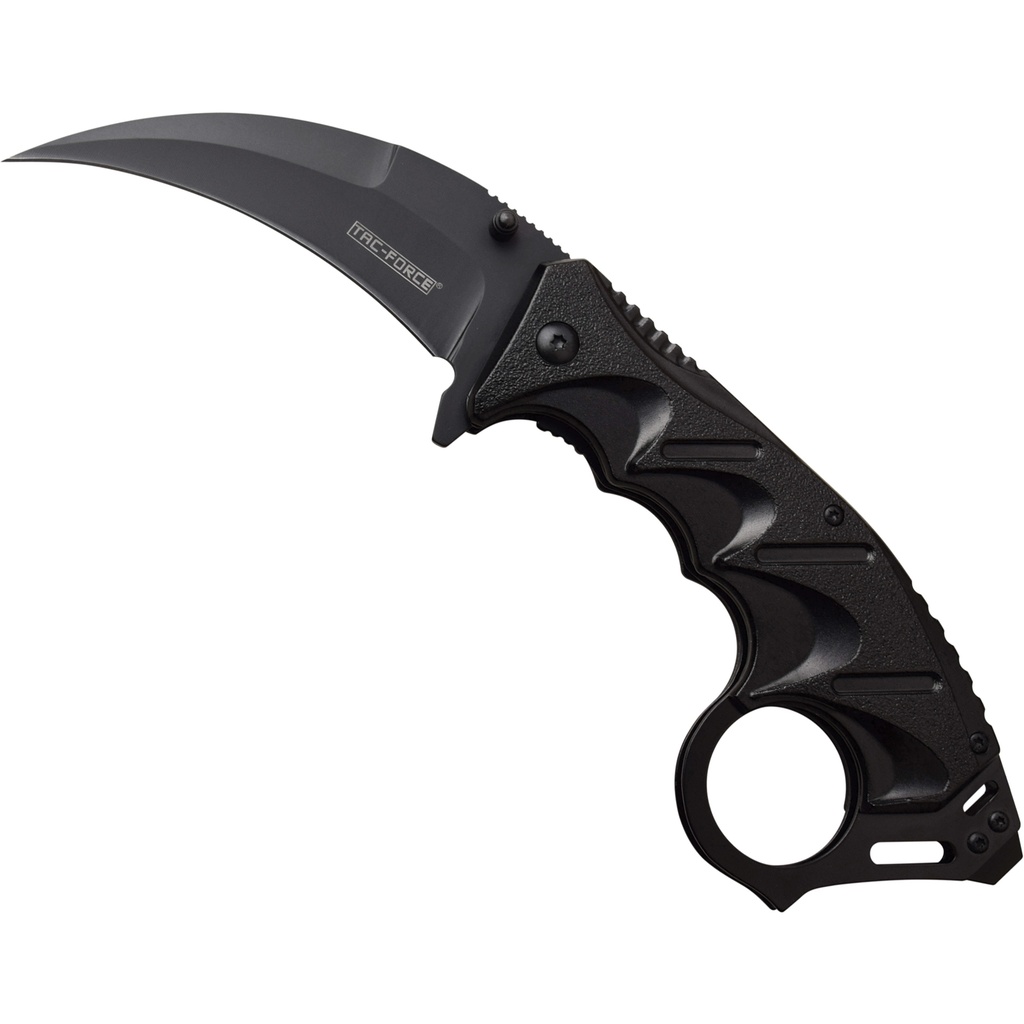
This is a spring-assisted karambit built for people who actually use their knives. The 3CR13 matte black talon snaps out with a clean, linear assist that’s easy to predict and hard to fumble. The finger ring locks your hand in, while anodized aluminum scales keep weight down without feeling toy-light. Jimping, finger grooves, and a solid liner lock make it a confident EDC choice for those who prefer a ringed tactical profile over another bland folder.
Spring-Assisted Karambit Built for Real-World Control
The Stealth Ring Rapid-Assist Karambit Knife - Midnight Black is not an automatic knife for sale in the legal sense, but it lives in the same neighborhood of fast deployment and decisive action. This is a spring-assisted folding karambit tuned for one thing: getting from closed to locked with predictable speed and rock-solid control through that finger ring.
Action That Earns Its "Rapid-Assist" Name
Plenty of budget folders claim to be quick. This one actually is. The spring-assisted mechanism on this karambit doesn’t try to mimic a full automatic knife; instead, it gives you a consistent, repeatable boost once you initiate the opening. You start the blade with the flipper or thumb, the spring takes over, and the talon-shaped edge snaps into battery against the liner lock with a clean, audible stop.
Because it’s assisted, not a true automatic, you stay in control of the start of the motion. That matters to serious users. There’s less chance of a surprise deployment in pocket, and more confidence when you want the blade to open the same way, every time. The geometry of the curved blade and the pivot placement work together so the arc of the blade doesn’t fight the assist — it rides it.
Why Spring-Assisted Suits a Folding Karambit
On a ringed karambit, your grip, index point, and blade orientation matter more than raw deployment speed. The finger ring anchors your hand first; the assist brings the blade out second. That sequence is exactly what you want for a tactical EDC karambit: you index on the ring, set your wrist, then let the spring finish the job. It’s fast, but more importantly, it’s predictable.
Steel, Geometry, and Edge Reality
The blade is 3CR13 stainless, a workhorse value steel that’s honest about what it is. You’re not buying a boutique powdered metallurgy showpiece; you’re buying a blade that shrugs off sweat, pocket carry, and general abuse, then sharpens back up without a fight. On a karambit this size, that’s a smart trade: corrosion resistance and easy maintenance beat exotic edge life you’re afraid to scratch.
The 3.5-inch talon profile gives you a continuous cutting curve, optimized for pull cuts, hooking, and controlled slicing. The matte black finish cuts down glare and visual signature. Combined with the jimping along the spine near the thumb ramp, you get solid purchase in both standard and reverse grips, especially when the ring is locked around your finger.
Handle, Ring, and Fit in Hand
The anodized aluminum handle scales keep the overall weight down while still giving you that reassuring metal density. Finger grooves along the handle guide your grip into place, making it easy to establish orientation the moment you grab it from pocket. The ring isn’t an afterthought — it’s large enough for gloved use on most hands and positioned to maintain a natural wrist angle in use.
The liner lock engages fully and visibly, so you can confirm lockup at a glance. In a folder with a highly curved blade, that’s not just a safety detail; it’s a mechanical necessity. This one gets it right.
Carry, EDC Role, and Where It Lives in Your Rotation
Closed, the knife comes in at a compact 5.5 inches, riding easily in pocket thanks to its spine-side pocket clip. It’s not a deep-carry ghost, but it sits low enough to stay out of the way while remaining accessible. The exposed flathead driver / strike point at the butt gives you an impact option and a bit of utility beyond cutting — think quick adjustments, scraping, or non-blade striking.
This isn’t a dainty gentleman’s folder. It’s a purpose-driven tactical EDC piece for people who want a ringed knife that deploys fast but still feels mechanically honest. If your rotation already includes a straight-blade flipper and a compact automatic knife for sale from your favorite maker, this karambit earns its place as the dedicated control-and-retention option.
Where It Sits Versus Automatics and OTFs
Compared to a true automatic knife for sale, the spring-assisted action here gives you one extra layer of intentionality — you must start the blade before the assist engages. Compared to an OTF, the mechanism is simpler, more tolerant of pocket lint, and easier to maintain. And unlike many switchblade-style autos, the ringed handle architecture changes the whole conversation: this knife is about anchored grip first, flashy deployment second.
Legal Context: Assisted Opening vs. Automatic Knife
One of the reasons many buyers reach for an assisted karambit instead of hunting down a full automatic knife for sale is legality. Under U.S. federal law, automatic knives (true switchblades that open with a button, switch, or other device in the handle) are restricted in interstate commerce, with exceptions for certain government, military, and one-armed users. Most of the day-to-day restrictions, though, come from state and local laws.
This knife is spring-assisted. That means you must initiate the opening manually — with a flipper or thumb — and the internal spring only completes the motion. In many states, assisted opening knives are treated differently from automatic knives and switchblades, and are legal to buy and carry where full autos are not. But that doesn’t mean it’s universally legal.
Before you buy or carry, you should check your specific state and local laws for how they define an automatic knife, switchblade, or gravity knife, and whether blade length, ringed designs, or "tactical" features matter. If you’re looking for an automatic knife legal to carry, this assisted karambit often lives in a more permissive category, but the only answer that counts is in your jurisdiction’s statutes.
What Buyers Ask Before Purchasing an Automatic Knife
Are automatic knives legal?
In the U.S., federal law (the Switchblade Knife Act) restricts the interstate sale and shipping of true automatic knives and switchblades — blades that open by pressing a button or other device in the handle. It does not outright ban possession nationwide, and it doesn’t treat assisted openers like this karambit the same way. However, states and cities layer their own rules on top: some allow automatic knives freely, others limit blade length or who can carry them, and some ban them outright.
If you’re specifically looking for an automatic knife legal to carry, you need to read your state and local codes, not just rely on federal law. Because this is a spring-assisted knife, not a true automatic, it’s often legal in places where switchblades are not — but there are exceptions. When in doubt, check current statutes or consult local legal guidance.
What’s the difference between an automatic knife, OTF, and a switchblade?
An automatic knife is any knife that opens its blade automatically when you press a button, switch, or similar device in the handle — no manual blade movement required. A switchblade is the classic legal term for that same concept under U.S. law: a knife whose blade opens automatically from the handle by pressing a button, spring, or other device.
An OTF (out-the-front) knife is a subtype of automatic where the blade travels straight out of the front of the handle rather than pivoting from the side. Many OTFs are double action (press to extend, press to retract) or single action (fires out, then manually reset). This karambit is none of those — it’s a spring-assisted folding knife. You start the blade open manually, and the spring only finishes the motion.
What makes this automatic-style knife worth buying?
If you’re used to looking at every fast-deploy blade as just another "automatic knife for sale," this piece stands out in three ways. First, the ergonomics: the ring, finger grooves, and jimping aren’t decorative — they give you true retention and indexing in a compact package. Second, the action: the assist is tuned for a curved karambit blade, so it doesn’t feel over-sprung or hesitant. Third, the materials: 3CR13 stainless and anodized aluminum are honest, low-maintenance choices that make this a knife you actually carry, not baby.
For a buyer who already understands OTFs, switchblades, and assisted mechanisms, this is the knife you add when you want a ringed, talon-profile folder that deploys fast, locks solid, and lives comfortably in your pocket every day.
For Enthusiasts Who Care How a Knife Actually Works
If your idea of a good time is arguing the merits of side-opening autos versus double action OTFs, you’re the audience this karambit was built for. It’s not pretending to be an automatic knife for sale; it’s a spring-assisted ringed folder that leans into its mechanical strengths: predictable deployment, secure grip, and low-drama maintenance. Add it to your rotation because you understand the difference — and because you like your EDC to feel as dialed-in as your opinions.
| Blade Length (inches) | 3.5 |
| Overall Length (inches) | 8 |
| Closed Length (inches) | 5.5 |
| Blade Color | Black |
| Blade Finish | Matte |
| Blade Style | Karambit |
| Blade Edge | Plain |
| Blade Material | 3CR13 Steel |
| Handle Finish | Anodized |
| Handle Material | Aluminum |
| Theme | None |
| Pocket Clip | Yes |
| Deployment Method | Spring-assisted |
| Lock Type | Liner lock |