Shadowline Rescue Dual-Action OTF Knife - Black Aluminum
8 sold in last 24 hours
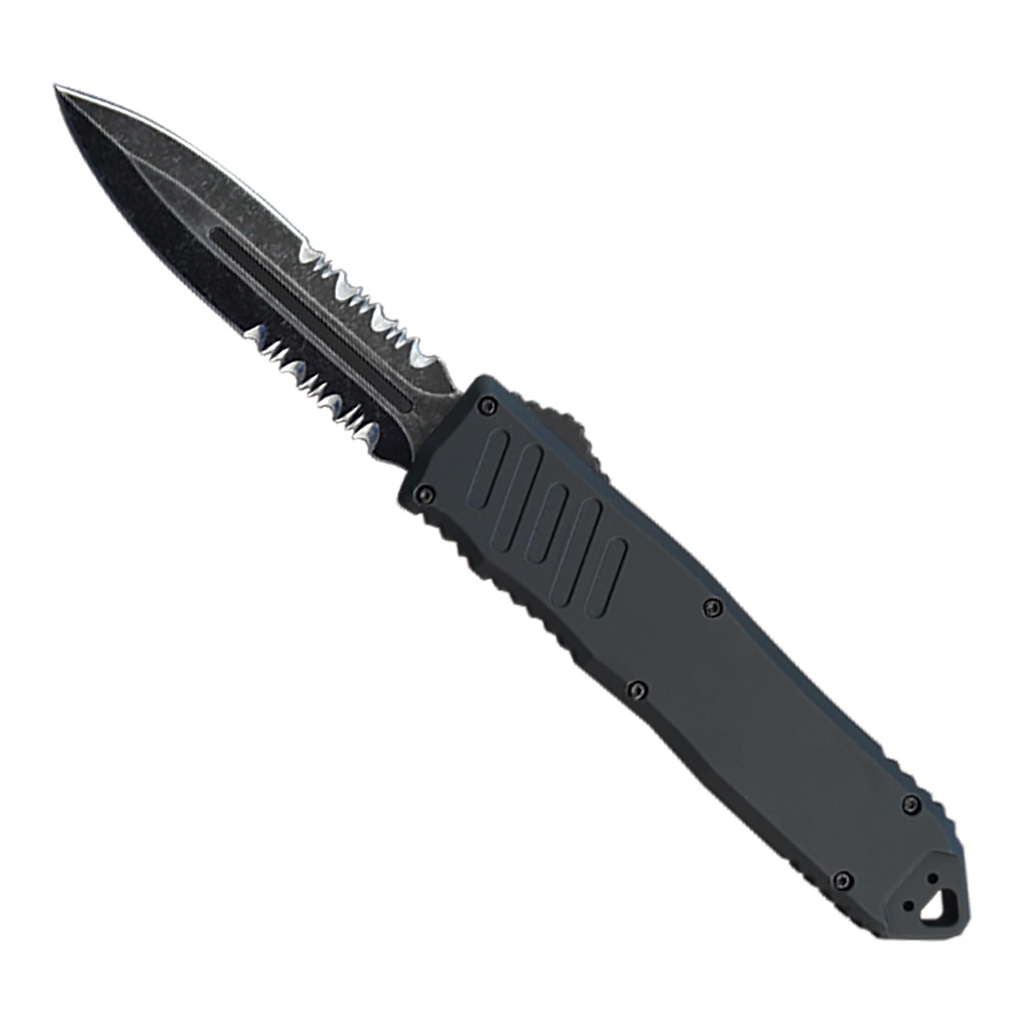
If you’re going to buy an automatic knife, buy one that gets the mechanics right. This dual-action OTF dagger drives a stonewashed blade straight out the front with a positive, confident track, then retracts just as cleanly. Partial serrations chew through rope and webbing, while the matte black aluminum handle, deep-carry clip, and glass-breaker pommel keep it honest as a duty-ready EDC. It looks like work, not decoration — and that’s exactly the point.
Automatic Knives for Sale Built Around the Action, Not the Hype
When you’re looking for an automatic knife for sale, you’re not chasing another disposable toy. You’re chasing a mechanism that earns its keep every time you thumb the slide. This dual-action OTF dagger is built around that moment: blade tracks dead straight out the front, locks with authority, retracts on command, and disappears back into a matte black aluminum chassis that feels like a piece of gear, not a novelty.
If you’ve handled enough out-the-front knives, you know the difference between a rattle-prone import and a tuned automatic you actually trust. This one lives in that second category: stonewashed dagger blade, partial serrations for real cutting work, and a low-profile profile that carries like it was meant to be there.
Buy Automatic Knife Designs That Respect the Mechanism
Before you buy an automatic knife, ask one simple question: did the maker respect the mechanism? On this dual-action OTF, the answer is yes. The side-mounted slide rides a precise internal track so the blade doesn’t slop side-to-side or feel mushy at lockup. You get a clean, decisive deployment both directions — that’s the whole point of a double-action OTF.
The dagger profile gives you symmetrical thrust and piercing performance, while the serrated section near the handle is there for a reason: rope, webbing, and fibrous material that laughs at a plain edge alone. You’re not swinging this like a camp chopper; you’re driving it into specific cutting tasks where a straight-out-the-front automatic just makes sense.
Dual-Action OTF: Why the Return Stroke Matters
Plenty of buyers obsess about how fast an automatic knife fires and forget the return stroke. On a dual-action OTF, the retract is just as critical as the deploy. Here, the slide pulls the blade back with the same positive engagement as the launch. No half-hearted spring fallback, no finger gymnastics to reset the action. You ride the same track forward and back, with audible, tactile confirmation at both ends.
That means less fidgeting, more control, and a cleaner overall mechanism lifespan. Repeated manual resets beat up cheaper OTFs; a true double-action spreads the work across the system the way it was meant to.
Stonewash Dagger Steel That Hides the Miles
The stonewashed finish does two jobs. First, it breaks up reflections — this isn’t a mirror-polished showpiece. Second, it disguises the scuffs and micro-abrasions that come with real pocket time. Combine that with the symmetrical dagger grind and partially serrated edge, and you get a blade meant to be used, not babied.
Collectors know: a good stonewash is a working finish. It shrugs off the cosmetic wear that would make a satin blade ugly after a few months of cutting and snapping in and out of an OTF chassis.
Automatic Knife for Sale With Real-World Carry in Mind
A lot of automatic knives for sale look great on a table and fall apart on a pocket clip. This one doesn’t. The rectangular matte black aluminum handle gives you a solid, neutral grip that doesn’t dictate hand position. Chamfered edges keep it from chewing up your hand or your jeans, and the deep-carry clip tucks the knife low in the pocket without fighting the draw.
The glass-breaker style pommel is more than ornament. It gives you a dedicated impact point and protects the blade tip when the knife is clipped against hard surfaces. The lanyard hole is there if you want redundancy in retention; if you don’t, it stays out of the way.
Matte Black Aluminum: Why the Handle Feels ‘Right’
The handle is matte for a reason. Glossy finishes show every scratch and slip, and they get slick at exactly the wrong time. A matte anodized aluminum block with subtle grip grooves gives you the balance between traction and pocket comfort. You get control during deployment without your pocket material welding itself to the chassis.
Mechanics First: Understanding This Automatic OTF Action
This is a double-action out-the-front automatic, not a side-opening switchblade, not a spring-assisted folder. The slide on the handle spine controls both deployment and retraction. Push forward: blade rides on internal rails, driven by a spring system tuned for a clean, assertive snap. Pull back: the same control, same confirmation, blade parked safely inside the handle.
That straight-line travel means there’s no pivot screw to loosen, no liner lock to fail, and no thumb stud to fight with when your hands are cold or gloved. For tactical and rescue-oriented use, that matters. You’re cutting seatbelt, webbing, or clothing with a blade that appears point-first, exactly where you expect it.
OTF vs. Side-Opening: Where This Knife Belongs
Side-opening automatics excel as general EDC cutters; they feel familiar if you grew up on traditional folders. OTF knives like this one own the vertical, straight-out deployment space. If you want minimal lateral clearance — inside a vehicle, in tight environments, or working around gear — a compact rectangular OTF package is simply more efficient.
Legal Context: When Is an Automatic Knife Legal to Carry?
Every serious buyer who wants an automatic knife for sale should care more about statutes than speculation. Under U.S. federal law, automatic knives (including OTF and many switchblade designs) are restricted primarily in interstate commerce and certain federal jurisdictions. Day-to-day carry, however, is controlled almost entirely at the state and sometimes local level.
Some states now allow automatic knives broadly, others limit blade length, action type, or who can carry (for example, law enforcement or military exemptions), and a few still prohibit or heavily restrict switchblades and OTF knives altogether. City ordinances can add another layer of rules on top of state law.
The bottom line: before you buy an automatic knife or treat any OTF as your primary EDC, check the current laws in your state and municipality. Statutes change; don’t rely on old forum posts or anecdotes. When in doubt, consult official state code or qualified legal guidance.
What Buyers Ask Before Purchasing an Automatic Knife
Are automatic knives legal?
In the U.S., automatic knives are not governed by a single universal rule. Federal law (notably the 1958 Federal Switchblade Act, amended since) mainly restricts interstate commerce and possession in certain federal or territorial jurisdictions. That’s why you’ll see specific shipping and sales policies from dealers.
For carry, your real constraints are state and local laws. Some states fully permit automatic knives, including OTF and traditional switchblades, sometimes with blade-length caps. Others allow them only for specific users (law enforcement, active duty, certain professions). A handful still treat switchblades and OTF automatics as contraband for most civilians. Always verify your state and local regulations before you buy or carry — and re-check periodically as many states have recently relaxed, or in some cases re-written, their knife laws.
What’s the difference between an automatic knife, OTF, and a switchblade?
Think of “automatic knife” as the broad category: any knife where a spring-driven blade deploys with a button, slide, or similar control, without you having to manually swing it open through the full arc. Within that category, an OTF (out-the-front) automatic sends the blade straight out the front of the handle, like this dual-action OTF dagger.
“Switchblade” is a legal and cultural term usually referring to side-opening automatics — blades that pivot out from the handle like a traditional folder, but powered by a spring you trigger with a button or lever. Legally, many statutes use “switchblade” to cover both side-opening automatics and OTF designs, but mechanically, OTF and side-opening automatics are distinct. This knife is: automatic, OTF, and falls under most legal definitions of a switchblade — but from a mechanism standpoint, it’s best described as a double-action OTF automatic.
What makes this automatic knife worth buying?
Three things: the action, the blade configuration, and the carry geometry. The double-action OTF mechanism gives you full control over both deployment and retraction — a cleaner, more satisfying system than single-action OTFs that need manual resets. The stonewashed double-edge dagger with partial serrations is tuned for real work: clean thrusts, solid slashing performance, and aggressive bite on rope and webbing.
Then there’s the chassis: matte black aluminum, deep-carry clip, glass-breaker pommel, and a silhouette that reads more “duty tool” than “flashy toy.” As an automatic knife for sale in the real-world EDC and tactical lane, it hits the marks that matter to enthusiasts and collectors who care about mechanism first, cosmetics second.
For Enthusiasts Who Buy Automatic Knives With Intent
If you’re looking for automatic knives for sale that respect the mechanics, not just the marketing, this dual-action OTF dagger belongs in the conversation. It’s built for the buyer who can feel the difference between a lazy spring and a tuned track, who understands why a stonewash is a working finish, and who wants an OTF they can actually carry — not just photograph.
Own it because you appreciate the engineering. Carry it because it earns its space in your pocket. That’s what it means to buy an automatic knife for the right reasons.
| Blade Color | Silver |
| Blade Finish | Stonewash |
| Blade Style | Dagger |
| Blade Edge | Serrated |
| Blade Material | Steel |
| Handle Finish | Matte |
| Handle Material | Aluminum |
| Button Type | Slide |
| Theme | None |
| Double/Single Action | Double |
| Pocket Clip | Yes |