
Trail Heritage Compact Kukri Knife - Wood Handle
7 sold in last 24 hours
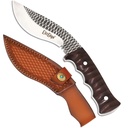
This is the kukri you actually carry. The Trail Heritage Compact Kukri Knife brings the classic forward curve into a 4-inch satin fixed blade that chops and carves far above its weight. Full-tang stainless with a 0.197" spine gives real bite, while the finger-grooved wood handle locks into the hand. Paired with a basketweave leather belt sheath, it rides close, draws fast, and works like a field knife that learned to hit like a kukri.
Trail Heritage Compact Kukri Knife - Wood Handle
Not every day on the trail demands a full-size chopper strapped to your leg. But when you need bite, leverage, and that unmistakable kukri curve, a compact, full-tang fixed blade like this earns its space. The Trail Heritage Compact Kukri Knife takes the traditional profile and scales it into a field-ready 8.75-inch package that still hits with real authority.
Why This Compact Kukri Knife Belongs in Serious Kits
Kukris are about power-to-size ratio. That forward-curved belly does the work, putting the edge and mass out in front of your knuckles so the knife chops above its dimensions. Here, a 4-inch satin-finished blade paired with a thick 0.197" spine gives you exactly that leverage, without the bulk of a full Nepalese-style blade. It slices, chops, and preps like something much larger, but carries like a straightforward field knife.
The full-tang stainless steel construction runs clean through the handle and out the butt, with an exposed tang for durability and impact use. You feel it in hand: no flex, no mystery about what’s under the scales. Just steel from tip to pommel, ready for trail work, camp chores, and general bushcraft tasks.
Blade Geometry and Balance: How the Curve Does the Work
The heart of this knife is the compact kukri profile. The blade’s pronounced belly and forward sweep shift the center of percussion toward the front, so even with a 4-inch edge you get meaningful chopping and aggressive draw-cuts. It’s a heritage working shape, not a fantasy curve.
Spine Thickness and Edge Behavior
At roughly 0.197" thick at the spine, this is not a dainty slicer. That mass behind the edge stabilizes the blade for light chopping, batoning kindling, and controlled carving. Paired with a plain-edge grind, it gives you a reliable compromise between durability and workable sharpness, especially for users who maintain their own edges in the field.
Stainless Steel You Don’t Baby
The stainless steel blade keeps maintenance low when you’re dealing with wet weather, camp food, and trail grime. You trade some ultimate edge longevity versus high-carbon tool steels, but you gain corrosion resistance and easy clean-up—exactly what you want in a belt knife that sees real use instead of safe time.
Handle Ergonomics: Wood, Contours, and Real Traction
The handle is where a lot of compact kukris fail. This one leans into traditional materials and practical shaping: polished dark wood scales contoured to fit the palm, with finger grooves that actually line up in a forward or hammer grip. It’s not just pretty—it locates your hand and keeps it locked when the blade is doing real work.
The full-tang profile is visible all around, with an exposed tang at the butt. Two holes in the tang/handle area let you add a lanyard, safety loop, or lash it to a pack or temporary handle if you’re improvising in the field. The result is a compact kukri you can choke up on for detail cuts, then slide back into a power grip for short, controlled chopping.
Leather Sheath Carry: How This Compact Kukri Rides
A working fixed blade is only as good as the way it carries. This knife ships with a basketweave-tooled brown leather sheath that’s built for belt carry, not drawer storage. The belt loop keeps the knife close to the body, the snap-strap with floral concho secures the handle, and the mouth of the sheath is shaped for quick, predictable re-sheathing.
For hikers, hunters, and anyone who lives with a belt knife on, the combination of overall length (about 8.75") and sheath design hits the sweet spot: long enough to draw cleanly, short enough that it’s not banging into everything in camp or catching in brush.
Where This Compact Kukri Earns Its Keep
This is a bushcraft and trail companion first, collector piece second. It’s at home processing kindling, trimming branches, breaking down camp food, and handling the small but repetitive jobs that wear out cheap blades. That compact kukri belly makes fast work of rope, cordage, and fibrous material, while the stout spine gives you confidence prying bark or splitting smaller pieces of wood.
Collectors who appreciate ethnic and traditional blade shapes will recognize the nod to classic kukri form—brought into a manageable, modern trail size, with wood and leather that look right at home on a pack or hanging in a cabin.
What Buyers Ask Before Purchasing an Automatic Knife
Are automatic knives legal?
Automatic knife legality in the United States sits at the intersection of federal and state law. Federally, automatic knives (often casually called switchblades) are restricted mainly in terms of interstate commerce and certain federal jurisdictions. The real deciding factor is your state and sometimes local law: some states allow automatic knives with few restrictions, others limit blade length, ownership, or carry, and a few still prohibit them outright. Before you buy or carry any automatic knife, check current statutes where you live and where you travel; laws change, and “I didn’t know” doesn’t hold up in court.
What's the difference between an automatic knife, OTF, and a switchblade?
Mechanically, an automatic knife is any knife whose blade opens fully at the press of a button, switch, or similar device in the handle—spring-driven, no manual assist needed. A switchblade is the traditional term used in older laws and in casual speech, but functionally it describes the same basic automatic-opening behavior.
An OTF knife (out-the-front) is a specific subtype of automatic where the blade travels straight out of the front of the handle instead of pivoting from the side. Many OTFs are double-action automatics, meaning the same switch both deploys and retracts the blade under spring tension. Side-opening automatics, by contrast, swing out like a conventional folder but are powered open by a coil or leaf spring when you hit the release. This Heritage kukri is a fixed blade—no automatic, OTF, or switchblade mechanism. The blade is always deployed and ready, which keeps the mechanics simple and the action 100% manual.
What makes this automatic knife worth buying?
When buyers talk about what makes an automatic knife worth owning, they point to three things: reliable action, proven steel, and purposeful design. A serious automatic knife for sale will have a tuned spring system that fires the blade the same way every time, a lockup that doesn’t develop play after hard use, and steel that holds an edge without chipping or rolling under realistic cutting tasks. Add ergonomics that work in real grips and a carry system that matches how you actually use the knife, and you’ve got something that belongs in rotation, not just in a drawer.
By contrast, this compact kukri earns its keep on the mechanical honesty of a full-tang fixed blade: no springs, no lock failures, just solid steel and proven geometry. It appeals to the same buyer who appreciates a well-built automatic knife, but wants a dependable belt companion for trail and camp work.
For Enthusiasts Who Respect Function Over Flash
If you’ve handled enough knives to know the difference between marketing and mechanics, this compact kukri will make sense the moment it lands in your hand. Full tang, real spine thickness, a belly that bites, and a wood-and-leather package that looks like it belongs outdoors, not under glass.
Whether you rotate through high-end automatic knives for EDC or you’re building out a functional field kit, this Trail Heritage Compact Kukri Knife fills the slot reserved for the tool you actually reach for when work appears. It’s the right curve, in the right size, built to be used.
| Blade Length (inches) | 4 |
| Overall Length (inches) | 8.75 |
| Weight (oz.) | 7.91 |
| Blade Color | Silver |
| Blade Finish | Satin |
| Blade Style | Kukri |
| Blade Edge | Plain |
| Blade Material | Stainless steel |
| Handle Finish | Polished |
| Handle Material | Wood |
| Theme | Kukri |
| Handle Length (inches) | 4.75 |
| Tang Type | Full tang |
| Spine Thickness (inches) | 0.197 |
| Pommel/Butt Cap | Exposed tang |
| Carry Method | Belt loop |
| Sheath/Holster | Leather sheath |