Trail-Ring Precision Skinner Hunting Knife - Red Pakkawood & Bone
3 sold in last 24 hours
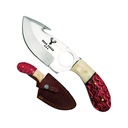
This is a compact fixed-blade skinner built for control. The Trail-Ring Precision Skinner pairs a gut hook blade with a full-tang stainless build and a large finger ring that locks your grip when the hide turns slick. At 7.25" overall with a 4.25" satin-finish blade, it cuts like a bigger knife but rides light on your belt in a fitted leather sheath. Red pakkawood and bone scales give you a confident, traditional hunting grip that feels right the first time you use it.
Trail-Ring Precision Skinner Hunting Knife – Built for Control Where It Matters
Some hunting knives look the part and then disappear when the hide hits the ground. The Trail-Ring Precision Skinner Hunting Knife - Red Pakkawood & Bone was built for the moment everything gets slick, cramped, and unforgiving. The full-tang stainless skinner with gut hook and control ring isn’t trying to be a camp knife, a chopper, or a tactical toy. It’s a purpose-built field dressing tool that earns its keep every time you punch a tag.
Why This Fixed Blade Hunting Knife Works in the Field
This isn’t a folder, and it’s not pretending to be an automatic knife. When you’re wrist-deep in a whitetail or elk, a fixed blade skinner with predictable geometry is the right tool. The Trail-Ring runs a 4.25-inch satin-finished stainless blade on a full tang, giving you one continuous piece of steel from tip to ring. At 7.25 inches overall and about 10 ounces, it’s compact enough for tight work but carries enough mass to track steady through hide and fascia.
The gut hook rides the spine where it should, shaped to bite and glide through hide without digging into what you’re trying to protect underneath. No gimmick serrations, no overbuilt saw tooth fantasy – just a clean hook you can sharpen and trust.
Control by Design: Finger Ring, Full Tang, and Handle Geometry
The defining feature here is in the name: the trail ring. That large circular cutout ahead of the handle isn’t decoration. Slip your index or middle finger through and the entire knife locks into your hand, even when blood, fat, and rain have done their best to turn everything into a bar of soap. That’s not marketing – it’s simple leverage and mechanics.
Ring and Blade Working Together
On a standard skinner, you’re relying on a pinch grip or an improvised choke-up on the spine when you get into careful work around joints, shoulders, and the pelvic region. With the Trail-Ring, that finger ring becomes a pivot point. You can roll the knife, adjust angle, and pull with your whole hand instead of white-knuckling empty steel. It reduces hand fatigue and gives you a consistent edge presentation where a slip would cost you meat or worse.
Handle Materials That Actually Earn Their Keep
The handle is a layered affair: polished red pakkawood at the ends with a central section of natural bovine bone, all pinned over the full tang with brass. Pakkawood brings water resistance and dimensional stability – it doesn’t swell and crack like untreated hardwood – while the bone section gives a subtle texture and temperature contrast you feel the moment you pick it up. The wave-like patterning in the red pakkawood isn’t just there for looks; it breaks up smoothness and adds micro-traction without shredding your hands.
Steel, Edge, and Real-World Maintenance
The blade is stainless steel, satin finished to balance corrosion resistance with easy field cleaning. No high-polish mirror to blind you in the sun, no bead blast to trap fat and grime. Satin is the working hunter’s finish – it wipes down clean and shows you exactly where your edge contacts bone.
Is this a boutique powdered steel? No. And that’s the point. In hunting season, you want a steel that takes a reliable edge quickly off a stone or pull-through sharpener, not something you have to baby back in the shop. Stainless at this level delivers solid edge holding through a full field dressing, then hones right back up at camp. It’s a working blade, not a safe queen.
Carry, Sheath, and How It Rides on Your Belt
The included brown leather sheath is basic in the good way: belt loop, secure snap strap, contrast stitching so you can see wear over time. It sits high enough on the belt to stay out of brush but low enough that you’re not fighting your jacket hem to draw. The 7.25-inch overall length means you’re not dealing with an overlong dangler constantly whacking into your leg or banging off the stand rail.
There’s no pocket clip here because this isn’t an EDC piece trying to masquerade as a hunting knife. You strap it on when you head out, you use it hard, you wipe it down, and you put it away ready for the next season.
What Buyers Ask Before Purchasing an Automatic Knife
Even though the Trail-Ring is a fixed blade hunting knife and not an automatic knife, a lot of collectors and everyday carriers cross-shop between fixed blades, folders, and automatics. The questions below come up constantly when people look for an automatic knife for sale, so it’s worth addressing them clearly.
Are automatic knives legal?
In the United States, automatic knife legality is a mix of federal import/transport rules and state or local laws. Federally, automatic knives (including side-opening automatics and OTF switchblades) are restricted under the Federal Switchblade Act for interstate commerce, with exceptions for military, law enforcement, and certain occupational uses. Day-to-day legality, however, is defined at the state and sometimes city level.
Some states allow automatic knives and OTFs for general carry, some allow ownership but restrict carry to certain blade lengths or purposes, and others still ban them outright. Before you buy an automatic knife online or carry one, you need to check your specific state and local laws rather than relying on generic advice. A fixed blade hunting knife like the Trail-Ring is generally treated differently from an automatic knife or switchblade, but you should still confirm blade length and carry restrictions where you live.
What’s the difference between an automatic knife, OTF, and a switchblade?
Mechanically, an automatic knife is any folding knife whose blade deploys from the closed position using a spring or stored energy mechanism when you actuate a button, switch, or lever in the handle. Most side-opening automatics swing the blade out like a traditional folder, just under spring power.
An OTF (out-the-front) automatic knife is a specific type of automatic where the blade travels linearly out the front of the handle. Double-action OTFs deploy and retract under spring power with the same control switch; single-action OTFs use spring power to deploy but require manual retraction.
“Switchblade” is the legal term often used in statutes to refer to automatic knives, including many OTF designs. Enthusiasts tend to use automatic, OTF, and switchblade with more precision, but when you’re looking up laws, assume “switchblade” is talking about automatic knives broadly.
What makes this automatic knife worth buying?
This is where the distinction matters: the Trail-Ring isn’t an automatic knife. It’s a fixed blade hunting skinner. There’s no button, no spring, no assisted action – and for its job, that’s an advantage. You don’t want a folding joint or an automatic mechanism packed with fat, hair, and grit when you’re breaking down an animal.
What makes this knife worth buying is the purpose-built geometry: the gut hook that actually tracks, the control ring that keeps your hand locked, the full-tang stainless build that shrugs off abuse, and the red pakkawood and bone handle that gives you a traditional look with real-world ergonomics. It’s a field tool first, collectible second – and that’s exactly why seasoned hunters reach for it.
Who This Knife Is For
If you’re the buyer who carefully chooses an automatic knife for sale based on action quality, lockup, and steel, you’ll recognize the same priorities baked into this fixed blade. The Trail-Ring Precision Skinner is for hunters who care more about how a knife tracks through hide than how it photographs on a display stand. It’s for the person who’d rather own one knife that does its job every season than a drawer full of almost-right designs.
Own this, and you’re not just buying another hunting knife. You’re choosing a purpose-driven skinner that understands its role as clearly as you understand yours on the mountain, in the stand, or at the skinning pole.
| Blade Length (inches) | 4.25 |
| Overall Length (inches) | 7.25 |
| Weight (oz.) | 10 |
| Blade Color | Silver |
| Blade Finish | Satin |
| Blade Style | Gut Hook |
| Blade Edge | Plain |
| Blade Material | Stainless Steel |
| Handle Finish | Polished |
| Handle Material | Bovine Bone & Pakkawood |
| Theme | None |
| Handle Length (inches) | 3 |
| Tang Type | Full |
| Pommel/Butt Cap | None |
| Carry Method | Belt sheath |
| Sheath/Holster | Leather |