Trailcurve Field Recurve Hunting Knife - Red Wood
7 sold in last 24 hours
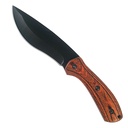
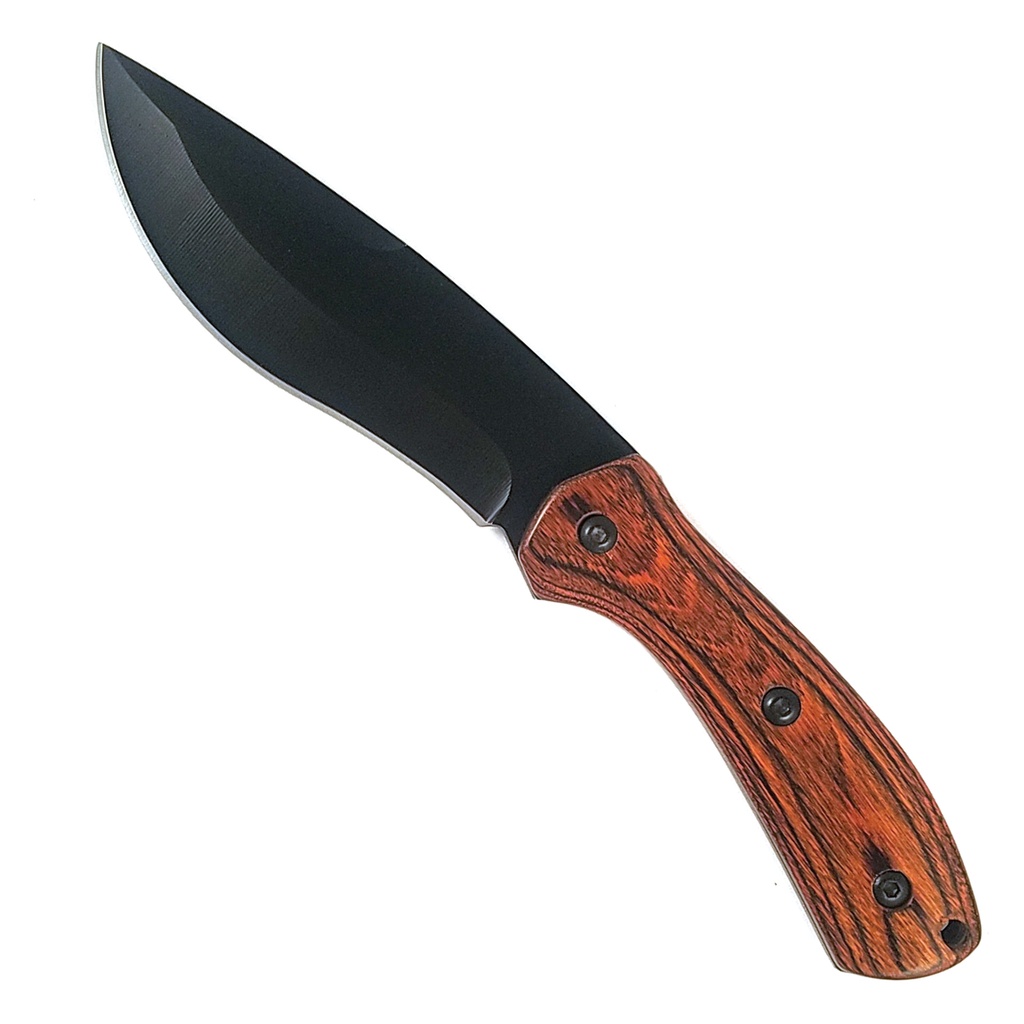
This is a fixed blade hunting knife built to work, not pose. The Trailcurve’s matte black recurve blade bites deep on push cuts and slices clean through hide and fiber. Full-tang construction and contoured red wood scales lock into the hand without hot spots. At 9 inches overall with a nylon belt sheath, it carries light, draws fast, and does exactly what a serious field knife should: disappear in the grip and dominate at the edge.
Trailcurve Field Recurve Hunting Knife - Red Wood
The Trailcurve isn’t pretending to be a safe-queen. This is a fixed blade hunting knife built for real field work: dressing game, breaking down camp chores, and living on a belt instead of in a display case. A matte black recurve blade, full-tang backbone, and red wood handle are the three choices that define this knife — and each of them is made for function first.
Why This Fixed Blade Earns a Spot in Your Kit
Look at the profile: that recurve isn’t there for drama, it’s there for bite. The inward curve between heel and belly loads more edge into the cut, so when you pull through hide, rope, or webbing, the blade naturally wants to stay engaged. You feel the edge do the work instead of having to muscle through material.
The matte black finish keeps reflection down. In the field, glare off a polished blade is more than just annoying — it’s distracting when you’re trying to make a precise cut on an animal or work in bright snow or midday sun. A low-glare finish keeps your focus on the line of the cut, not on a mirror flash every time you move.
Blade Geometry and Steel That Favor Real Cutting
This isn’t a wedge disguised as a hunting knife. The blade carries a usable recurve with a defined belly, giving you three working zones: heel for controlled push cuts, mid-recurve for aggressive pull cuts, and belly for skinning and sweeping. That geometry is what lets a 4.875-inch blade cut like a larger knife when you’re breaking down game or processing wood for kindling.
Recurve Advantage in the Field
On a straight edge, you’re constantly repositioning the knife to keep the cut engaged. On this recurve, the curve does that for you. As you pull, the material naturally settles into the inward sweep of the edge, which increases pressure per millimeter and keeps your cuts tracking straight. That’s why experienced hunters gravitate toward recurve profiles for mixed camp and game work — they cut above their weight.
Full Tang, Honest Construction
Full tang means exactly what you think: one continuous piece of steel from tip through handle to the lanyard hole at the butt. No mystery joints, no hidden rat-tails. The red wood handle scales are secured with three screws over that tang, giving you a rigid, predictable feel when you torque the knife sideways for prying or leverage cuts. In cold, wet conditions, that kind of feedback is what keeps a fixed blade trustworthy.
Carry-Ready Hunting Knife for Belt, Pack, or Truck
At 9 inches overall with a 4.125-inch handle, the Trailcurve lives in the sweet spot: big enough to work, small enough to stay out of the way. It’s long enough to open up a rib cage or baton smaller pieces of wood, but compact enough that it doesn’t feel like a short sword on your belt.
The included nylon sheath rides clean on a belt. Nylon isn’t glamorous, but it’s light, tough, and shrugs off mud and blood without complaining. Belt carry keeps the knife where it belongs — accessible, secure, and consistent every time you reach for it.
Grip and Control: Where the Red Wood Handle Shines
The red wood handle is more than just classic looks. The gentle palm swell and subtle contouring let the knife disappear into your hand in a standard hammer grip, but also rotate cleanly into a pinch grip when you need fine, close work on a joint or along a bone. The matte finish on the wood offers enough traction without chewing up your palm after a long session of cutting.
At the butt, a lanyard hole gives you options — add a lanyard for extra security when working over water or in heavy brush, or keep it clean if you prefer a minimalist profile. Either way, it’s a thoughtful, functional detail, not an afterthought.
What Buyers Ask Before Purchasing an Automatic Knife
Even though the Trailcurve is a fixed blade hunting knife, automatic knife buyers and collectors often cross-shop gear. So let’s address the automatic side clearly and accurately — mechanism, legality, and terminology — because if you care about knives, you care about getting the facts straight.
Are automatic knives legal?
Under U.S. federal law, automatic knives — often called autos or switchblades — are regulated primarily by the Federal Switchblade Act. That law restricts interstate commerce (shipping, importing, and transporting across state lines) of automatic knives, with specific exemptions for military, law enforcement, and certain one-armed users. It does not set your day-to-day carry rules.
Carry and ownership are decided at the state — and sometimes city — level. Some states allow automatic knives with few restrictions, some set limits by blade length, some require specific conditions (like having a hunting or fishing license), and a few still prohibit autos outright. Before you buy or carry an automatic knife, you need to check the current laws where you live and where you travel. Statutes change, and “legal in my state” doesn’t automatically mean “legal everywhere I drive.”
What’s the difference between an automatic knife, OTF, and a switchblade?
In enthusiast and legal language:
- Automatic knife (auto): A folding knife whose blade is deployed by a button, switch, or similar control. A spring or stored-energy mechanism drives the blade open. Side-opening autos swing the blade out from the handle like a standard folder, but the spring does the work.
- OTF (out-the-front): A specific type of automatic where the blade travels linearly out the front of the handle instead of pivoting from the side. Many OTFs are double action, meaning the same control both deploys and retracts the blade using spring energy and user input. Single-action OTFs typically auto-deploy but require manual retraction.
- Switchblade: In U.S. law, this is the term typically used for automatic knives — both side-opening autos and OTFs can fall under “switchblade” language in statutes. In casual enthusiast talk, “switchblade” is often just the old-school word for an auto, but mechanically we distinguish between side-opening autos and OTF designs.
The Trailcurve, to be clear, is a fixed blade. No springs, no deployment mechanism — the blade is permanently fixed in the open position, which also means it usually falls under a simpler and often more permissive legal framework than an automatic knife or switchblade in many jurisdictions.
What makes this automatic knife worth buying?
If you’re an automatic knife buyer reading this, the honest answer is: it isn’t an automatic, and that’s exactly why it belongs alongside your autos. Where your side-opening automatic knife or OTF handles fast deployment and pocket carry, a fixed blade like the Trailcurve takes over when you need strength, simplicity, and zero moving parts to fail.
Collectors who live in the automatic knife world know the value of a good fixed blade: it takes the abuse you’d never put on your favorite double-action OTF, it’s legal in more places than an auto, and it gives you a dedicated, belt-mounted cutting tool that’s always ready without worrying about springs, locks, or buttons. Think of it as the reliable field companion to your precision automatic EDC.
Why the Trailcurve Belongs Next to Your Autos and Switchblades
Enthusiasts who buy an automatic knife for sale aren’t casual shoppers — they’re people who care about action, geometry, steel, and purpose. The Trailcurve speaks the same language, just in a fixed blade format. It gives you:
- A recurve profile that actually cuts better under real load.
- A full-tang spine you can lean on without babying.
- A low-glare blade that stays quiet in the field.
- A red wood handle that balances classic feel and modern function.
- A belt-ready sheath that makes it an honest everyday field companion.
If you’re the kind of buyer who knows the difference between an automatic, an OTF, and a traditional switchblade — and you care about using the right tool for the job — this is the fixed blade that earns its place next to your autos. Different mechanism, same serious intent.
| Blade Length (inches) | 4.875 |
| Overall Length (inches) | 9 |
| Blade Color | Black |
| Blade Finish | Matte |
| Blade Style | Recurve |
| Blade Edge | Plain |
| Blade Material | Steel |
| Handle Finish | Matte |
| Handle Material | Wood |
| Theme | None |
| Handle Length (inches) | 4.125 |
| Tang Type | Full Tang |
| Pommel/Butt Cap | Lanyard Hole |
| Carry Method | Belt Carry |
| Sheath/Holster | Nylon Sheath |