Twist-Guard Home Shield Defense Spray - Black Canister
14 sold in last 24 hours
Home defense doesn’t need drama, it needs certainty. Twist-Guard Home Shield Defense Spray – Black Canister gives you a simple twist‑top safety, a bright red actuator you can find in the dark, and a 3 oz payload sized for doorways, hallways, and nightstands. No flip caps to fumble, no guesswork about where it’s pointing. You twist, press, and it does exactly what it’s built to do: stop a threat fast in real homes with real people.
Twist-Guard Home Shield Defense Spray Built for Real Home Protection
Most “self-defense” products are designed for packaging, not for the moment your heart rate spikes at 2 a.m. Twist-Guard Home Shield Defense Spray – Black Canister is the opposite. It’s a 3 oz home defense pepper spray sized and built to live where problems actually start: by the front door, in the hallway, or on the nightstand. The twist-guard top gives you a clear, simple sequence under stress—twist, press, defend—without the fragile flip caps or awkward triggers that fail when adrenaline hits.
Why a Twist-Guard Pepper Spray Belongs Next to Your Other Defensive Tools
If you already carry an automatic knife or keep a defensive blade within reach, you know the rule: deployment matters more than theory. Same applies here. The twist-guard top physically shrouds the nozzle to prevent accidental discharge, then opens with a short, intuitive twist that you can do without looking. Your thumb naturally finds the red actuator button, recessed for safety but exposed enough to press decisively.
That means you can stage this pepper spray upright by a doorway, tucked on a shelf, or on a bedside table and trust two things: it won’t go off if bumped, and it will fire when you deliberately twist and press. No half-latched lids, no mystery orientation.
Designed for Home Defense, Not Pocket Carry
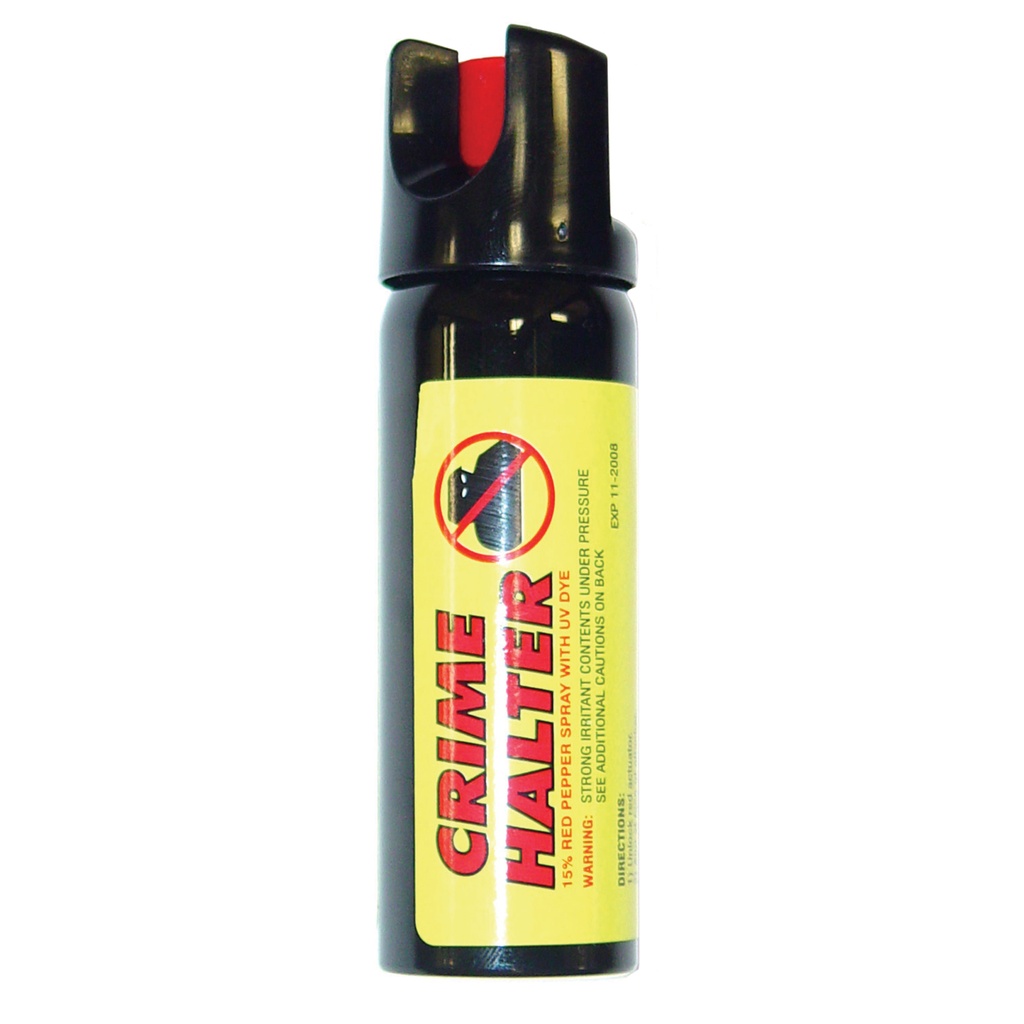
This is not a keychain sprayer. At 3 oz, the canister is large enough to fill a hand, visible enough to find in low light, and substantial enough to deliver multiple solid bursts if you need to control a situation until help arrives. The black body keeps it unobtrusive, while the yellow label and bold CRIME HALTER branding serve as a visual warning: this is a defensive tool, not a toy.
In a home setting, those design choices matter. You want something easy to explain and easy to recognize under stress: “Twist the top, push the red button.” A spouse, roommate, or older family member can understand and operate this in seconds.
Mechanics That Make Sense Under Stress
Good defensive tools trade complexity for reliability. The twist-guard mechanism is simple: the top rotates between safe and fire positions, and you get a clear tactile cue when it’s open. No tiny sliders, no two-handed manipulations, no misaligned spray head.
Twist-Guard Top: One Motion from Safe to Ready
The protective shroud around the actuator serves two roles: it shields the nozzle from accidental hits and it physically blocks discharge until you deliberately rotate it. That twist is short, positive, and easy to train: store it in safe, twist to fire when things get real. Because the actuator is recessed, you’re far less likely to spray unintentionally when grabbing or setting it down.
Red Actuator for Instant Orientation
Under low light or high stress, bright color beats clever design. The red actuator on this pepper spray is both a visual and tactile index. Your thumb goes to red, you know which direction it’s pointed, and you can confirm you’re on the business end without needing to look down and fumble.
Placement Strategy: How Serious Defenders Stage This Spray
Collectors and enthusiasts who already think carefully about where they stage their automatic knives, flashlights, and first-aid gear treat pepper spray the same way. A 3 oz twist-top canister is ideal for fixed locations in the home:
- Front or back door: On a shelf or in a small wall-mounted caddy where you can reach it before you open to a stranger.
- Hallway or stair landing: A midpoint fallback if someone is already inside and you need distance while you move family members to safety.
- Bedroom or nightstand: A quieter first option before drawing a blade or reaching for more lethal tools.
The size and shape make it easy to grab in a hurry and easy to identify by feel. That’s the same logic serious knife owners use when they choose handle materials, texture, and clip orientation: the tool should find your hand, not the other way around.
What Buyers Ask Before Purchasing an Automatic Knife
If you collect automatic knives, OTFs, or traditional switchblades, adding a home defense pepper spray isn’t a downgrade—it’s a complement. It gives you a non-lethal layer before steel ever leaves a pocket or safe.
Are automatic knives legal?
In the United States, automatic knife legality is a mix of federal baseline and state-specific rules. At the federal level, the Switchblade Knife Act restricts interstate commerce of automatic knives and traditional switchblades, with exemptions for military, law enforcement, and certain one-armed users. Day-to-day, what matters most is state and sometimes local law: some states now allow automatic knives and OTFs for most adults, others limit blade length, and a few still ban possession or carry outright. Before you buy automatic knives online or add another double-action OTF to your rotation, check your state statutes and any city ordinances for carry limits, blade length caps, and where you can legally conceal or deploy them.
What’s the difference between an automatic knife, OTF, and a switchblade?
Enthusiasts use these terms precisely:
- Automatic knife: An umbrella term for knives that open with a spring when you press a button, lever, or hidden release. Most side-opening autos fall here.
- OTF (out-the-front) knife: A specific automatic design where the blade travels straight out the front of the handle along a track. Many OTFs are double-action—press or slide to deploy, reverse the motion to retract.
- Switchblade: Traditionally, U.S. legal language for automatic knives with a button-activated spring-open blade. In enthusiast circles, it usually refers to classic side-opening autos, but not every automatic or OTF is accurately called a switchblade.
All three share powered deployment, but mechanism, direction of travel, and legal treatment can differ. Knowing that distinction helps when you buy automatic knives, compare OTFs, or dig into state-level switchblade laws.
What makes this automatic knife worth buying?
For the collector who already owns a stable of side-opening autos and OTFs, the value of Twist-Guard Home Shield Defense Spray is in what it adds to the ecosystem: a non-lethal, fast-access option staged where you can’t realistically keep a blade in hand 24/7. You gain the ability to escalate force in steps rather than jumping straight from verbal commands to edged steel. Mechanically, the twist-guard top mirrors what you already appreciate in a good automatic knife: deliberate, positive action that separates safe from live, and a design that favors instinctive use under adrenaline.
Why Enthusiasts Add a Twist-Guard Spray Next to Their Blades
Collectors don’t buy tools to fill a drawer—they buy them to fill a role. Twist-Guard Home Shield Defense Spray – Black Canister fits a role most knife people quietly acknowledge: not every problem justifies drawing an automatic knife, and not every family member wants to run an OTF under pressure.
By pairing a reliable home defense pepper spray with your existing defensive loadout, you get options. You keep your identity as someone who cares about gear, mechanics, and smart preparation, while giving yourself and the people you live with a simple, effective tool they can actually use. That’s the same mindset that leads you to seek out a well-tuned automatic knife for sale instead of a gas-station special: when things go bad, the right mechanism is everything.
| Pepper Spray Case Type | Twist top |
| Pepper Spray Color | Black |
| Pepper Spray Size (oz.) | 3 |