
Urban Shield PM2.5 Mask Filter Insert - Light Gray
14 sold in last 24 hours
This isn’t another flimsy cloth layer. The Urban Shield PM2.5 Mask Filter Insert uses a five-layer stack—spunbond outer skins, activated carbon, and tight-density cores—to trap micron-level dust, industrial pollutants, smoke, and allergens. Sized to drop into most reusable cloth masks, it turns a basic face covering into a serious air-quality filter. Keep a 20 pack on hand in your emergency kit, glove box, or go-bag so when the air goes bad—fire season, smog, or unexpected events—you’re not breathing it in.
Serious Protection Starts with the Right Filter Insert
In emergency preparedness, "good enough" is exactly what lets you down when the air turns ugly. The Urban Shield PM2.5 Mask Filter Insert - Light Gray is built for people who treat filtration the way serious gearheads treat a cutting edge: as a system, not an afterthought. This is a five-layer PM2.5 filter insert designed to drop into most reusable cloth masks and actually do the job—fine particulate, smoke, urban pollution, and everyday allergens.
Five-Layer PM2.5 Filter Insert for Sale: What’s Inside Actually Matters
Most disposable inserts look the same from the outside. The difference is in the stack. This PM2.5 filter insert uses a layered architecture that behaves like a tuned mechanism—each layer doing a specific job so the whole system performs better than any single material could on its own.
Layer-by-Layer Filtration Breakdown
First layer: spunbond cloth – This outer skin catches larger micron-level dust and debris, keeping the inner media from loading up too fast. Think of it as the primary catch that preserves the performance of the finer layers behind it.
Second layer: pollutant barrier – Engineered to deal with the junk you actually meet in the real world: industrial pollutants, automobile exhaust, second-hand smoke, and pollen allergens. This is where a generic fabric insert simply can’t compete—this layer is tuned for airborne contamination, not just visible dust.
Third layer: activated carbon cloth – Activated carbon is the workhorse when it comes to adsorbing gases, odors, and finer particulate. In this insert, the carbon cloth sits in the middle of the stack, protected by the outer media so it can stay effective longer instead of clogging immediately.
Fourth layer: high-density filter core – This is your fine particulate choke point. Higher filter density targets smaller particles, pushing performance into the PM2.5 range where smoke, smog, and a lot of the real respiratory irritants actually live.
Fifth layer: spunbond cloth – The inner spunbond layer gives you a clean, non-irritating surface against the mask side while serving as the last pass for any remaining contaminants. It’s the final safety net in the stack.
Stitched Perimeter and Form Factor That Actually Fits
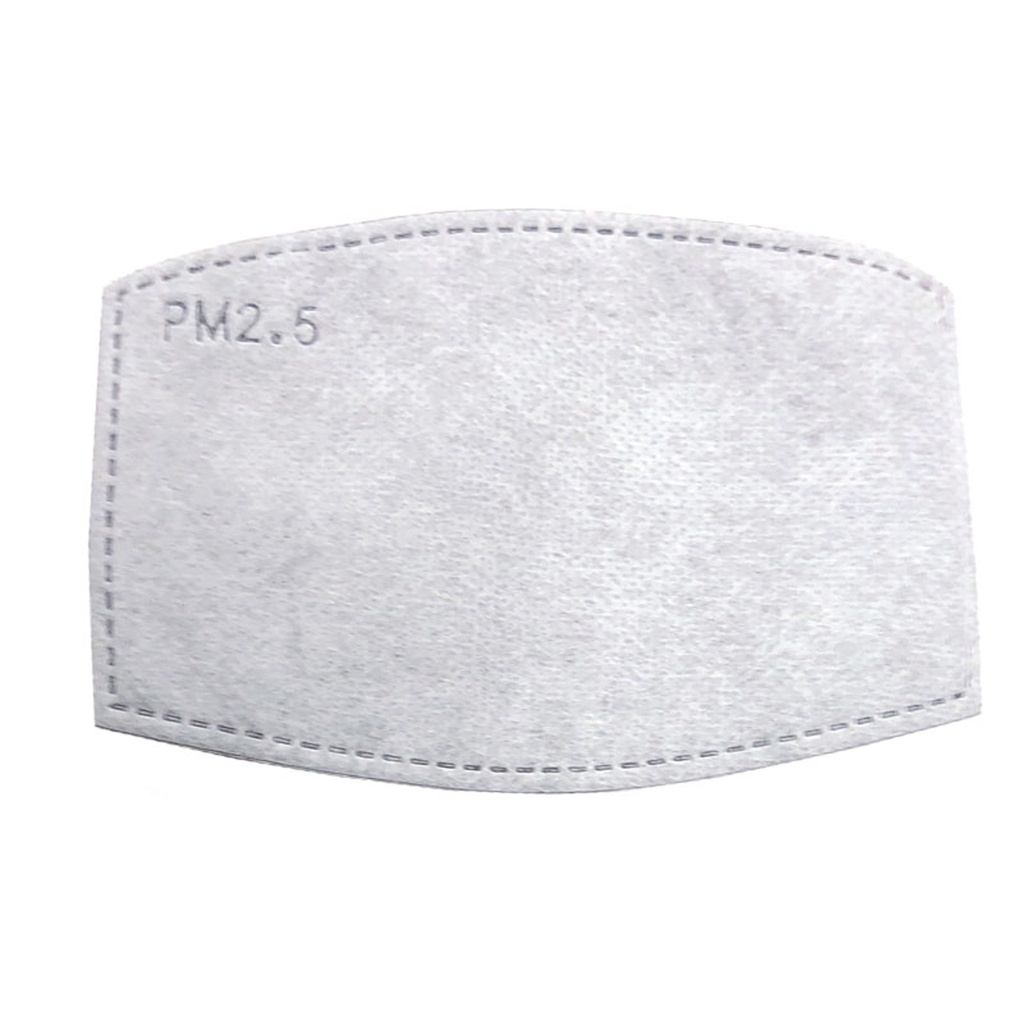
The curved rectangular shape with stitched perimeter isn’t cosmetic—it keeps the filter flat, prevents edge fraying, and helps it sit cleanly inside most adult cloth mask pockets. The light gray, nonwoven texture and PM2.5 marking make it easy to identify and orient quickly when you’re swapping filters in the field, not at a desk.
Why Prepared Buyers Keep a PM2.5 Filter Insert Pack Ready
This 20 pack is sized for real-world use, not just a one-off event. Wildfire smoke week? Urban smog spike? Shop dust and light fabrication? You’re not fumbling for a single worn-out insert—you’ve got a clean replacement ready to drop in. Each filter is thin, flexible, and low-profile, so it doesn’t turn your reusable mask into a bulky brick.
In an emergency context, this is the equivalent of having the right edge geometry on a blade: you don’t notice it when everything’s fine, but when things get rough, the difference is obvious. A proper PM2.5 filter insert turns a casual cloth mask into a more serious barrier against fine particulate and irritants.
Emergency-Grade Face Mask Filter Inserts for Sale
For an emergency kit, glove box, or go-bag, these PM2.5 mask filter inserts hit the sweet spot between protection and practicality. The stitched perimeter holds up to handling, the neutral light gray keeps things clean and non-flashy, and the standard PM2.5 marking makes them instantly recognizable to anyone who’s been paying attention to air quality standards.
They’re equally at home in a daily commuter setup or a dedicated emergency preparedness layout. You don’t buy a 20 pack of filter inserts for aesthetics—you buy it because once the sky turns brown, everyone suddenly cares about what they’re breathing, and you’d rather be the one who already took that seriously.
What Buyers Ask Before Purchasing an Automatic Knife
Are automatic knives legal?
Automatic knife legality in the United States is a mix of federal framework and state-by-state rules. Federally, the Switchblade Knife Act restricts interstate commerce and shipment of automatic knives (including many out-the-front and push-button autos) but allows certain exceptions for military, law enforcement, and in-state sales under specific conditions. State laws vary widely: some states allow automatic knives with few restrictions, others limit blade length or carry type, and some still prohibit possession or carry outright. Before you buy an automatic knife or switchblade online, you need to confirm your local state and municipal laws—including whether carry is allowed, and under what conditions. Reputable dealers will follow shipping restrictions and clearly state where they will not ship automatic knives.
What’s the difference between an automatic knife, OTF, and a switchblade?
"Automatic knife" is the broad mechanical category: a knife that opens by pressing a button, lever, or concealed mechanism in the handle, with spring or stored energy driving the blade open. A switchblade is essentially the same thing in legal and common language—most statutes use "switchblade" to describe automatic knives operated by a button or similar control. An OTF (out-the-front) knife is a specific subtype of automatic where the blade deploys straight out of the front of the handle rather than pivoting out of the side. OTF autos can be single-action (spring-driven open, manually reset) or double-action (spring-driven both opening and closing). Side-opening automatic knives pivot like a traditional folder but are still classified as automatic/switchblade when button-activated.
What makes this automatic knife worth buying?
When evaluating an automatic knife for sale, experienced buyers look past the hype and focus on three things: action quality, lock-up, and materials. A well-tuned automatic will fire consistently with no sluggish spots in the stroke and minimal handle torque. The lock should engage fully with solid, repeatable lock-up and no side-to-side blade play. Steel choice and heat treat matter as much as the name on the blade—edge retention, corrosion resistance, and toughness all come from that combination. Fit and finish, from button fit to spring channel machining, separate serious automatic knives from the commodity market. If a dealer can talk you through those specifics instead of just saying "amazing quality," that’s a good sign you’re looking at an auto worth owning.
Own Gear That Respects the Details
Whether it’s a finely tuned automatic knife for EDC or a five-layer PM2.5 filter insert in your emergency kit, the principle is the same: precision in the unseen details is what pays off when conditions turn bad. The Urban Shield PM2.5 Mask Filter Insert - Light Gray is built for buyers who don’t wait for a crisis to figure out what they should have carried, and who choose their equipment—blades or filtration—because the engineering makes sense.