
Vector Pivot Quiet-Authority Assisted EDC Knife - Matte Gray Aluminum
5 sold in last 24 hours
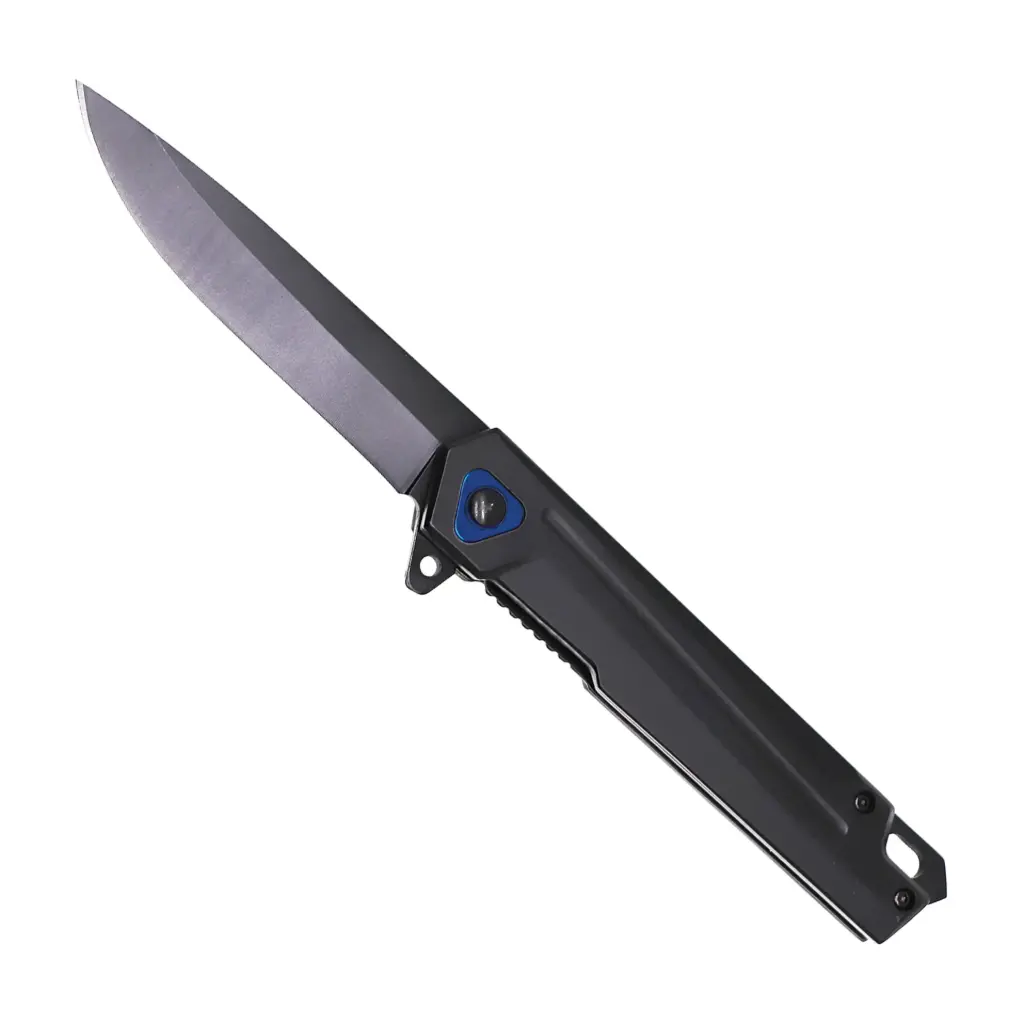
This is a spring assisted knife built for people who care about action, not hype. The flipper hits a tuned sweet spot—enough resistance to feel deliberate, enough assist to feel inevitable. A 3.625-inch matte gray drop point locks on a solid liner, riding in a straight-line aluminum handle with deep-carry clip and proper jimping. The blue pivot collar isn’t decoration; it’s a visual cue that this mechanism was dialed in on purpose. If you judge a knife by its deployment, this one passes.
A good spring assisted knife doesn’t surprise you—it confirms what your thumb already knew the moment it hit the flipper. This Vector Pivot Quiet-Authority Assisted EDC Knife is built around that feeling of inevitability. The assist isn’t showy or violent; it’s tuned. You start the motion, the mechanism finishes it with quiet certainty, and the 3.625-inch drop point settles into liner lock with no drama and no doubt.
Spring assisted knife action that feels inevitable, not gimmicky
Plenty of budget folders claim to be fast. Most just feel jumpy. The difference here is in how the spring assisted knife is tuned. The flipper tab has real intent behind it—there’s enough preload that you can stage the press, then commit. Once you cross that threshold, the assist takes over and drives the blade home with a clean, linear snap. No rattle, no bounce, no half-hearted opens.
That’s the real advantage of a well-executed spring assisted knife over a sloppy one: consistency. Whether your hands are cold, gloved, or slick from a job, that tuned detent and assist give you the same open every time. You’re not wrestling the mechanism; you’re partnering with it.
Jimping where it matters—on the tab and the spine
The flipper tab carries proper jimping at the engagement point, which matters more than any spec sheet claim about "fast deployment." The traction is cut where your fingertip actually lands, so you get positive purchase without having to think about it. Matching jimping on the spine gives you a locked-in thumb ramp once the blade is open, reinforcing control under load.
Why this spring assisted knife earns pocket time over automatics
If you’re the kind of buyer who’s usually hunting an automatic knife for sale, this design is speaking your language—just with a different accent. You get near-automatic speed, but with the mechanical simplicity and legal comfort of a spring assisted knife. There’s no firing button to hunt for, no accidental pocket discharge paranoia, and no need to baby the action.
Think of this as the middle ground between a true automatic knife and a pure manual folder. The flipper gives you the familiar motion of a manual, while the assist gets the blade locked quicker than most thumb-stud autos in real-world use. In tight workspaces, on ladders, or around material that bites back, that predictable, one-hand open matters more than bragging rights.
Deep-carry, low-visibility profile for real EDC
The deep-carry pocket clip anchors the knife low in the pocket, minimizing print and keeping the matte gray handle practically invisible. For anyone who works around customers, in warehouses, or on job sites where a bright, flashy blade draws the wrong kind of attention, that discretion is not an aesthetic choice—it’s a practical one.
Built like a working tool: aluminum frame, matte blade, and honest ergonomics
Under the modern lines, this is straightforward hardware. The handle is matte gray aluminum—rigid, relatively light, and thin enough to disappear in a front pocket. The 8.5-inch overall length and 4.875-inch closed length hit the EDC middle ground: enough reach for real cutting, compact enough that it doesn’t feel like a boat anchor when you sit down.
The blade runs a plain-edge drop point with a two-tone matte gray finish. That combination keeps reflections down, sharpens easily, and doesn’t scream "tactical cosplay" every time you cut open a case of product. At 6.28 ounces, the weight is intentional: there’s enough mass in the blade to let the spring assisted mechanism fire with authority, and enough heft in the handle that the knife feels planted when you bear down.
Blue pivot collar: a small detail that tells a bigger story
The blue pivot collar isn’t there to look pretty for Instagram; it’s a signal to the mechanically minded buyer. It draws your eye straight to the heart of the mechanism—the pivot—reminding you where the action lives. On the bench, it frames the torx hardware; in the hand, it’s a visual confirmation that this spring assisted knife was designed, not assembled at random.
Best spring assisted knife for EDC when work comes first
If you live with a knife in your pocket, you know the difference between a novelty flipper and a knife that quietly handles everything from pallet straps to heavy cardboard. This spring assisted knife leans into that work-first reality: a 3.625-inch blade that slices, pierces, and breaks down material without weird recurves; a liner lock that engages fully and unlocks cleanly; and a handle profile that stays straight and predictable in multiple grips.
For retailers and B2B buyers, this is the kind of assisted opening knife that sells itself in three moves: hand it over closed, let the customer dry-fire the flipper, then have them pocket it on the deep-carry clip. Once they feel the tuned assist, the secure lock-up, and the way it vanishes at the pocket seam, they understand the value immediately.
Spring assisted knife vs. automatic, OTF, and switchblade actions
Enthusiasts shopping for an automatic knife for sale, an OTF, or a classic side-opening switchblade are all chasing one thing: reliable, repeatable deployment. Mechanism choice is about how you want to get there.
- Automatic knife: Side-opening, fired by a button or lever. The spring does all the work once you hit the control.
- OTF (out-the-front): Blade travels along the handle’s long axis, usually via a sliding switch. Commonly double action—same control for open and close.
- Switchblade: In U.S. legal language, usually any automatic knife that opens via a button, switch, or similar device.
- Spring assisted knife (this piece): You start the blade manually with a flipper or thumb stud; once you pass a detent, the spring takes over and drives it to lock.
This Vector Pivot lives squarely in the spring assisted category. You’re in control of the start, the mechanism owns the finish. That gives you much of the speed the automatic and switchblade crowd loves, with the mechanical familiarity of a manual folder and, in many jurisdictions, a simpler legal footprint.
What Buyers Ask Before Purchasing an Automatic Knife
Are automatic knives legal?
In the United States, federal law (the Switchblade Act) mainly regulates interstate commerce in automatic knives, OTFs, and switchblades. It doesn’t outright ban ownership for most individuals—but it does restrict shipping across state lines in certain circumstances and to certain locations. Actual carry legality is driven by state and sometimes local law. Many states treat automatic knives and switchblades differently than spring assisted knives like this one, often allowing assisted openers where true automatics are restricted.
The only responsible move is to check your specific state and local statutes before you buy or carry any automatic knife, OTF, or switchblade. Don’t assume that what’s allowed in one state crosses the border without consequences.
What’s the difference between an automatic knife, OTF, and a switchblade?
Mechanically:
- Automatic knife: A side-opening folder that opens under spring tension when you press a button, lever, or similar control.
- OTF knife: A type of automatic where the blade travels straight out the front of the handle, often double action (same control to extend and retract).
- Switchblade: In most legal and collector usage, this is a broad term covering automatic knives that open via a button or switch. Many statutes treat "switchblade" and "automatic knife" as overlapping categories.
This Vector Pivot Quiet-Authority is not an automatic or OTF switchblade. It’s a spring assisted knife: you initiate movement with the flipper; the spring simply helps complete the open. That distinction matters both mechanically and legally.
What makes this spring assisted knife worth buying?
You’re not just buying a flipper with a spring; you’re buying a deployment that’s been tuned to hit the line between fast and controllable. The clean liner lock engagement, deep-carry pocket clip, and straight, no-nonsense aluminum handle make it a legitimate work tool, not a drawer queen. The matte gray blade and handle stay discreet in office or jobsite settings, while the blue pivot collar gives you that little nod of mechanical intention that collectors appreciate.
For the buyer who cares how a knife opens
If you’re the person who flips an assisted opening knife three times before you even look at the blade grind, this design is built for you. It’s a spring assisted knife that prioritizes deployment feel, lock confidence, and carry profile over loud branding and unnecessary ornament. You might come here looking for an automatic knife for sale, or wondering if an OTF or switchblade is the right call. What you find is a tuned assisted opener that earns its space in your pocket the honest way—one clean, inevitable deployment at a time.
| Blade Length (inches) | 3.625 |
| Overall Length (inches) | 8.5 |
| Closed Length (inches) | 4.875 |
| Weight (oz.) | 6.28 |
| Blade Color | Gray |
| Blade Finish | Matte |
| Blade Style | Drop Point |
| Blade Edge | Plain |
| Handle Finish | Matte |
| Handle Material | Aluminum |
| Theme | None |
| Pocket Clip | Yes |
| Deployment Method | Spring-assisted |
| Lock Type | Liner lock |