Vivid Control Double-Locking Handcuffs - Pink Steel
9 sold in last 24 hours
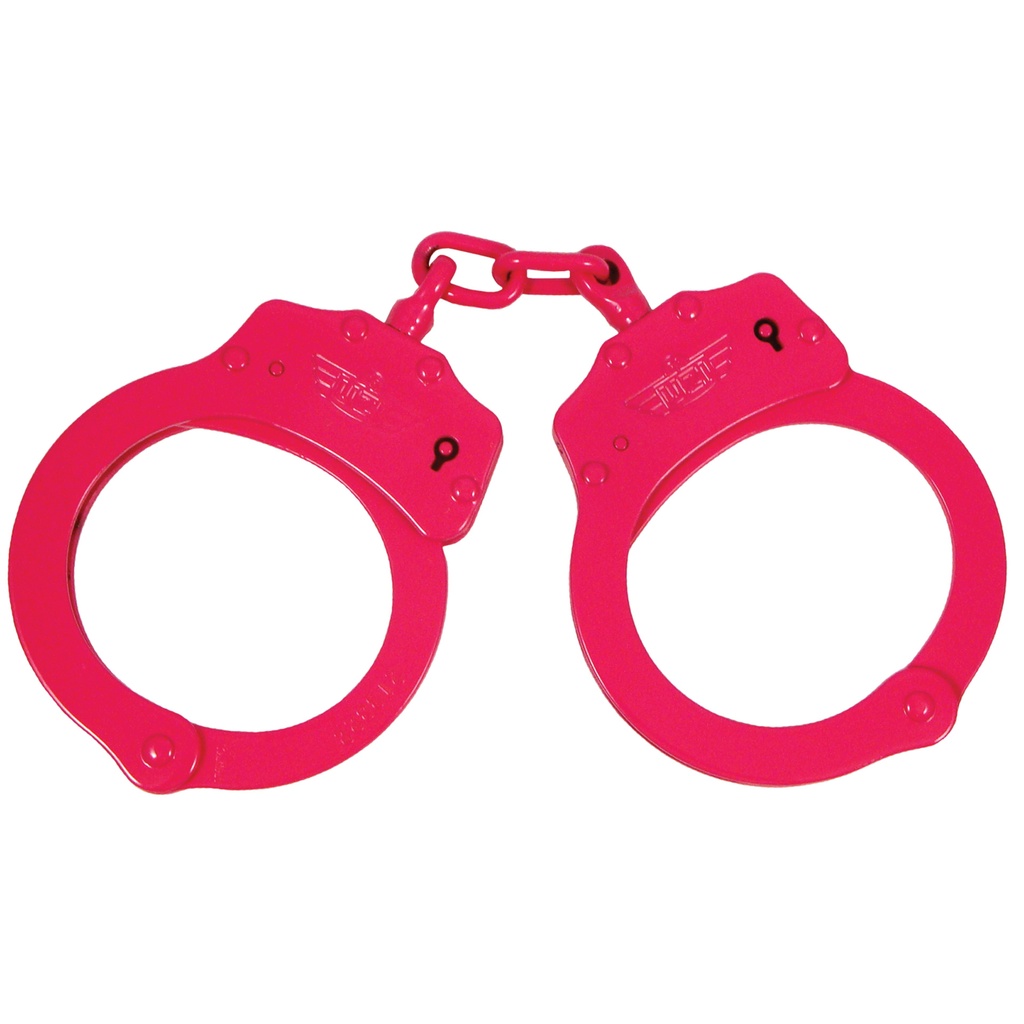
These UZI double locking handcuffs bring full-duty restraint mechanics in a standout pink finish. You get the familiar swing-through ratchet, positive double-lock to prevent over-tightening, and compatibility with any standard handcuff key. The pink coating isn’t just cosmetic—it adds quick visual ID in training scenarios, themed kits, or event use. For collectors and gear enthusiasts, it’s a professional-grade cuff with a colorway you won’t confuse with anyone else’s kit.
Vivid Control Double-Locking Handcuffs - Pink Steel
Not every piece of kit needs to whisper "standard issue." These UZI double locking handcuffs deliver the same professional restraint mechanics you’d expect from a duty cuff, then crank the visual profile to bright pink. The form is pure business: swing-through ratchet, short chain, metal construction, double-lock. The finish is unapologetically visible. If you’re building a kit with intent and personality, these belong in it.
Professional-Grade Handcuffs for Sale with Standout Visibility
When you buy handcuffs for real use—training, security work, role-specific kits—you’re buying a mechanism, not a color. Under the pink finish, these are traditional metal, double-locking handcuffs built around the same fundamentals as duty restraints:
- Swing-through ratcheting bows for fast initial application
- Short chain link between cuffs for controlled movement
- Standard handcuff key interface on both lock housings
- Positive double-lock to prevent over-tightening
The pink coating turns them into high-visibility restraints you can spot instantly in a bag, on a belt, or across a training mat. Functionally, they behave like familiar chain handcuffs. Visually, there’s no mistaking which pair is yours.
Why the Double-Locking Mechanism Matters
Collectors and serious users both know: single-lock cuffs are where bad technique and bad outcomes start. Double-locking is the standard because it gives you two key advantages—literally.
Controlled Ratchet, Reduced Risk
The primary ratchet gives you the fast, one-motion "swing and click" closure everyone recognizes. Once the bow is set to the right size, the secondary lock engages via the double-lock keyway on each cuff body. That double-lock prevents the ratchet from traveling further under load, which:
- Helps protect the wearer from over-tightening while in custody
- Locks the setting so incidental contact can’t cinch it down more
- Provides a clear, repeatable procedure for proper application
From a mechanism standpoint, this is the same logic you respect in a good automatic knife detent: positive, predictable control under stress beats loose, vague engagement every time.
Standard Key, Professional Pattern
These UZI double locking handcuffs use a standard handcuff key—no proprietary gimmicks, no orphan hardware you can’t replace. That’s what working gear is supposed to be: interoperable, predictable, and easy to service. For collectors with multiple sets from different makers, that compatibility is non-negotiable.
Handcuffs with Personality: The Pink Finish in Real Use
The bright pink finish isn’t a toy signal—it’s a designation. Color-coding gear has been standard practice for years in professional environments, and these handcuffs slide straight into that logic.
- Training rigs: Pink cuffs designate training-only gear at a glance.
- Event and demo use: High-visibility color keeps cuffs obvious for instructors, staff, or performers.
- Collector displays: A pink set stands out immediately in a row of standard nickel or black cuffs.
The glossy painted finish covers the full metal surface for a uniform look. Riveted construction at the body and chain ends keeps the mechanical integrity while the color does the talking.
Who Buys Double-Locking Pink Handcuffs?
Not someone looking for anonymous gear. These appeal to three types of buyers:
- Collectors: Building a restraint or tactical collection where color variants, branding, and mechanism differences matter.
- Security and training professionals: Using color-coded equipment sets for scenario training or non-duty roles.
- Enthusiasts: People with a serious gear habit who appreciate pro-grade mechanics in a nonstandard visual package.
The engraved UZI logo on each cuff body anchors the piece in recognizable tactical culture, but the color signals you’re not doing the stale, one-more-silver-pair routine.
What Buyers Ask Before Purchasing an Automatic Knife
This product isn’t an automatic knife—it’s a pair of UZI double locking handcuffs. But automatic knife buyers, restraint collectors, and tactical gear enthusiasts tend to overlap, and the same mechanical mindset applies. If you’re here for knives too, read on.
Are automatic knives legal?
Under U.S. federal law (the Switchblade Knife Act), automatic knives—often called switchblades—are regulated primarily in terms of interstate commerce and certain federal jurisdictions (like federal facilities and some federal lands). Federal law does not outright ban simple possession nationwide, but many states and localities impose their own restrictions.
Some states allow automatic knives for everyday carry with few limits. Others restrict blade length, require specific opening mechanisms, or ban carry while still allowing ownership at home. A handful still prohibit automatic knives entirely. Before you buy an automatic knife for carry, you must check your specific state and local laws; do not rely solely on federal rules or assumptions from other states.
Handcuffs themselves are generally legal to own in most U.S. jurisdictions, but using them in a way that imitates law enforcement, restrains someone unlawfully, or violates local impersonation statutes can be illegal. As with automatic knives, responsible ownership and awareness of your local law is non-negotiable.
What’s the difference between an automatic knife, OTF, and a switchblade?
Enthusiasts draw clean lines here:
- Automatic knife: Any folding knife where a spring drives the blade open once a button, lever, or similar control is intentionally activated. The blade is stored closed in the handle and snaps open under spring tension.
- OTF knife (Out-The-Front): A specific automatic knife where the blade travels linearly out of the front of the handle instead of pivoting from the side. Many OTFs are double action (the same control deploys and retracts the blade), while some are single action (spring-driven open, manual reset).
- Switchblade: In U.S. legal language, this is the umbrella term for automatic knives opened via a button, switch, or similar device in the handle. In enthusiast speech, “switchblade” often refers to traditional side-opening automatics.
Manual folders, assisted-openers, and gravity knives are mechanically and legally distinct. When you buy an automatic knife, you’re specifically choosing a spring-driven, button or switch-activated mechanism—not just “a knife that opens fast.”
What makes this automatic knife worth buying?
This listing is for UZI double locking handcuffs, not an automatic knife, but the evaluation mindset is the same. Serious buyers look for:
- Mechanism you can trust: Here, that’s the double-locking ratchet with standard key interface; in an automatic knife, it’s the action tune, lockup, and deployment consistency.
- Purpose-driven design: Short-chain, metal cuffs with a professional silhouette; on a knife, that might be blade steel, grind, and handle geometry built for real use.
- Distinct identity: Pink finish and UZI branding versus generic silver cuffs; in a knife, unique machining, inlays, or a specific automatic action.
If you buy gear because you care how it works—not just how it looks—these pink UZI double locking handcuffs fit right in next to your better automatics.
Finish Your Kit Like an Enthusiast, Not a Tourist
Collectors of automatic knives, OTFs, and tactical gear understand that details tell the story: deployment feel, steel choice, lock geometry—and, in this case, restraint mechanics and finish. These UZI double locking handcuffs in pink steel combine professional restraint engineering with a visual signature that doesn’t apologize for standing out. If you’re curating a kit rather than just buying more gear, this is the kind of piece that actually earns its spot.