Voltstrike Quick-Deploy Karambit Knife - Electric Black
10 sold in last 24 hours
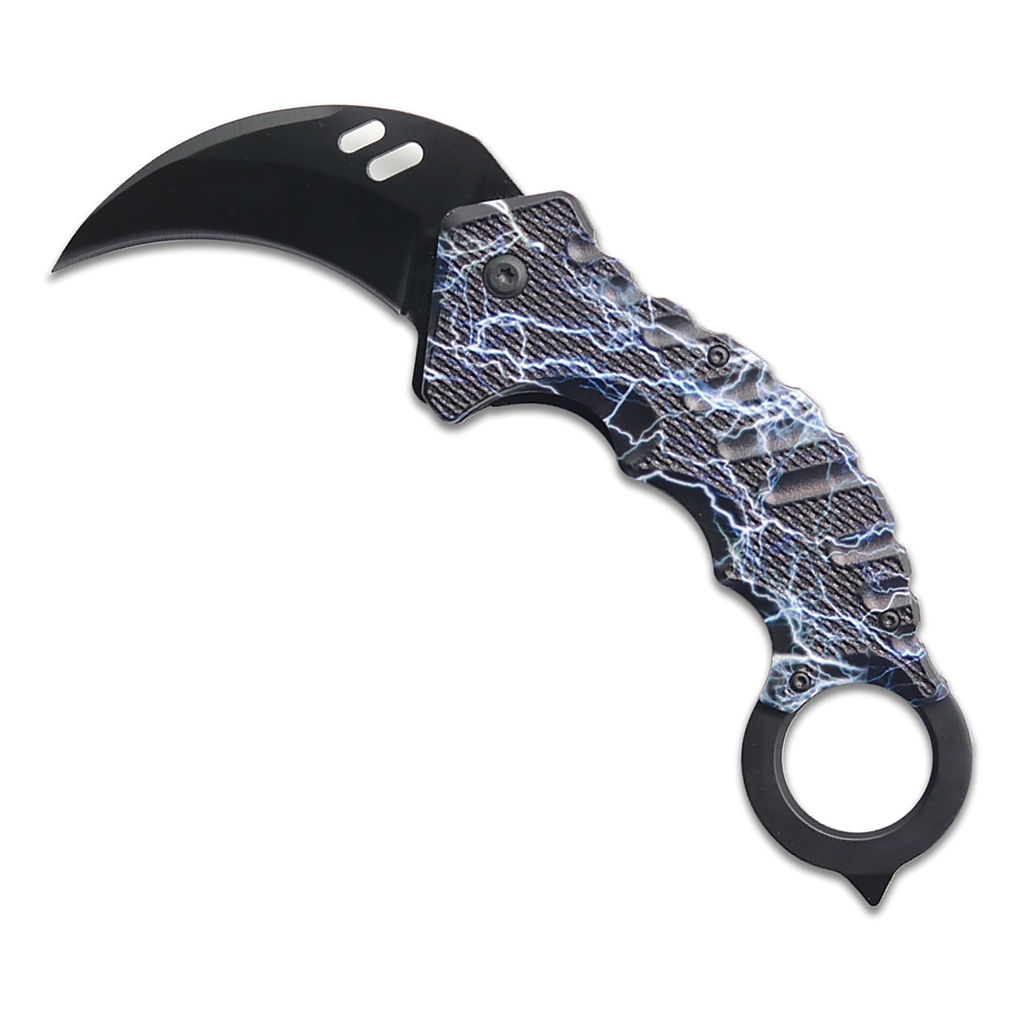
This is the spring-assisted karambit you reach for when speed and control both matter. A matte black, talon-curved blade snaps out with a decisive assisted surge, locking solid on a liner lock you can trust. The lightning-pattern handle isn’t just flash—its grooves and ring give you a secure, martial-arts-inspired grip. For the buyer who cares how a blade deploys and how it anchors in the hand, this electric black karambit delivers real mechanical satisfaction.
Spring-Assisted Karambit Knife for Sale with Serious Action
If you’re looking for more than another wall-hanger, this spring-assisted karambit knife for sale was built for people who care how a blade actually deploys. The Voltstrike concept starts with a classic talon curve, adds a fast, tuned assisted mechanism, and wraps it in a lightning-pattern handle that feels as aggressive as it looks. This isn’t about gimmicks; it’s about repeatable, confident one-hand opening in a grip that locks into your palm.
Why This Quick-Deploy Karambit Knife Deserves a Spot in Your Rotation
On paper, it’s a spring-assisted folding karambit with a matte black blade, liner lock, and pocket clip. In hand, the story is the action and the ergonomics. The assisted mechanism is tuned for a clean, decisive snap—not a lazy crawl, not a grenade going off in your fingers. Light pressure on the flipper or thumb movement starts the blade; the internal spring takes over, swinging that talon-curved edge into lockup with a clear, tactile stop.
The handle curves to follow the blade’s arc, with finger grooves that actually line up with real fingers. The karambit ring at the rear gives you indexing, retention, and spin potential for those who train, while the pointed tip doubles as an impact/glass-breaker style detail. The result is a knife that sits deep in the hand, stays anchored during deployment, and feels purpose-built instead of generic.
Action and Mechanics: How the Assisted Deployment Earns Its Keep
Mechanically, this is a true spring-assisted opening knife, not an automatic. You initiate the blade—then the spring finishes the job. That distinction matters if you care about both legality and feel. With an automatic knife or switchblade, a button or hidden actuator deploys the blade entirely on its own. Here, your thumb or finger sets the blade in motion along its pivot, and the assist kicks in only once you’ve started the move.
The payoff is control. Because your hand is already driving the blade, the transition from closed to locked feels like one continuous motion, not a binary on/off explosion of steel. The matte black finish on the blade cuts down on reflection, but more importantly it pairs with the oval cutouts to shave a bit of weight off the tip, which helps the assisted mechanism hit a satisfying, confident snap without feeling violent.
Grip, Ring, and Retention: Karambit Ergonomics Done Right
The karambit ring isn’t decorative. In a forward or reverse grip, running your finger through that ring gives you a mechanical lock between knife and hand. Combine that with the sculpted grooves along the handle and you get consistent indexing—your hand finds the same position every time you draw and deploy. That’s what separates a real useable karambit-style knife from a random curved novelty blade.
Everyday Carry Reality: Pocket Clip, Profile, and Use
As an EDC piece, the pocket clip keeps the knife accessible without broadcasting it to the room. The curved profile rides along the seam of most pockets, and the matte black blade stays low-key when you draw it. For buyers who rotate blades daily, this quick-deploy karambit fills the slot for a fast, close-control tool that still carries comfortably when you’re not on the mat or the range.
Collector Appeal: More Than Just Lightning Graphics
Collectors have seen a thousand loud handles. What earns this one a place in a tray is the way the lightning theme and the mechanics line up. The blue-white lightning bolt pattern across the handle isn’t just a paint job; it visually reinforces what the action already tells you—fast, energetic deployment from a compact frame. The S-curve running from talon tip through handle to ring gives the knife a cohesive silhouette, the kind that catches the eye from across a case.
Details like the dual oval cutouts in the blade, the pointed ring tip, and the clean liner lock cutout show that this isn’t just a slab-sided folder with a curve added as an afterthought. It was laid out as a true karambit-style assisted knife from the start. For a collector who likes to hand a knife to a friend and say, “Here, feel this action,” this piece delivers a story and a snap to match the artwork.
Understanding Assisted vs Automatic Knife for Sale Options
If you’re shopping automatic knives for sale, OTFs, and spring-assisted folders side by side, mechanism clarity matters. This knife is assisted opening, not an automatic knife and not an out-the-front. The blade pivots from the side like a traditional folding knife and uses an internal spring to accelerate the last part of the opening stroke once you’ve started it.
Automatic knives and switchblades, by contrast, typically use a button, slider, or hidden actuator that deploys the blade under spring pressure without you having to move the blade along its arc. Out-the-front (OTF) automatic knives push the blade straight out of the handle on rails, either single-action (auto deploy, manual retract) or double-action (auto both ways). This karambit keeps things simpler and more legally friendly in many regions by relying on assisted opening rather than full automatic deployment.
Legal Context: Where an Assisted Karambit Fits In
From a legal standpoint, this assisted karambit often sits in a more permissive category than a true automatic knife or switchblade, but you still need to know your local laws. In the United States, federal law mainly restricts interstate commerce in automatic knives; it doesn’t outright ban possession nationwide. The real rules live at the state and sometimes city level, and those rules treat assisted opening and automatic differently in many jurisdictions.
Because you must start the blade manually before the assist engages, many states classify spring-assisted opening knives as standard folders rather than automatic knives. That can mean fewer restrictions on carry, sale, and transport compared to a push-button automatic knife for sale or an OTF switchblade. However, some states and cities write broader weapon statutes that focus on overall intent, blade length, or any form of “spring-activated” opening. Translation: never assume—always check your state and local regulations before carrying.
What Buyers Ask Before Purchasing an Automatic Knife
Are automatic knives legal?
Federally in the U.S., automatic knives and switchblades are regulated under the Federal Switchblade Act, which mainly targets interstate shipment, import, and certain federal jurisdictions. It does not universally criminalize owning one. The real complexity is state and local law. Some states allow automatic knives, OTFs, and switchblades with few or no restrictions; others limit blade length, concealment, or who may carry (for example, law enforcement exemptions); a handful ban them outright.
Assisted opening knives like this karambit are often treated separately and more leniently because you must mechanically start the blade. That said, some jurisdictions bundle all spring-driven mechanisms together. Before you buy or carry any automatic knife, OTF, switchblade, or assisted opener, read your current state statutes and local ordinances—or consult an attorney if in doubt. Laws change, and ignorance isn’t a defense.
What’s the difference between an automatic knife, OTF, and a switchblade?
“Switchblade” is the traditional and legal term for an automatic knife where the blade opens under spring pressure when you hit a button, switch, or similar actuator. An automatic knife is the broader enthusiast term for the same thing: press the control, the blade deploys on its own. An OTF (out-the-front) automatic pushes the blade straight out of the handle on a linear track instead of pivoting from the side—single-action autos deploy automatically and require manual retraction; double-action autos use spring power both ways.
This karambit is neither OTF nor automatic. It’s a spring-assisted folding knife: you begin the opening stroke manually, then the assist spring takes over. For buyers comparing an automatic knife for sale to an assisted opener, that’s the key distinction—who starts the blade moving.
What makes this automatic-style knife worth buying?
Mechanically, the value is in the tuned assisted action and the way the karambit geometry works with it. You get a consistent, confident snap into lockup from a compact, pocketable frame, with a liner lock that engages cleanly and a ring that locks the knife into your hand. Aesthetically, the electric lightning handle over matte black steel gives you a display-worthy look without sacrificing real-world grip and control.
For the collector or EDC user who appreciates deployment feel, this piece scratches the same mechanical itch as many automatic knives for sale, while staying in the assisted category that’s often easier to carry legally. It’s a fast, aggressive, visually distinct addition to a rotation that already includes flippers, autos, and OTFs.
For Enthusiasts Who Choose Their Knives by the Action
If your first move with any new blade is to cycle the action a dozen times and feel for grit, slack, and lockup, this spring-assisted karambit belongs in your hand. It’s not pretending to be an OTF or a switchblade; it knows exactly what it is—a fast, controlled assisted opening knife with a talon profile and lightning-charged attitude. For the buyer who understands the difference and wants a knife that earns its place every time it snaps open, this quick-deploy karambit knife for sale delivers.
| Blade Color | Black |
| Blade Finish | Matte |
| Blade Style | Karambit |
| Blade Edge | Plain |
| Theme | Lightning |
| Pocket Clip | Yes |
| Deployment Method | Spring-assisted |
| Lock Type | Liner lock |