Wanted Poster Outlaw Spring-Assisted Pocket Knife - Black Blade
15 sold in last 24 hours
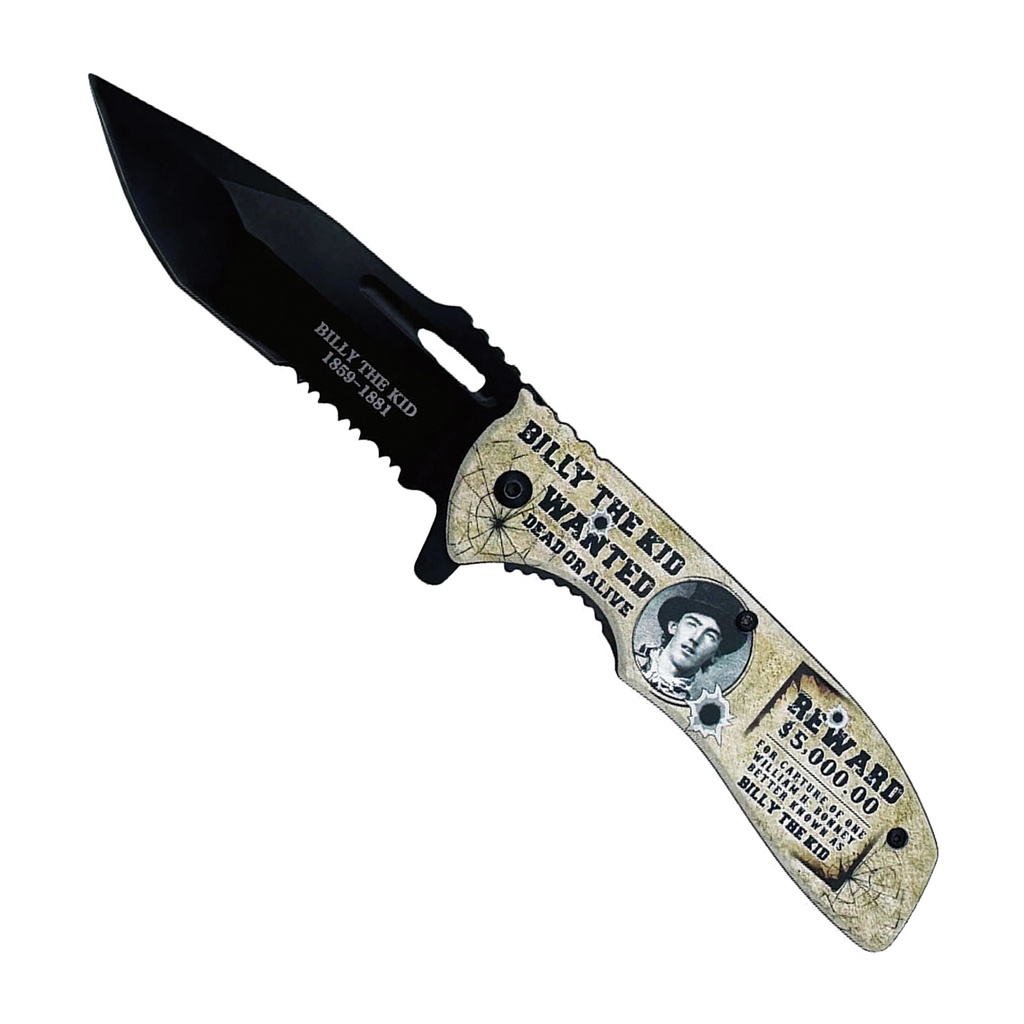
This isn’t your average themed folder. The Wanted Poster Outlaw Spring-Assisted Pocket Knife pairs a black-coated, partially serrated drop point with a fast, one-handed assist that actually snaps to attention. The aluminum handle carries Billy the Kid wanted-poster art without adding bulk, while the liner lock and pocket clip keep it practical for real EDC. It looks like a relic from the frontier, but it works like a modern tool—built for anyone who wants a Wild West story riding in their pocket.
Automatic Knives for Sale vs. a Proper Spring-Assisted Outlaw Folder
If you’re hunting for an automatic knife for sale and end up here, good. You care about action, not just labels. The Wanted Poster Outlaw Spring-Assisted Pocket Knife is a spring-assisted folder, not a true automatic. That means you start the blade with the thumb slot, and the internal assist spring finishes the deployment with a confident snap—fast, controlled, and legal in more places than a push-button automatic or switchblade.
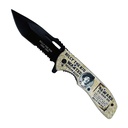
This knife leans hard into the Wild West theme—Billy the Kid portrait, vintage wanted-poster typography, mock bullet hole—and backs it up with a black-coated, partially serrated stainless blade that actually wants to work. It’s a frontier story built on modern mechanics.
Automatic Knife for Sale Alternatives: Why Spring-Assisted Still Scratches the Itch
Plenty of buyers search for an automatic knife for sale when what they really want is fast, one-handed deployment. This assisted opening pocket knife delivers that speed while sidestepping some of the legal baggage that comes with full autos and classic switchblades. You get a similar end result—blade out, locked, and ready—without relying on a push-button mechanism or coil-spring automatic action.
At 4 inches of black-coated, partially serrated drop point, the blade gives you enough length for real work without feeling clumsy. Cardboard, banding, cord, light field tasks—the serrations chew, the plain edge cleans up. Closed, the 4.5-inch aluminum handle rides like a standard pocket EDC, just with a lot more attitude.
Mechanics First: Action, Lockup, and Carry That Earn Enthusiast Respect
Mechanism matters. This is a spring-assisted folding knife with a liner lock—no mystery, no marketing fog. The thumb slot on the blade lets you start the motion; the assist spring takes over and drives the blade into full lock with a crisp, audible finish. It’s not as violent as some double-action out-the-front (OTF) knives, but it’s quicker and more positive than cheap assisted flippers that feel mushy or hesitant.
Assisted Action That Snaps Instead of Smearing
A good assisted opener should feel like it’s helping, not fighting you. On this outlaw-themed folder, the spring tension is tuned so the blade doesn’t try to open in your pocket, but once you intentionally start the stroke, it commits and finishes cleanly. There’s a distinct difference between that and a true automatic knife where a button or hidden release trips the mechanism. Enthusiasts feel it immediately—the transition from manual to assisted is smooth, and the blade tracks straight into lockup.
Liner Lock and Ergonomics You Can Actually Lean On
The liner lock is simple: spine jimping for thumb control, a finger groove and ergonomic contouring so your hand settles right behind the pivot. When the blade is open, that lock bar engages the tang and gives reliable security for typical EDC use. No gimmicks, no secondary safeties to fumble with. The jimping at the spine gives your thumb purchase when you’re bearing down, and the aluminum handle keeps weight reasonable for an 8.5-inch open-length knife.
Collector Appeal: Wild West Story, Modern Working Edge
There are two kinds of themed knives: the ones that live in a drawer, and the ones that actually see pocket time. This sits in the middle—collector-friendly Western art with enough real-world function to earn its way into rotation.
The handle is the headline: aged parchment tones, period-style fonts, “BILLY THE KID WANTED DEAD OR ALIVE” text, reward callout, bullet-hole graphic, and an outlaw portrait that actually reads clearly at a glance. It feels like a wanted poster got wrapped around a modern tactical folder. The black-coated blade balances that visually busy handle, giving the whole profile a clean, aggressive silhouette when open.
For collectors who already have automatic knives, OTFs, and classic Italian-style switchblades, this adds a different flavor: American outlaw history with contemporary assisted deployment. It’s a conversation piece that doesn’t have to stay behind glass.
Steel, Edge, and Real-World Use
The blade is stainless steel with a black coating and a partial serration. No fantasy metallurgy claims here—this is workmanlike stainless chosen for corrosion resistance and easy touch-ups, not bragging rights on Rockwell charts. The coating helps with glare and surface protection, and it visually ties the knife into that modern-outlaw, tactical black category.
The drop point profile gives you a strong tip and a generous belly; the serrated portion near the ricasso is your go-to for rope, strap, or fibrous material. For an everyday carry that doubles as a themed collectible, that’s the right priority stack: easy to sharpen, tough enough for daily abuse, and visually consistent with the Wild West motif.
Legal Context: Where This Fits in the Automatic and Switchblade Landscape
When buyers search for an automatic knife for sale, the next question is usually about legality. This knife is spring-assisted, not a true automatic, switchblade, or OTF. Under U.S. federal law, the big restrictions center on interstate commerce of automatic knives and switchblades, especially those that open by a button or similar device in the handle.
Most jurisdictions treat assisted opening knives differently from full automatics, because you must manually start opening the blade before the spring kicks in. That said, some states and localities write their laws broadly enough that any spring involvement can be an issue. Classification can vary, and some places don’t care about the distinction as much as enthusiasts do.
The practical takeaway: check your state and local knife laws before you carry, especially if your area has strict switchblade, automatic knife, or OTF regulations. Don’t assume that because it’s assisted, it’s automatically legal to carry everywhere.
What Buyers Ask Before Purchasing an Automatic Knife
Are automatic knives legal?
In the U.S., there’s a federal framework (the Switchblade Knife Act) that mainly regulates interstate sale and shipment of automatic knives and switchblades—blades that open by a button, lever, or similar device in the handle. It doesn’t outright ban ownership for most civilians, but it does limit how automatics move across state lines. The real complexity is at the state and local level: some states fully allow automatic knives, some allow them with blade-length or carry-type restrictions, and some largely prohibit them. Spring-assisted folders like this one are often treated differently, but not always. Before you buy or carry any automatic, OTF, or assisted knife, read your state and city statutes instead of relying on assumptions or forum hearsay.
What’s the difference between an automatic knife, OTF, and a switchblade?
Mechanically, a true automatic knife (often called a switchblade in law and casual speech) opens via a button, lever, or similar control that releases a spring-driven blade. The blade usually pivots from the side like a standard folder. An OTF knife (out-the-front) is a subtype where the blade slides straight out of the handle, either single-action (fires out, manually retracted) or double-action (fires out and retracts via the same control). A lot of OTFs are automatic knives under the law. A spring-assisted knife—like this outlaw folder—is different: you manually start opening the blade with a thumb stud, hole, or flipper, and only then does the assist spring take over. No button in the handle, no fully automatic deployment from a closed, static state.
What makes this automatic knife worth buying?
Strictly speaking, this isn’t an automatic knife—it’s a spring-assisted folder—but it targets the same crowd that wants fast deployment and mechanical character. What makes it worth owning is the combination of reliable assisted action, practical partially serrated drop point, and a handle that actually tells a story. Billy the Kid wanted-poster art, bullet-hole graphics, and distressed parchment tones give it a clear identity, while the liner lock, jimping, and pocket clip keep it from being just a novelty. It’s the knife you buy when you want a Wild West piece that can still justify space in your EDC rotation.
Carry It Like You Mean It: An Enthusiast’s Outlaw, Not a Toy
If you’re deep into automatic knives for sale, OTFs, and classic switchblades, you already know how fast steel can become either pure collection or pure tool. The Wanted Poster Outlaw Spring-Assisted Pocket Knife threads that needle—it’s fun, thematic, and still mechanically honest. You’re not just buying a picture on a handle; you’re choosing an assisted opener that behaves the way a serious knife should when you pull it from your pocket.
For the buyer who wants their gear to say something—and still cut when it counts—this outlaw belongs in the lineup.
| Blade Length (inches) | 4 |
| Overall Length (inches) | 8.5 |
| Closed Length (inches) | 4.5 |
| Weight (oz.) | 5 |
| Blade Color | Black |
| Blade Finish | Coated |
| Blade Style | Drop Point |
| Blade Edge | Partial-Serrated |
| Blade Material | Stainless Steel |
| Handle Finish | Matte |
| Handle Material | Aluminum |
| Theme | Wild West |
| Safety | Liner Lock |
| Pocket Clip | Yes |
| Deployment Method | Spring-assisted |
| Lock Type | Liner lock |