Wilderness Howl Spring-Assisted Folding Knife - Wolf Wood
15 sold in last 24 hours
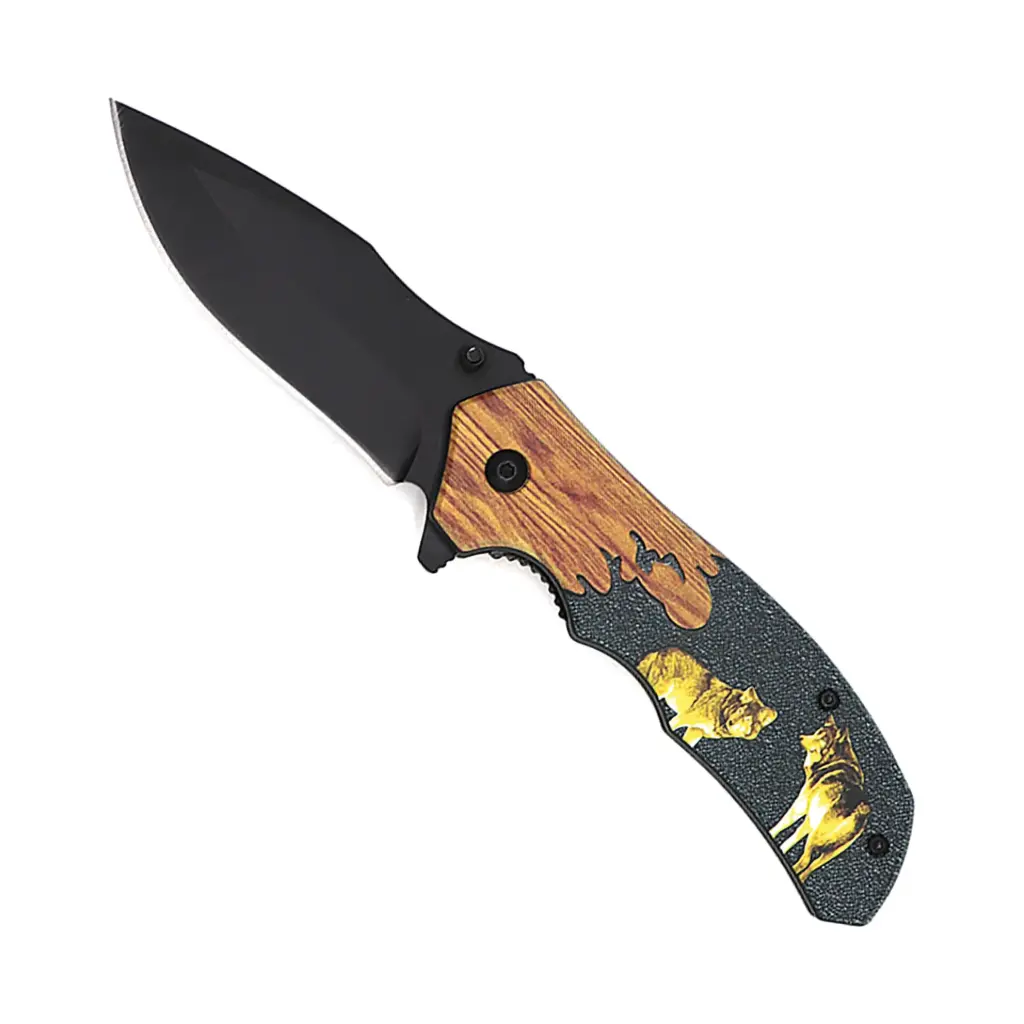
This is the spring-assisted knife for buyers who actually care how a blade opens. The Wilderness Howl snaps to attention off the thumb stud with a tuned assist and a secure liner lock behind it. A matte black drop point pairs with jimping for real control, while the wood-and-wolf handle art makes it an easy counter pickup that still feels like a keeper. It carries light, opens fast, and looks like it belongs in the field, not the junk drawer.
Spring-Assisted Knife for Sale That Actually Feels Tuned
If you’ve handled enough cheap folders, you know the difference between a spring-assisted knife that just kind of stumbles open and one that feels like it wants to get to work. The Wilderness Howl Spring-Assisted Folding Knife sits in that second camp. Thumb the stud, hit the detent, and the assist takes over with a clean, decisive snap into lockup. No flailing wrist, no guessing if it will get there this time.
This isn’t an automatic knife in the legal or mechanical sense — you still start the blade manually — but the assist makes it deploy fast enough that most casual users won’t care about the distinction. Enthusiasts will, and that’s exactly who this is built to satisfy at the price point.
Why This Spring-Assisted Knife for Sale Earns Pocket Time
Mechanically, this is a straightforward liner-lock, spring-assisted folder done the right way. The matte black drop point rides on a pivot tuned so the assist doesn’t fight you on the way out. You get a clear detent, a predictable break, and then the spring takes over to drive the blade home. The lock bar seats fully on the tang, which matters if you’re actually cutting, not just flicking this open behind a counter.
At 3.5 inches of plain-edge steel and 8.25 inches overall, it lives right in that EDC sweet spot: enough blade to be useful in camp or around the shop, but not a pocket anchor. The jimping on the spine gives your thumb a place to live when you’re bearing down on rope, packaging, or whatever else ends up in front of you. It’s not a safe queen; it’s a working profile with enough personality to get noticed.
Action and Lockup: The Real Test
Collectors and regulars at any knife show will tell you: deployment and lockup are where budget folders usually fall apart. On the Wilderness Howl, the spring-assisted mechanism engages consistently from the thumb stud with a short, confident stroke. Once open, the liner lock engages with enough face on the tang that you don’t feel flex or ambiguity.
Is it a custom shop grade mechanism? No, and it doesn’t pretend to be. But in the realm of spring-assisted knives for sale that are meant to move in volume, this one behaves more like a piece you chose than a giveaway you grabbed.
Steel and Edge Reality
The blade steel sits in the workhorse category — not a boutique powder metallurgy steel, but a functional stainless tuned for easy maintenance and reasonable edge life. That matters for the kind of owner this knife attracts: someone who will throw it in a pocket, cut everything in front of them, and hit it on a stone or pull-through sharpener when it finally dulls. It sharpens quickly, shrugs off light abuse, and doesn’t demand a degree in metallurgy to keep running.
Design Story: Wolf Art Meets Field-Ready Utility
The first thing that catches your eye isn’t the blade; it’s the handle. Up front, a warm wood scale hugs the pivot, giving you that traditional touch. Then the handle flows into a darker rear section where gold wolves run the spine, pulling the whole knife into a wilderness and predator theme. It’s not subtle, but it’s not cartoonish either. It looks like something that belongs in a pack or glove box on a long drive into the woods.
That two-tone handle does more than just look good. The curve and contour sit naturally in the hand, and the exposed liner gives you a visual cue of the lockwork doing its job. The pocket clip (mounted on the reverse) keeps it riding where it should: secure, accessible, and out of the way until you actually need it.
EDC Reality: How It Carries and Works
Closed, the knife sits at 4.75 inches — long enough to fill the hand when you draw it, short enough that it doesn’t print like a brick. The spring-assisted opening means that one-handed deployment is a given, whether you’re right-handed or adapting with your off-hand. In a world where people throw the word “tactical” onto anything black, this one doesn’t need the label. It just does what an everyday carry knife is supposed to do: open when you tell it to, stay open until you tell it not to, and cut more than it complains.
The liner lock keeps the mechanism simple and familiar. Anyone who’s carried a modern folding knife in the last twenty years will know exactly how to close it. No safeties to fumble, no guesswork. That accessibility matters if you’re handing this to a friend at camp or selling it across a counter to a first-time buyer who’s done their homework but hasn’t lived with a drawer full of blades yet.
Legal Context: Where Spring-Assisted Fits vs Automatic Knives
Here’s where terminology matters. This is a spring-assisted folding knife, not a true automatic knife, not an OTF, and not what most statutes mean when they say “switchblade.” You must start the blade manually with the thumb stud; only then does the internal spring assist finish the opening. That mechanical difference is what keeps most assisted-openers on safer legal ground than full automatics in many jurisdictions.
Under U.S. federal law, automatic knives and switchblades are regulated differently than assisted-openers. Many states that restrict automatic knives still allow spring-assisted folders like this, but not all. Some local ordinances blur lines or use broad language. If you’re buying this as a daily carry piece, you should always check your specific state and city laws on folding knives, assisted-opening mechanisms, blade length, and carry method. Don’t rely on rumor or what someone at a gun show told you ten years ago.
If you’re used to shopping for an automatic knife for sale, think of this as the legal-friendly cousin in a lot of regions: fast, one-handed deployment, but with that crucial manual start that keeps it out of the strict automatic category in many codes.
What Buyers Ask Before Purchasing an Automatic Knife
Are automatic knives legal?
In the U.S., automatic knives (true push-button or fully spring-driven opening) are governed by the Federal Switchblade Act for interstate commerce, and by a patchwork of state and local laws for carry and possession. Some states allow automatic knives with few restrictions; others limit them by blade length, opening type, age, or permit status; a handful still ban them outright. This Wilderness Howl is a spring-assisted folding knife, which is treated differently from an automatic knife or switchblade in many jurisdictions. Even so, you should verify your state and local laws before carrying any knife as an EDC, especially if you’re used to automatic or OTF platforms.
What’s the difference between an automatic knife, OTF, and a switchblade?
Mechanically, an automatic knife opens its blade fully by spring power at the press of a button or release—no manual start. A classic switchblade is a legal term usually referring to that same automatic action, whether the blade comes out the side or the front. An OTF (out-the-front) knife is a subcategory where the blade travels linearly out of the handle, often with a slider and double-action mechanism (press forward to open, back to close). This Wilderness Howl is not an automatic or OTF; it’s a spring-assisted side-opening folder. You begin the opening with the thumb stud, and the internal spring only assists once you’ve started the motion.
What makes this automatic-style assisted knife worth buying?
For the buyer torn between a true automatic knife for sale and a more legally comfortable EDC, this piece hits a smart middle ground. The assist gives you near-automatic speed with a familiar, simple liner-lock platform. The 3.5-inch matte black drop point is a proven working shape, not a gimmick, and the handle blends warm wood with wolf art in a way that makes it feel intentional, not novelty. It’s the kind of knife that sells easily to first-time enthusiasts but still makes a collector nod because the action, lockup, and ergonomics are dialed in beyond what the graphics alone would suggest.
For the Enthusiast Who Chooses Their EDC on Purpose
Whether your drawer is already full of automatic knives, OTFs, and well-worn folders, or you’re just adding a spring-assisted workhorse with some personality, the Wilderness Howl earns its place. It’s fast without pretending to be a full auto, distinctive without feeling gaudy, and sized right for actual use. If you buy knives for the way they open, lock, and cut — not just the way they look in a picture — this is the kind of assisted folder that justifies its spot in the rotation every time you thumb that stud and let the spring do its job.
| Blade Length (inches) | 3.5 |
| Overall Length (inches) | 8.25 |
| Closed Length (inches) | 4.75 |
| Blade Color | Black |
| Blade Finish | Matte |
| Blade Style | Drop Point |
| Blade Edge | Plain |
| Blade Material | Steel |
| Handle Finish | Glossy |
| Handle Material | Wood |
| Theme | Wolf Design |
| Safety | Liner Lock |
| Pocket Clip | Yes |
| Deployment Method | Spring-assisted |
| Lock Type | Liner lock |