Winged Revenant Dual-Blade Assisted Knife - Red and Blue
10 sold in last 24 hours
An assisted opening knife built for drama, not subtlety. The Winged Revenant Dual-Blade Assisted Knife snaps its twin 3-inch dagger blades out like bat wings from a skull-marked fuselage. Spring-assisted deployment on both ends, stainless steel construction, and a usable pocket clip turn the fantasy artwork into a real EDC conversation piece. At 6 inches closed and 12 fully extended, it rides like a compact, carries like a statement, and opens with the kind of symmetry collectors actually talk about.
Winged Revenant Dual-Blade Assisted Knife - Red and Blue
Some knives are tools. This one is an entrance. The Winged Revenant Dual-Blade Assisted Knife is what happens when a fantasy artist and a mechanism-obsessed knife nerd sit down and agree on one thing: the action has to be as serious as the artwork. Dual spring-assisted dagger blades, a skull-centered wing profile, and full stainless construction turn this into a statement piece you can actually carry.
Automatic Knives for Sale vs. Assisted Action: Where This Knife Fits
If you’re hunting for an automatic knife for sale and you know your mechanisms, you’ll clock this one correctly: it’s spring-assisted, not a true push-button automatic. That matters. An automatic knife deploys purely off a button or switch with no help from your wrist. An assisted opening knife like this Revenant needs a manual nudge on the blade, then the spring takes over and finishes the launch.
Functionally, that gives you two advantages: first, the action still feels snappy and intentional without crossing fully into automatic or switchblade territory in many jurisdictions; second, the dual-blade layout can stay slimmer because there’s no internal button hardware or leaf spring pocket to chew up handle real estate. You get theatrics without the bulk.
Dual-Wing Deployment: How the Assisted Action Actually Works
Each 3-inch dagger blade sits at either end of the 6-inch handle, giving you 12 inches of total length when both are deployed. The spring-assisted mechanism on each blade uses a torsion bar style setup: once you thumb the flipper or thumb ramp past a set resistance point, the internal spring snaps the blade to lockup.
Symmetry You Can Feel When Both Blades Open
Because the blades mirror each other, the balance shifts evenly as you deploy. Most fantasy pieces are all show and no mechanical consistency; here, the matched blades mean when you fire one, then the other, the handle rotation and resistance feel nearly identical. Collectors notice that. Badly tuned dual-blade knives twist in the hand. This one tracks straight.
Stainless, Matte, and Built for Real Use
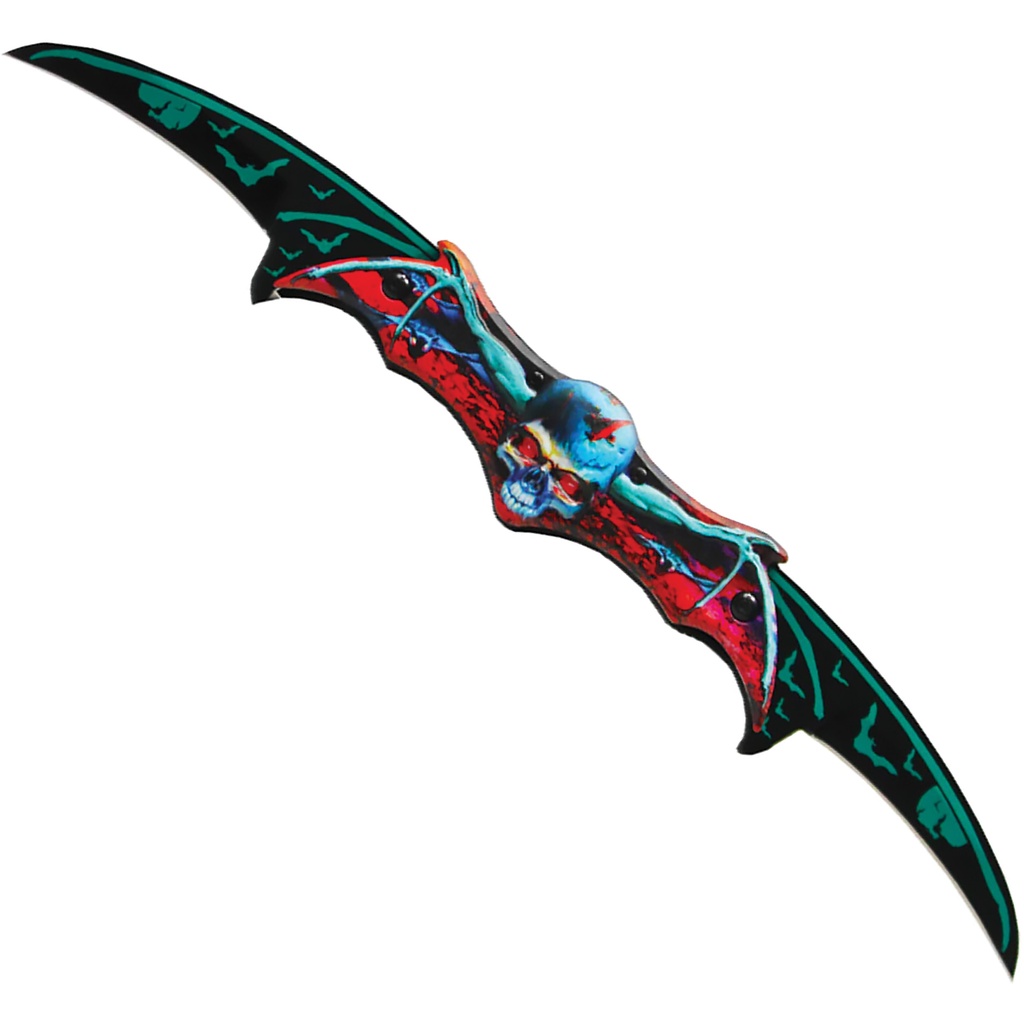
The blades are stainless steel with a matte black finish, etched with bat silhouettes that extend the winged skull theme. Is this a powdered super steel? No. It’s a straightforward stainless meant to handle light cutting, package duty, and display rotation without babying. For the price range this lives in, buyers are honest: you want corrosion resistance, easy touch-ups, and enough hardness to hold a respectable edge between strop sessions.
Buying an Automatic Knife: Why Enthusiasts Still Care About Assisted
Anyone searching where to buy an automatic knife already knows the rush of a button-fired action. This knife earns a spot in the same display case for a different reason: mechanical theater. Dual assisted blades that open like wings from a blue skull centerline are not common. Most automatic knives for sale lean tactical or minimalist; this one leans unapologetically gothic while still giving you a reliable, repeatable deployment.
If your collection already covers OTF double action and side-opening autos, adding a dual-blade assisted piece like this is about variety. It’s a conversation knife that still ticks the enthusiast boxes: consistent spring timing, solid lockup, and a handle that doesn’t flex under load.
Skull, Bats, and Blood Red: Collector Appeal Beyond the Mechanism
The central handle panel carries a vivid blue skull on a blood-red background, arms and framing shaping into stylized wings. The black blades, with their green bat silhouettes, complete the night-creature profile. This is straight gothic/fantasy territory — think horror cover art more than military iconography.
For retailers, that matters. This is the knife that pulls eyes from across the counter. For collectors, it’s the one you pull out when someone says, “Show me something different.” You’re not just buying another black-handled side opener; you’re buying a theme executed across handle, blades, and silhouette.
Pocket Clip and Carry Reality
At 6 inches closed with a steel handle and integral pocket clip, the Winged Revenant rides like a heavy but manageable EDC. The clip keeps the skull and red handle mostly buried, so you’re not broadcasting the artwork to the room until you decide to. It’s more pocketable than the 12-inch open length suggests, and the symmetry of the design keeps hotspots to a minimum for short cutting tasks.
Legal Context: Where This Sits vs. Automatic Knives and Switchblades
Any serious buyer looking at an automatic knife for sale is already thinking about legality. Here’s where this design can be an advantage: because it is spring-assisted and requires manual pressure on the blade to begin opening, it is not classified as a traditional automatic or switchblade under many U.S. statutes. That said, knife law is a minefield of definitions and exceptions.
In the United States, federal law (notably the Switchblade Knife Act) primarily targets interstate commerce in automatic knives and switchblades, defined as knives that open automatically by a button, switch, or inertia with no ongoing manual input. Spring-assisted knives that require a deliberate push on the blade itself often fall outside that definition, but several states and cities treat assisted opening knives similarly to automatics.
The practical rule: always check your state and local laws before you buy or carry. Some regions focus on blade length, some on opening mechanism, some on intent or concealment. This knife’s assisted mechanism may give it a friendlier legal profile than a true automatic knife in many jurisdictions, but there is no universal guarantee.
What Buyers Ask Before Purchasing an Automatic Knife
Are automatic knives legal?
In the U.S., automatic knife legality is a patchwork. Federally, automatic knives and switchblades are regulated mainly in interstate commerce and on certain federal properties, but ownership and carry are mostly left to the states. Some states have largely legalized automatic knives for adults; others restrict blade length, prohibit concealed carry, or ban autos and switchblades outright.
This Winged Revenant is assisted opening, not an automatic knife in the classic sense, which can make it more acceptable in jurisdictions that specifically ban button-fired or fully automatic blades. However, a few states and municipalities lump assisted and automatic mechanisms together. The only responsible move is to review your local statutes and, if in doubt, consult current state-by-state knife law resources or legal counsel.
What’s the difference between an automatic knife, OTF, and a switchblade?
Mechanically, here’s how it breaks down:
- Automatic knife (side-opening): Blade sits folded in the handle and opens automatically when you press a button, switch, or lever. The spring does all the work once you trigger it.
- OTF (out-the-front): Blade travels in and out of the front of the handle. A double action OTF extends and retracts via the same slide or switch; a single action OTF deploys automatically but must be manually reset.
- Switchblade: In U.S. legal language, this is usually an umbrella term for automatic knives — including OTFs — that open automatically via a button, switch, or similar device.
- Assisted opening (this knife): You start the blade manually, and a spring takes over to finish the deployment. No button, no fully automatic opening from rest.
This Winged Revenant lives firmly in the assisted opening camp, even though people casually shopping for an automatic knife for sale will often lump it into the same general category.
What makes this automatic-style assisted knife worth buying?
Three things: the dual-wing mechanism, the consistent assisted action, and the unapologetic theme. Twin blades that open in opposite directions with matching spring tension are rare at this price point. The matte stainless dagger profiles and full steel handle make it more than wall art; it’s a usable, if clearly dramatic, EDC cutter for light tasks.
For a collector, it fills a very specific slot: a skull-and-bat fantasy knife that still respects mechanical fundamentals. The action is predictable, the lockup is honest for its category, and the silhouette is unlike the usual tactical autos or budget folders.
For Enthusiasts Who Already Own Real Automatics
If your drawer already holds a double action OTF, a couple of side-opening push-button autos, and maybe an old-school Italian stilettos, this knife isn’t trying to compete on raw deployment speed. It’s about character and mechanical variety. When someone comes over and says, “Show me something weird,” this is the piece you reach for.
You’re not buying this instead of an automatic knife for sale; you’re buying it alongside your automatics because you appreciate a knife that commits to its own identity: dual assisted blades, skull-forward artwork, and the kind of winged profile that actually deserves a second look from serious collectors.
If that sounds like you, you’re the kind of buyer this knife was built for.
| Blade Length (inches) | 3 |
| Overall Length (inches) | 12 |
| Closed Length (inches) | 6 |
| Blade Color | Black |
| Blade Finish | Matte |
| Blade Style | Dagger |
| Blade Edge | Plain |
| Blade Material | Stainless Steel |
| Handle Finish | Matte |
| Handle Material | Steel |
| Theme | Skull |
| Pocket Clip | Yes |
| Deployment Method | Spring-assisted |