Woodland Strike Spring-Assisted EDC Knife - Wood-Grain
13 sold in last 24 hours
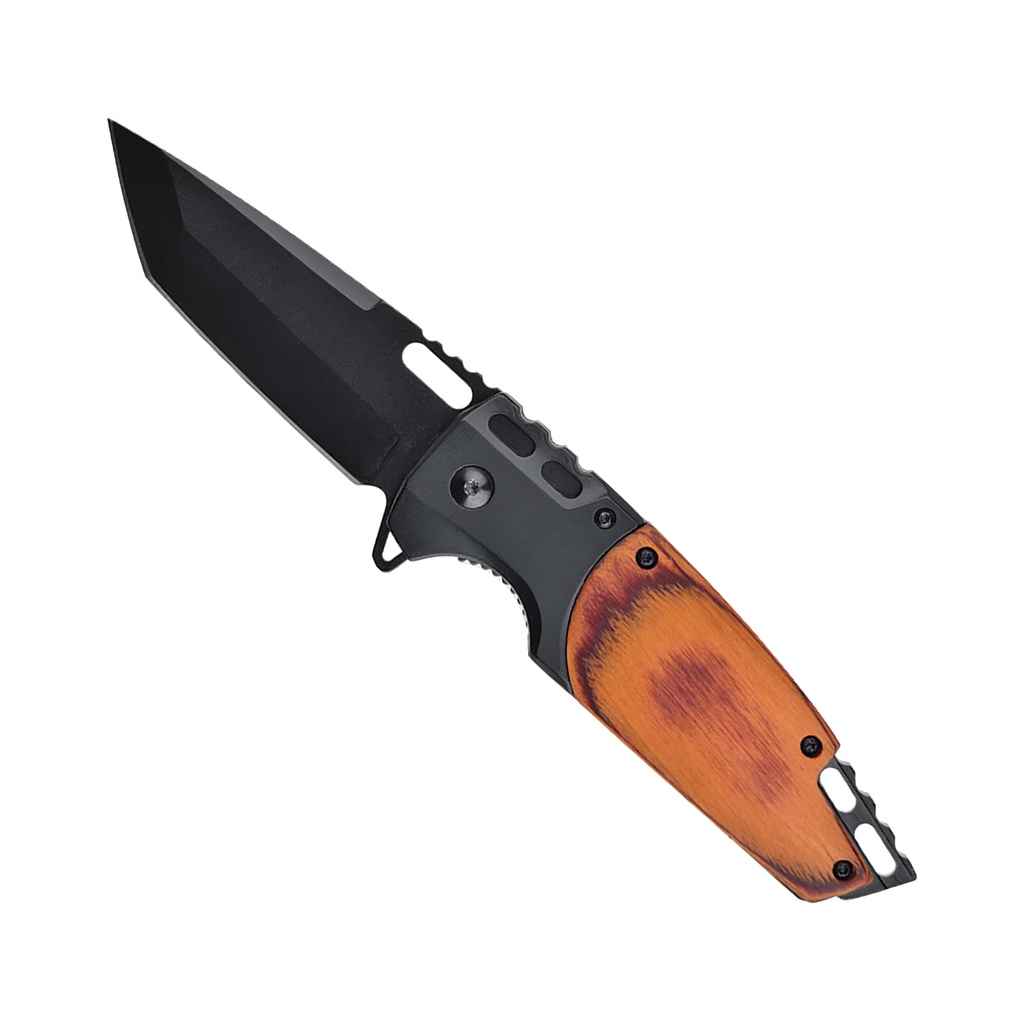
This is a spring-assisted knife built for people who actually use their gear. Woodland Strike pairs a black American tanto blade in 3Cr13 with a warm wood-grain handle and steel frame cutouts for balance. The flipper tab drives a fast, decisive snap, while the liner lock and deep-carry clip keep it honest in pocket. It’s a work-ready EDC that feels like timber in hand but runs like a modern tactical folder.
Spring-Assisted Knife for Sale That Feels Like the Woods, Works Like a Tool
If you’re looking for an automatic knife for sale and you actually care how the mechanism feels in hand, this spring-assisted tanto folder sits in that sweet spot between rustic and tactical. It’s not pretending to be an OTF or a full switchblade; it’s a tuned assisted opener with a clean snap, a real lock, and a handle that looks like it belongs at a trailhead, not a mall kiosk.
The Woodland Strike brings together a black American tanto blade, 3Cr13 stainless steel, and a wood-grain scale over a steel frame. It’s built as an everyday carry knife that can live in real pockets, see real cardboard, rope, and light camp work, and still look like something you’d throw on a stump beside your coffee in the morning.
Why This Spring-Assisted EDC Knife Belongs Beside the "Automatic Knife for Sale" Crowd
Mechanically, assisted opening and automatic aren’t the same animal, and serious buyers know it. This knife runs a spring-assisted flipper action: you start the blade with light pressure on the tab, the internal spring takes over, and the blade snaps into lockup with a positive, mechanical feel. That means no accidental pocket rocket, but deployment speed that keeps up with many side-opening automatics.
Where a true automatic knife uses a button or hidden release to both fire and sometimes close the blade, this assisted opener respects the manual start. The payoff is control. You get the speed and satisfying snap without the extra legal baggage some automatic and switchblade designs carry in certain states.
Flipper, Thumb Hole, and Jimping: Action You Can Actually Run
The flipper tab is the primary deployment method, tuned for a straight, forward press that drives the blade onto the spring. Once you feel that spring engage, the rest of the motion is automatic in everything but statute language. The thumb hole gives you a secondary way to open when you want a slower, more deliberate move — gloves, cold fingers, or just not wanting to telegraph that signature assisted click.
Jimping along the spine and at the finger choil isn’t cosmetic. It gives you traction when you choke up on the tanto’s reinforced tip for push cuts, stripping material, or controlled scoring. It’s the sort of detail you notice the first time your hands are wet, cold, or covered in tape residue.
Automatic Knives for Sale vs Assisted Openers: Where This Knife Fits
Someone searching for an automatic knife for sale is usually chasing three things: speed, reliability, and that mechanical satisfaction when the blade fires. This knife answers those same cravings through a spring-assisted mechanism rather than a push-button automatic.
- Speed: Once you nudge the flipper, the spring drives the blade out in one consistent motion.
- Reliability: Fewer moving parts than many automatics or OTF switchblades means fewer chances for pocket lint and grit to ruin your day.
- Control: The blade only moves when you deliberately start it — no accidental purse or pocket launch just from bumping a button.
If you like the idea of buying an automatic knife but your local laws, workplace rules, or personal comfort level say “not yet,” this type of assisted knife gives you 80–90% of the deployment experience with a much easier legal and practical footprint.
Steel, Edge, and Tanto Geometry: The Working End of This Knife
3Cr13 stainless is a no-drama working steel. It isn’t trying to be exotic. It sharpens fast, shrugs off corrosion, and comes back to life on a pocket stone or basic pull-through sharpener. For a knife that’s going to see tape, cardboard, plastic, and light camp use, that ease of maintenance is worth more than bragging rights about some super steel you’re afraid to touch.
The American tanto profile gives you two distinct working zones: a long, straight primary edge for slicing and a reinforced tip section for scraping, light prying, or controlled puncture work. That secondary point, where the grind transitions, is where a lot of real-world cutting gets done — opening thick clamshell packaging, cutting out sections of tarp, scoring drywall or insulation. With the black oxidized finish, you get added corrosion resistance and less glare, more in line with modern tactical folders than classic hunting knives.
Handle, Wood-Grain Scale, and Frame Cutouts
The warm wood-grain scale isn’t just there for looks; it changes the way the knife feels under pressure. Wood gives you a subtle, organic traction that anodized metals and some plastics don’t. Under that, a black stainless steel frame with cutouts keeps the weight under control without sacrificing rigidity.
The exposed metal pommel, with its lanyard slot and impact-style shape, anchors the knife visually and physically. Clip it deep in pocket using the steel pocket clip, tie it off with a lanyard for pack carry, or let it ride in jeans — the geometry and 4.85-inch closed length make it a realistic everyday companion, not a drawer queen.
Legal Context: Why Assisted Opening Changes the Conversation
When people look for an automatic knife for sale, the smart ones immediately worry about laws. In the U.S., federal law mainly targets interstate commerce in switchblades and automatic knives, with exceptions for law enforcement, military, and certain uses. But the real trap is state and local law — that’s where automatic, OTF, and switchblade restrictions live.
This knife is spring-assisted, not a fully automatic or OTF switchblade. You must manually start the blade by pressing the flipper or using the thumb hole; the spring only completes the motion. In many jurisdictions, that distinction makes assisted openers legal to own and carry where true automatics are restricted. That said, knife law is a moving target. Always check your current state and local statutes before you treat any knife like it’s good everywhere.
Carry Reality: Size, Balance, and Pocket Behavior
At 8.26 inches overall with a 3.41-inch blade, this sits squarely in the practical EDC range. Closed, it’s 4.85 inches — enough handle to actually hold, not so much that it prints like a fixed blade in your pocket. The deep-carry clip tucks most of the handle beneath the pocket edge, and the weight distribution — wood scale on one side, steel frame and clip on the other — gives a neutral in-hand balance that doesn’t fight you during detail work.
What Buyers Ask Before Purchasing an Automatic Knife
Are automatic knives legal?
In the United States, there is no single nationwide "yes" or "no" on automatic knives. Federal law (the Switchblade Knife Act) mainly restricts interstate shipment and import of automatic and switchblade knives, with carve-outs for military, law enforcement, and certain occupational uses. The real answer lives at the state and sometimes city level. Some states allow automatic knives and switchblades with few or no restrictions; others limit blade length, carry type (open vs concealed), or restrict them entirely.
Assisted opening knives like this one are typically treated differently because you must manually start the blade. Still, the only correct move is to check your current state and local knife laws before you buy, carry, or ship any automatic, OTF, switchblade, or assisted opener across borders.
What's the difference between an automatic knife, OTF, and a switchblade?
"Switchblade" is the older umbrella term often used in law to describe automatic knives that open at the press of a button, lever, or similar device. In enthusiast language, an automatic knife is usually a side-opener: the blade swings out from the side of the handle when you press a button or hidden release, powered fully by an internal spring.
An OTF knife (out-the-front) is a specific type of automatic where the blade travels in line with the handle, exiting through the front. Many OTF knives are double action — the same slider both deploys and retracts the blade. This knife is neither automatic nor OTF; it’s a spring-assisted folder. You initiate the opening manually with a flipper or thumb hole, and the spring only helps complete the swing.
What makes this automatic-style knife worth buying?
If you’re chasing the feel of an automatic knife for sale without the legal hassle, this assisted tanto delivers the action in a more permissive package. The flipper-driven spring assist gives you decisive deployment, the liner lock offers straightforward reliability, and 3Cr13 steel keeps maintenance simple. Add the wood-grain scale, black oxidized blade, and real-world EDC dimensions, and you get a knife that looks like a custom booth piece but is priced and built to be used, not babied.
For Buyers Who Choose Their EDC on Purpose
If your search for an automatic knife for sale is really about finding a fast, honest working knife you won’t be afraid to carry, this spring-assisted tanto deserves a place in your rotation. It’s the tool you toss into a daypack, clip in your pocket, or loan to the one friend you actually trust with a blade — a piece that respects the mechanics, the law, and the work it’s going to see.
Buy an automatic-style knife because you care how the action feels and how the edge behaves, not because it looks good on social. This one was built for the former.
| Blade Length (inches) | 3.41 |
| Overall Length (inches) | 8.26 |
| Closed Length (inches) | 4.85 |
| Blade Color | Black |
| Blade Finish | Black oxidized |
| Blade Style | American Tanto |
| Blade Edge | Plain |
| Blade Material | 3CR13 Stainless Steel |
| Handle Material | Wood and stainless steel |
| Theme | Wood-Grain |
| Pocket Clip | Yes |
| Deployment Method | Spring-assisted |
| Lock Type | Liner lock |