Wyrmwatch Sentinel Dragon Sword Cane - Gold & Black
5 sold in last 24 hours
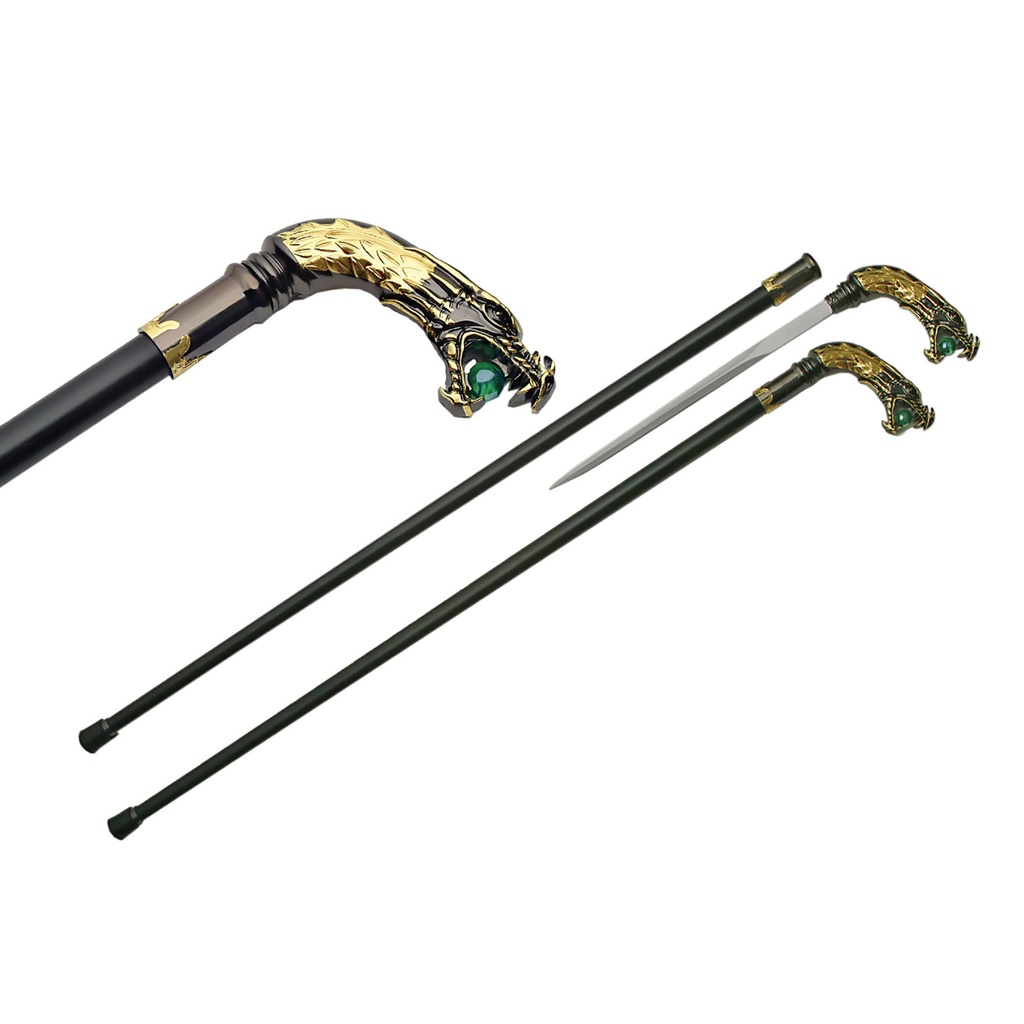
This isn’t a novelty stick; it’s a dragon-themed sword cane with presence. The Wyrmwatch Sentinel hides an 11.25" straight blade inside a 34" black shaft, locked beneath a detailed gold dragon head handle. Draw the blade from the dragon’s mouth and you’ve gone from walking prop to full fantasy display piece. For collectors, cosplayers, or anyone who appreciates mythical hardware with a concealed edge, this dragon sword cane earns its spot in the rack.
Dragon Sword Cane for Sale – Wyrmwatch Sentinel with Hidden Blade
The Wyrmwatch Sentinel Dragon Sword Cane is what happens when a fantasy artist and a prop weapons designer share the same napkin. At a glance, you’ve got a dramatic gold dragon head perched over a sleek black cane shaft. Look closer, and the real story shows up: an 11.25" hidden sword blade, drawn straight from the dragon’s mouth. This is a decorative sword cane built for display, costume work, and theatrical flair, not quiet minimalism.
Hidden Sword Cane with Dragon Handle – How This Piece Is Built
Mechanically, this is a straightforward sword cane, not a trick umbrella or collapsible staff. The 34" cane shaft houses a slim, straight, spear-like blade. The upper section with the dragon head unscrews or pulls free from the shaft, exposing the hidden blade. No springs, no automatic deployment, no OTF action here — just a fixed blade concealed in a rigid tube.
The dragon head itself is sculpted with clear fantasy intent: scales along the neck, defined snout, and a curved profile that doubles as a grip. The finish leans gold and black, with a green faux gem set where a dragon might be breathing fire. On the ground end, a rubber or plastic tip gives it some traction if you’re using it lightly as a prop cane on stage or at a convention.
Blade and Balance: What You’re Actually Holding
The blade is slim and straight, more spear-like than sabre, designed to fit cleanly inside the narrow cane shaft. It’s a decorative hidden sword, not a purpose-built cutting tool. The geometry favors ease of draw and re-sheathing over heavy-duty work. Balance is handle-forward because of the dragon head’s weight, which actually helps the theatrical feel — when you lift the cane, the dragon leads.
Handle Ergonomics: Dragon as Grip
That dragon head isn’t just a sculpture. The curve of the neck and head gives you a hook-like grip when walking or posing, and enough purchase to pull the blade free with a firm yank. The metal collar at the junction between handle and shaft reinforces the joint and visually separates the detailed top from the clean, black cane body.
Collector Appeal – Why This Dragon Cane Belongs in a Fantasy Display
This is a collector and costume piece first, and that’s where it shines. The gold-and-black dragon handle with the green gem reads like something lifted out of high fantasy art. Put it on a stand next to other decorative swords and it won’t disappear into the background; the dragon motif and the vertical cane form give it a very different silhouette from standard wall-hanger blades.
For fantasy fans, dragon imagery carries obvious weight: guardianship, power, and a sense of ancient hoard culture. The hidden sword cane format doubles down on the theme. It’s not just a dragon statue; it’s a dragon that literally guards a blade inside its own body. That kind of visual story is what separates a random decorative staff from a piece you actually talk about when guests are in the room.
Cosplay and Stage Use
As a prop, this dragon sword cane makes sense in any setting that needs a sorcerer’s focus, a noble’s walking staff with a secret, or a dragon cultist’s ceremonial piece. The long, black shaft gives you the posture and body language of a cane, while the dragon head instantly communicates character. Being able to draw a hidden sword from the dragon’s mouth is pure stage drama.
Important Note on Use and Legality
This is not an automatic knife, OTF, or switchblade. It is a decorative sword cane with a concealed fixed blade. That matters legally. In many jurisdictions, any concealed blade built into a cane, stick, or similar object can fall under specific weapons restrictions, regardless of whether it’s an automatic knife or a simple fixed blade.
Some areas treat sword canes as prohibited weapons outright, while others allow ownership but restrict carry in public. Even if you see this as a costume piece or display item, the law may classify it based on the concealed blade, not your intended use. Always check your local and state regulations before taking a sword cane like this outside your home, bringing it to events, or transporting it in a vehicle.
What Buyers Ask Before Purchasing an Automatic Knife
Are automatic knives legal?
On the federal level in the United States, automatic knives (often called switchblades in statutes) are regulated mainly by the Federal Switchblade Act. That law restricts interstate commerce and mailing of automatic knives under certain conditions, but it does not ban simple ownership nationwide. The real complications are at the state and local level. Each state can set its own rules on possession, carry, blade length, and whether automatic or switchblade-style knives are allowed at all.
Some states now allow automatic knife carry with few limits; others restrict them to law enforcement or keep older bans in place. City ordinances can add another layer. If you were buying an automatic knife for EDC, the move would be to check both state law and any major city rules you travel through, and to look specifically for phrases like "switchblade," "automatic knife," or "gravity knife" in the text. This sword cane, however, is a concealed fixed blade, not an automatic, so it would be evaluated under a different part of most weapon codes.
What's the difference between an automatic knife, OTF, and a switchblade?
In enthusiast language, an automatic knife is any knife where the blade opens by pressing a button, switch, or similar control in the handle, with spring or stored-energy assistance. A side-opening automatic snaps the blade out from the side, like a traditional folder, but under spring tension.
An OTF (out-the-front) automatic is a specific subtype where the blade travels linearly out the front of the handle. Many OTFs are double action: the same slider controls both deployment and retraction, with springs doing the work in both directions. Others are single action: the spring fires the blade out, but you manually reset it.
"Switchblade" is the term most laws use for automatic knives, especially side-openers, and sometimes OTFs. In legal text, "switchblade" and "automatic knife" are often interchangeable, but in the enthusiast world, people distinguish by mechanism: side-opening autos, OTFs, assisted openers, and so on.
This dragon sword cane is none of those. It’s a fixed-blade sword hidden inside a cane shaft, with no springs and no automatic deployment. You manually draw it free, just like unsheathing a sword.
What makes this sword cane worth buying?
From a collector’s perspective, the value is in the visual storytelling. The gold dragon handle with a green gem instantly reads as a guardian figure. The fact that the dragon conceals and releases the 11.25" hidden sword turns it from mere décor into an interactive piece. You’re not just looking at a dragon; you’re drawing steel from its mouth.
Compared to generic decorative canes or basic display swords, this piece offers a stronger theme, a more memorable silhouette, and a clear narrative you can explain in one sentence: "The dragon guards the blade until you call on it." If your collection leans fantasy, myth, or cosplay-ready hardware, that’s the kind of detail that earns shelf space.
For Collectors Who Like Their Fantasy Gear with a Hidden Edge
If you’re the kind of collector who prefers character in your hardware — dragons over plain knobs, blades with a story instead of anonymous wall-hangers — this dragon sword cane delivers. It’s a decorative concealed-blade cane built for display, convention floors, and themed rooms where fantasy isn’t just an afterthought. Add it to your lineup as the piece that proves you don’t just collect swords; you collect stories they look like they came from.