
Blackout Command Urban Chopper Fixed Blade Knife - Black Pakkawood
9 sold in last 24 hours
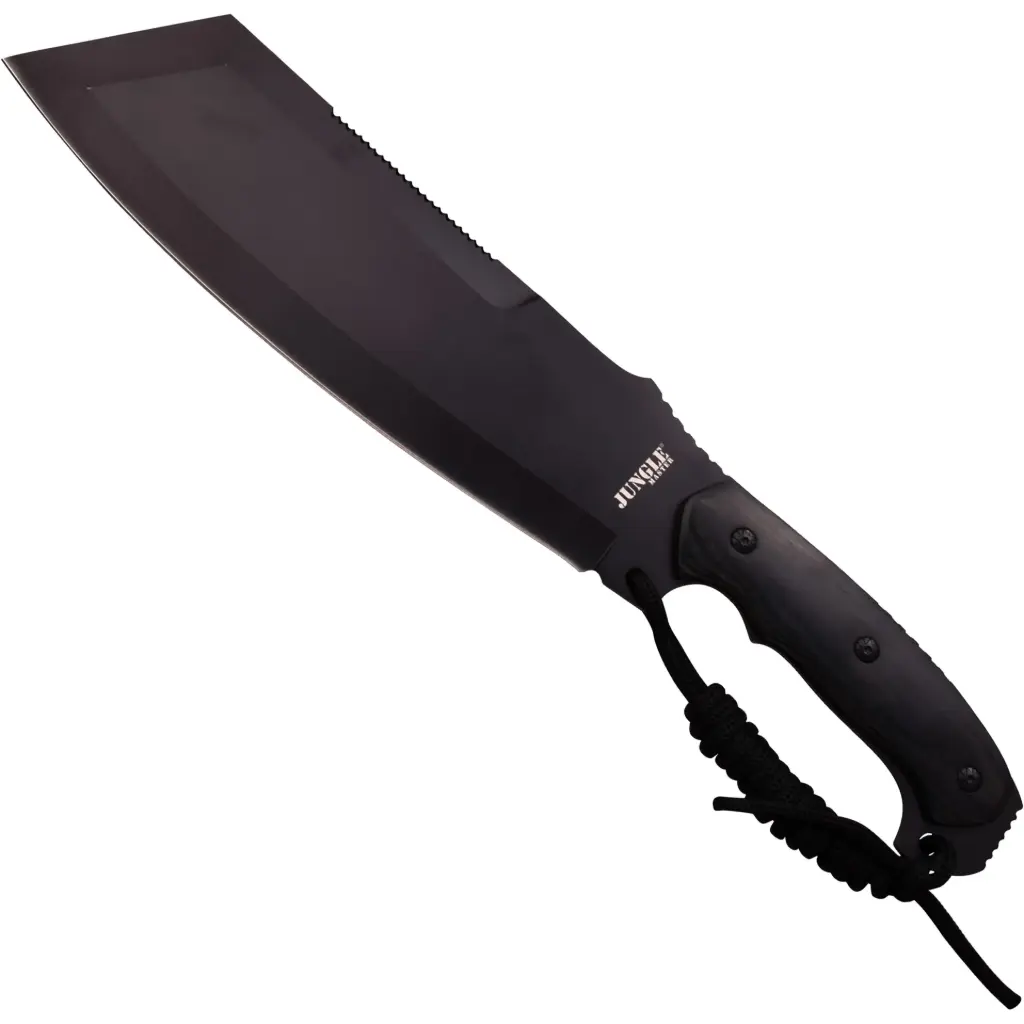
This isn’t a wall-hanger—it’s a blackout workhorse. The Blackout Command Urban Chopper Fixed Blade Knife pairs a 10-inch black stainless clip-point blade with a full-tang spine for serious chopping and penetration. Black pakkawood scales contour into finger grooves for a locked-in grip, while the glass-breaker pommel and lanyard-ready tang finish the duty-ready package. For the buyer who prefers a fixed blade over any automatic mechanism when the work gets ugly, this is the knife you reach for without thinking twice.
Blackout Command Tactical Fixed Blade Knife for Sale – Built Like It Means It
Some jobs don’t need a clever mechanism. They need steel, leverage, and a handle you can trust when your hands are wet, cold, or exhausted. The Blackout Command Urban Chopper Fixed Blade Knife - Black Pakkawood is exactly that: a full-tang tactical fixed blade that leans into brute mechanical reliability over moving parts.
In a world obsessed with every new automatic knife for sale, a serious fixed blade like this reminds you why solid steel from tip to pommel still owns the hardest work.
Why Choose This Over an Automatic Knife for Sale?
There’s a time for a fast-deploying automatic knife, and there’s a time for a long, blackout clip-point with a 10-inch blade and no hinges to fail. This knife is built for the second category: chopping, prying, batoning, and general abuse where a folding or automatic mechanism is the weak link.
The blade is black-finished stainless steel in a long clip-point profile, giving you three things at once: reach, a strong spine for lateral load, and a tip geometry that will actually penetrate instead of just looking aggressive in photos. At 0.1375 inches thick across a full tang, you’re dealing with a real spine, not a decorative strip of metal hidden inside a handle.
Full-Tang Construction: The Original “Fixed Mechanism”
With automatic knives, we talk endlessly about springs, buttons, and lock-up. On a hard-use fixed blade, the mechanism is simpler: uninterrupted steel. This Blackout Command runs full tang from the point of the clip to the glass-breaker pommel. That means the load path from tip to your hand is one continuous piece of metal.
In real terms, this buys you:
- Better control under heavy chopping or clearing work
- Far lower risk of catastrophic failure under twisting or prying
- Predictable behavior when batoning through wood or material
Clip-Point Geometry Tuned for Tactical Chopping
The blade on this knife isn’t a machete and it isn’t a small field knife—it’s sitting in that sweet spot where you get chopping leverage without sacrificing point control. The long, straight-dominant edge gives you usable bite for brush, saplings, and camp tasks, while the clipped tip gives you a controllable point for thrusts or detail cuts.
Jimping on the spine near the handle lets you choke up and drive your thumb for controlled push cuts, instead of skating off smooth steel when you try to do real work.
Mechanics, Steel, and Handle: The Real Story Behind This Fixed Blade Knife
Serious buyers don’t care about marketing adjectives; they care about how the steel, grind, and handle come together in the hand. This tactical fixed blade isn’t pretending to be a high-end custom, but it’s built with the things that matter when the job gets ugly.
Black Stainless Steel Blade: Coating with a Purpose
The black stainless blade brings basic corrosion resistance and low-reflection presence—important if you actually use your gear outdoors or in urban environments where flashing bright steel is a liability. While the exact steel grade isn’t listed, this class of black-coated stainless is typically optimized for easy field sharpening and reasonable toughness, not fragile, high-hardness edge queens that chip when you look at them wrong.
In other words: you can knock the edge back into line with a simple field stone or pull-through sharpener and get back to work.
Black Pakkawood Handle: Classic Material, Tactical Execution
Pakkawood has been around long enough that most collectors have at least one blade in it—wood stabilized with resin so it behaves more like a composite than a natural stick. On this knife, the black pakkawood scales are contoured with finger grooves, giving you a forward index lock and a palm swell that bites into the hand without hotspots.
Two visible fasteners secure the scales to the full tang, leaving an exposed steel pommel that transitions into the glass-breaker point. The result is a grip that feels more like a purpose-built tool than a decorative handle.
Glass-Breaker Pommel and Lanyard: Details for Real Use
The pommel ends in a pointed glass breaker—more than a style cue, it’s a legitimate impact point for emergency egress or striking. Paired with the paracord lanyard, you can lock this knife into your hand during heavy swings or when working over water or rough terrain where dropping your blade isn’t an option.
A nylon sheath rounds out the package, giving you basic belt or kit carry so the blade is where you need it without improvising a carry system on day one.
Fixed Blade vs Automatic Knife: Where This Blade Belongs in Your Kit
If you already own an automatic knife for EDC, this Blackout Command sits one tier up in the use hierarchy. The auto or OTF rides in your pocket for quick access cutting—boxes, straps, emergency seat belts. This fixed blade lives on your belt or pack when you know you’ll be dealing with wood, brush, or anything that needs chopping force rather than finesse.
Collectors who appreciate double-action automatic knives and OTF switchblades usually keep at least one blackout fixed blade around for the simple reason that no spring, coil, or button can match a full-length tang under impact load. This knife fills that role without pretending to be something it isn’t.
What Buyers Ask Before Purchasing an Automatic Knife
Are automatic knives legal?
In the United States, automatic knife legality is a mix of federal transport rules and very specific state and local laws. Federally, automatic knives (often called switchblades) are regulated mainly in interstate commerce—you generally can’t ship them across state lines to consumers unless certain exemptions apply. State laws vary widely: some states now allow automatic knives and OTF knives for everyday carry, others restrict blade length, opening mechanism, or who can carry them, and a few still ban them outright.
This Blackout Command is a fixed blade, not an automatic knife, OTF, or switchblade, so it’s regulated under your jurisdiction’s fixed-blade and carry-length rules instead of automatic knife statutes. Before you buy any automatic knife for sale—or carry a fixed blade like this—check your state and local laws regarding blade length, open carry vs concealed carry, and location-based restrictions (schools, government buildings, etc.). When in doubt, consult current statutes or a qualified legal source; knife law blogs go out of date faster than people think.
What’s the difference between an automatic knife, OTF, and a switchblade?
These terms get abused constantly, so let’s be precise:
- Automatic knife: A folding or OTF knife that opens by pressing a button, switch, or similar control. The blade is under spring tension and deploys automatically once released.
- OTF knife (Out-The-Front): A specific type of automatic where the blade travels linearly out the front of the handle rather than pivoting from the side. Double-action OTF knives both deploy and retract via the same control.
- Switchblade: In U.S. legal language, this is essentially the same as an automatic knife—any knife that opens automatically with a button or similar device in the handle.
The Blackout Command here is none of those. It’s a fixed blade: the cutting edge is permanently exposed, with no folding joint, spring, or automatic deployment mechanism. That’s why it’s the right call when you want strength over speed.
What makes this fixed blade worth buying?
Mechanically, you’re getting a full-tang blackout blade with a real chopping length, a clip-point geometry that balances reach with tip control, and a handle layout that makes sense when you’re actually swinging it. The glass-breaker pommel and lanyard-ready tang give you legitimate tactical and emergency capability, not just catalog fluff.
For the collector or enthusiast who already owns their favorite automatic knife for EDC, this piece earns its slot as the dedicated hard-use fixed blade: the knife you reach for when a spring-loaded folder is clearly the wrong tool. It’s not trying to be a safe-queen custom—it’s the blackout work knife that takes the punishment your automatics shouldn’t.
Own It Because You Understand the Difference
Anyone can impulse-buy an automatic knife for sale because a button and a snap caught their eye. The Blackout Command Urban Chopper Fixed Blade Knife - Black Pakkawood is for the buyer who’s past that stage—who knows exactly why a full-tang fixed blade belongs beside their favorite OTF or switchblade in the kit.
If you’re building a lineup that respects mechanics—automatic deployment in the pocket, solid steel on the belt—this blackout fixed blade is the part of the system that doesn’t flinch when the work turns rough.
| Blade Length (inches) | 10 |
| Blade Color | Black |
| Blade Finish | Black |
| Blade Style | Clip Point |
| Blade Edge | Plain |
| Blade Material | Stainless Steel |
| Handle Material | Pakkawood |
| Theme | None |
| Spine Thickness (inches) | 0.1375 |
| Sheath/Holster | Nylon |