Brushline Compact Loadout Tactical Backpack - Woodland Camo
14 sold in last 24 hours
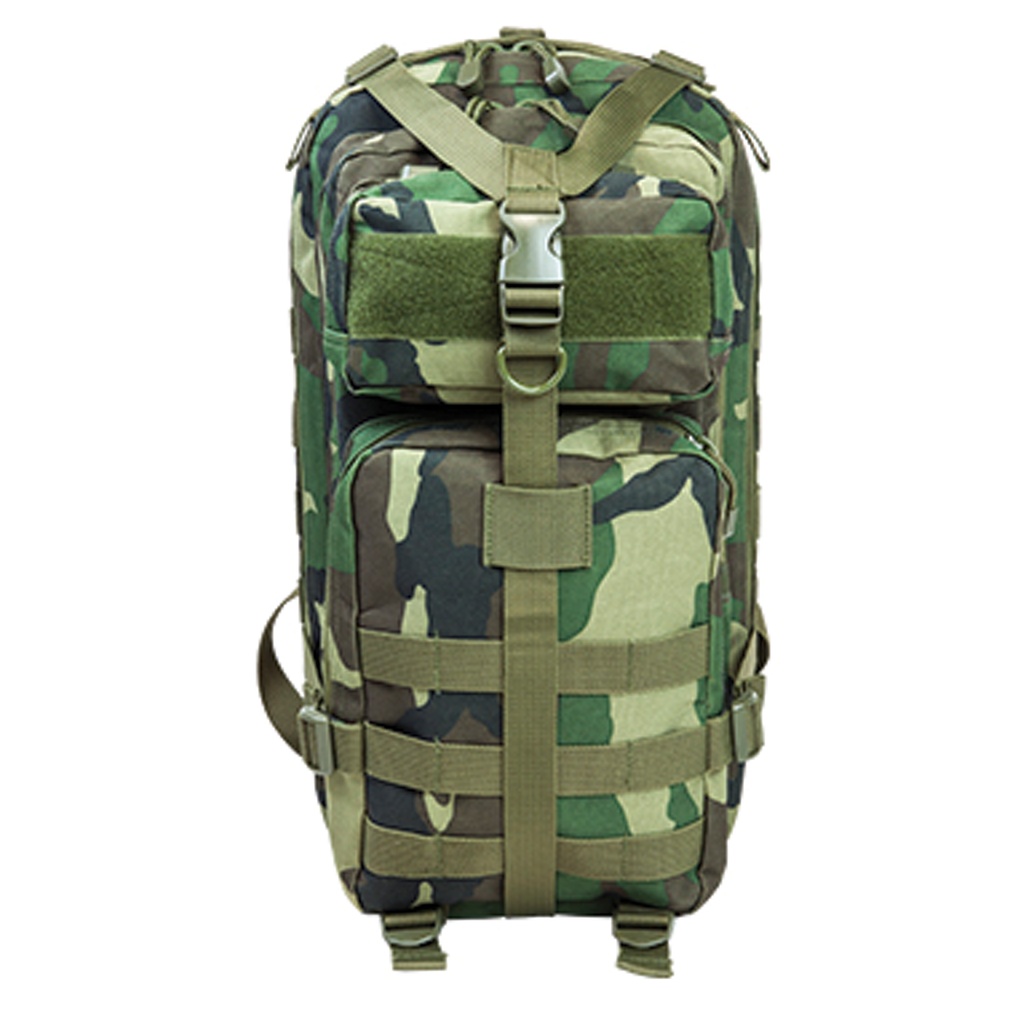
Built for real-load carry, the Brushline Compact Loadout Tactical Backpack in woodland camo keeps your essentials tight, organized, and ready. A 669 cu. in. main compartment, 330 cu. in. middle with admin layout, and quick-access front pockets handle range or trail gear without bulk. MOLLE webbing on the front and sides scales the pack for different missions, while a padded hydration bladder sleeve rides clean against your back. It’s a small tactical backpack that wears light but works like a full-size rig.
Brushline Compact Loadout Tactical Backpack - Woodland Camo
Some packs are fashion pieces. This one is a compact loadout tool. The Brushline Compact Loadout Tactical Backpack in woodland camo is built for people who actually haul gear — to the range, into the woods, through airports, or across town. It’s small on purpose, modular by design, and tuned around real-world carry, not catalog photography.
Why This Small Tactical Backpack Works Harder Than Its Size
This isn’t a big ruck pretending to be “tactical.” It’s a legitimately small tactical backpack tuned around three realities: limited footprint, hard use, and modular expansion. The 669 cu. in. main compartment gives you enough room for a stripped-down day load — rain shell, ammo, headphones, a packed IFAK, or camera kit — without turning into a sagging, overstuffed blob.
In front of that, a 330 cu. in. middle compartment with admin organization breaks out the smaller gear: notebooks, tools, multi-tool, chargers, and small range fixtures. Up front, dual quick-access pockets handle the things you touch constantly: gloves, ear pro, snacks, flashlight, or keys. The layout keeps weight tight to the spine instead of dragging you backward.
Modular Carry for Serious Users, Not Gear Cosplay
What makes this backpack "tactical" isn’t just the woodland camo pattern — it’s the modular thinking behind it. Full rows of MOLLE webbing across the front and sides turn this into a customizable platform. Need more medical capacity for the range? Lace on a med pouch. Running it as a trail pack? Add a bottle pouch or small utility pocket. Urban EDC? Clip on a slim admin panel and keep the profile tight.
The compression straps help lock the load down so the pack doesn’t balloon when you add gear. Cinch it flat for daily carry, loosen it up when you’re stuffing it for a long loop. The central vertical strap and buckle give you a quick way to pull the front of the pack tight, stabilizing the contents when you move at speed or climb.
Hydration Compartment That Actually Rides Right
A padded hydration bladder sleeve lives against the back panel, where it belongs. That means your water weight sits close to the body, improving balance and reducing fatigue. It also keeps a full bladder from printing awkwardly through the front of the pack. The padding between your back and the bladder does double duty for comfort and insulation, helping keep the water from warming up against your body heat too quickly.
Organization That Makes Sense in the Field
Inside, the layout is straightforward — not a maze of gimmick pockets. The main compartment takes bulk items; the middle admin area controls tools, pens, notepads, and small electronics. The quick-access front pockets are where you stage your grab-first gear. It’s a simple hierarchy that works in low light, under pressure, and when you’re tired. You don’t have to think about where you put your gear; your hands just go there.
Field-Bred Woodland Camo for Range, Trail, and EDC
Woodland camo has been proven in the real world for decades. On this small tactical backpack, it does more than look the part. In the woods, it breaks up the pack’s silhouette against trees, brush, and dirt. On the range, it blends in with the rest of your kit rather than screaming for attention. In town, it reads as serious gear, not streetwear.
The subdued webbing, hardware, and zipper pulls stay within that palette — greens, browns, blacks, and tans — so you’re not flashing reflective plastic or bright color pops every time you move. It’s a visual language that appeals to shooters, hunters, and preparedness folks who want their gear to work first and get noticed never.
Carry Reality: How This Small Tactical Backpack Wears All Day
The compact rectangular profile keeps the pack high and tight on the back instead of dropping into the lower lumbar like an overloaded school bag. Dual adjustable shoulder straps let you dial in the ride height so the load rides centered on the shoulder blades rather than hanging off them.
The padded back panel spreads the pressure across a larger area, which matters more as you use the MOLLE and push the capacity. A reinforced top grab handle lets you move the pack quickly between vehicle, bench, and ground, or hang it from a rack at the range or in the garage.
Small, But Still a Legitimate Loadout Pack
“Small” here doesn’t mean decorative. It means purpose-built for pared-down missions. Think half-day range session, scouting hike, hunting stand approach, or stripped-down travel carry when you don’t want to check luggage. You still get layered storage, hydration support, MOLLE expansion, and compression — just without the weight and bulk tax of a full-size ruck.
What Buyers Ask Before Purchasing an Automatic Knife
Are automatic knives legal?
Under U.S. federal law, automatic knives (including side-opening automatics and OTF designs) are regulated primarily by the Federal Switchblade Act, which restricts interstate commerce but does not outright ban ownership. Actual legality comes down to your state and sometimes city or county. Some states allow automatic knives with few restrictions, others limit blade length or carry method, and a few still prohibit them. Before you buy or carry an automatic knife, check current state and local laws — don’t rely on hearsay, and understand that "legal to own" and "legal to carry" are not always the same thing.
What's the difference between an automatic knife, OTF, and a switchblade?
“Automatic knife” is the broad category: any knife where a spring-driven blade deploys from a closed position when you deliberately activate a button, switch, or lever. A “switchblade” is the older cultural term often used interchangeably, but enthusiasts and makers tend to stick with “automatic knife.”
OTF — out-the-front — is a specific subtype of automatic knife where the blade travels linearly out of the front of the handle. Side-opening automatics pivot the blade out from the side, like a standard folder that’s spring-driven. Both are automatic knives; OTF just defines the direction of deployment. In serious circles, using the right term signals you actually know what you’re talking about.
What makes this automatic knife worth buying?
When you choose an automatic knife, you’re not just buying a blade — you’re buying a mechanism. The good ones combine reliable spring tension, precise lockup, and consistent deployment geometry so the knife fires hard, seats fully, and stays locked without blade play. Steel choice matters too: edge retention, toughness, and corrosion resistance all have to match the use case. A worthwhile automatic knife brings all of that together in a package that carries comfortably, deploys predictably, and holds up to real-world cutting instead of just desk drawer flips.
Where This Small Tactical Backpack Fits in a Serious Kit
If you’re the kind of buyer who cares about the difference between an automatic knife, an OTF, and a generic “switchblade,” you already know gear either earns its place or it doesn’t. The Brushline Compact Loadout Tactical Backpack is built to earn it — as your range companion, your stripped-down trail rig, or your urban EDC backbone.
It’s modular without being ridiculous, compact without being useless, and purpose-first in a way that matches the rest of a serious loadout: knife, light, med, and a pack that keeps it all where you put it. For the buyer who chooses tools on performance, not marketing, this small tactical backpack fits right into a kit built around real use.