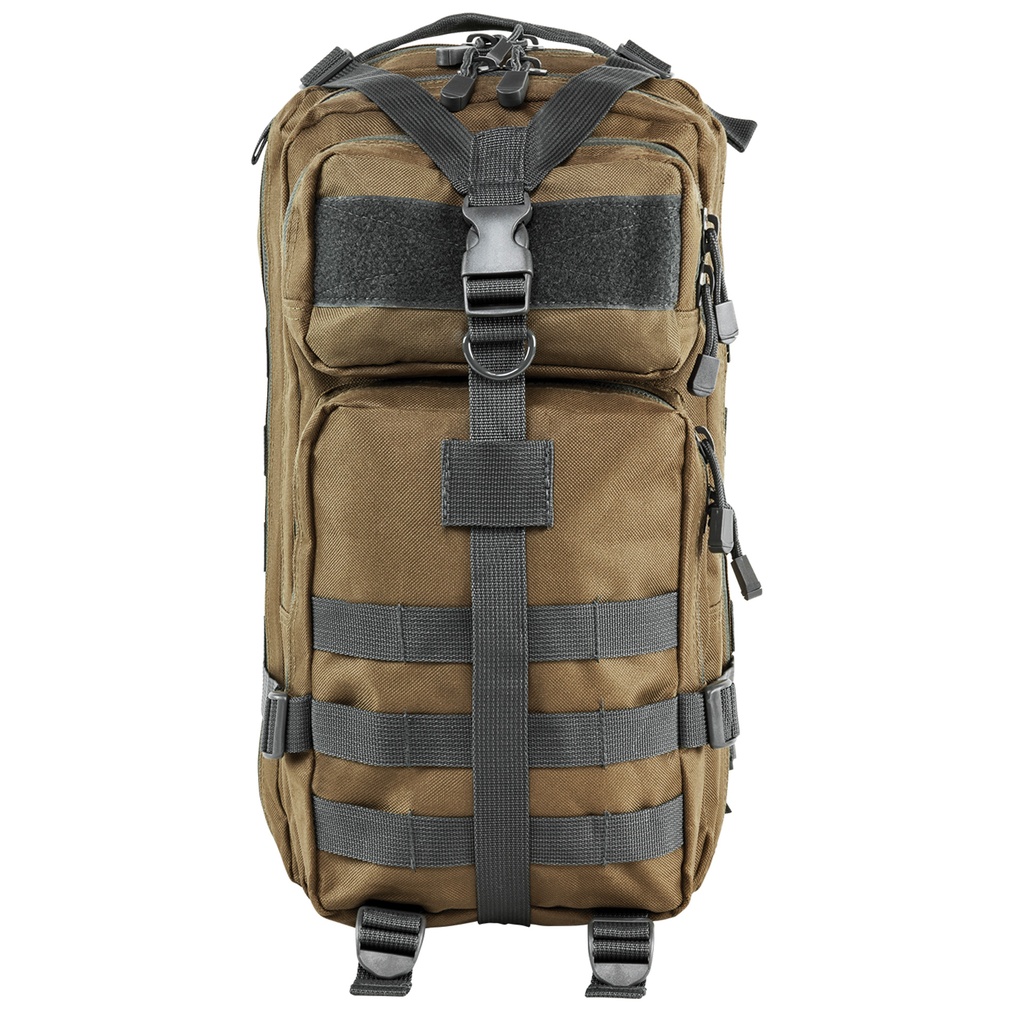
City Recon Compression-Load Tactical Backpack - Tan & Urban Gray
14 sold in last 24 hours
Built for urban recon and off-grid detours, the City Recon Compression-Load Tactical Backpack locks your EDC down without bulk. Top, side, and bottom compression straps cinch the load tight, MOLLE-style webbing and lash points add expansion, and a rugged nylon shell shrugs off hard use. With an adjustable sternum strap and waist belt for stable carry, this compact tactical pack stays quiet, organized, and ready whether you’re running city blocks or trail miles.
City Recon Compression-Load Tactical Backpack – Built for Real-World Carry
The City Recon Compression-Load Tactical Backpack - Tan & Urban Gray is what happens when you treat a small daypack like serious gear, not a giveaway bag. Compact footprint, tactical layout, and compression from every angle so your load rides tight whether you’re weaving through commuters or dropping into a trailhead after work.
Why This Tactical Backpack Earns a Spot in Your Daily Rotation
This isn’t a fashion pack with MOLLE stitched on as decoration. The City Recon is a true compression-load tactical backpack with a structured body, multiple anchor points, and a layout that respects how people who carry every day actually move.
Top, side, and bottom compression straps let you tune the profile to the load. Cinch it flat when you’re running light, or relax the straps to swallow a jacket, tablet, and field kit. The front webbing grid and bottom loops give you options: carabiners, light pouches, or a bedroll lashed under the pack. It’s built for people who think in attachment points, not just pockets.
Load Management and Organization That Don’t Fight You
The spine of this tactical backpack is simple: keep the weight close, keep access clean, and don’t waste space on gimmicks. Two front zip compartments stack vertically for quick-grab gear—chargers, notepad, gloves, or a compact med kit. Behind them, the main compartment opens with dual heavy-duty zippers and paracord-style pulls that are easy to work with gloved or wet hands.
Inside, multiple internal pockets separate your essentials so you’re not elbow-deep hunting for that one tool that always sinks to the bottom in lesser packs. The rectangular patch panel on the upper front pocket isn’t just cosplay; it’s a proper loop field ready for ID, unit, or morale patches so you can mark this bag as yours at a glance.
Compression System: Why It Carries Better Than a Standard Daypack
Most small backpacks sag and swing once they’re under half load. This tactical pack fixes that with a three-axis compression system. The central vertical strap pulls the front panel into the body, squeezing out dead space. Dual side straps clamp the load toward your spine, improving balance when you’re moving fast or ducking through crowds. Bottom webbing lets you lash gear low while still keeping the center of gravity tight.
The result is a backpack that doesn’t slop around when you have to sprint for a train, cut across a parking lot, or scramble up a short, steep trail. It rides like a properly tuned rig, not a soft sack of shifting weight.
Carry Geometry: Sternum Strap, Waist Belt, and Real-World Comfort
Comfort on a tactical backpack isn’t just about padding; it’s about control. The adjustable sternum strap locks the shoulder straps into a stable triangle across your chest, reducing fatigue and keeping the pack centered when you twist or lean. The waist belt takes some of that weight off your shoulders and anchors the load to your hips, especially useful when the pack is fully stuffed or you’re moving over rough ground.
Combined, these elements give this small EDC backpack a carry profile more like a technical daypack—secure, predictable, and comfortable for long days.
Built to Take Abuse: Materials and Hardware That Actually Hold Up
The City Recon is cut from rugged nylon in a tan and urban gray palette that looks at home on city concrete and dusty trail alike. Nylon’s abrasion resistance means it tolerates being dragged under train seats, dropped on gravel, and scraped along brick without disintegrating after a month of use.
Heavy-duty zippers with paracord-style pulls are the mechanical heart of this pack’s reliability. Zippers are the failure point on cheap bags; here, they’re reinforced and sized appropriately for a tactical role. Box-stitched reinforcement at stress points—strap junctions, grab handle, and compression attachment—keeps the structure intact when the pack is fully loaded or yanked hard by the top handle.
EDC-Focused Tactical Backpack for Urban and Trail Use
This backpack is sized in the sweet spot: small enough to stay tight to the body in crowded environments, big enough to carry a day’s worth of urban EDC or trail essentials. Think water, outer layer, compact toolkit, notebook, first-aid basics, and tech—all organized instead of piled together.
The tan and gray colorway stays discreet. It doesn’t scream high-vis hiker or neon commuter, but it clearly speaks the language of tactical and preparedness gear to the people who recognize those cues—MOLLE-style webbing, patch panel, compression layout, and structured body.
What Buyers Ask Before Purchasing an Automatic Knife
Most of our regulars are here for an automatic knife for sale, browsing OTF options, side-opening autos, and classic switchblade patterns. They also need a pack that can carry that gear—quietly and efficiently. So let’s tackle the questions that come up constantly when someone is shopping automatics and building out their kit.
Are automatic knives legal?
Under U.S. federal law, automatic knives (including many patterns people casually call switchblades) are regulated mainly in terms of interstate commerce and certain federal property. Federal law doesn’t outright ban ownership, but it restricts how automatic knives can be shipped and where they can be carried—especially on federal facilities and across some state lines.
The real deciding factor is state and local law. Some states allow automatic knives for everyday carry with blade length limits; others restrict them to law enforcement, military, or specific professional use. A few still ban possession entirely. Before you buy automatic knife models online or add an OTF to your EDC loadout, you need to check your own state statutes and, ideally, city or county ordinances. The short version: buying is usually possible; carrying is where the rules get particular.
What’s the difference between an automatic knife, OTF, and a switchblade?
In enthusiast terms, “automatic knife” is the umbrella: you press a button, slide a switch, or actuate a release, and spring tension snaps the blade open without you having to manually rotate it. A side-opening automatic pivots like a standard folding knife but uses a spring to complete the opening.
OTF (out-the-front) knives are a specific type of automatic knife where the blade travels linearly out of the handle. Many modern OTF knives are double-action: the same control both deploys and retracts the blade using spring and track mechanisms. “Switchblade” is the older, popular term that the law still uses, but in the modern enthusiast market it’s more slang than a precise mechanical description. When we list an automatic knife for sale, we call out whether it’s side-opening or OTF, and whether it’s single-action or double-action, because the mechanism matters.
What makes this automatic knife worth buying?
When you buy automatic knife hardware from a serious dealer, you’re paying for more than the drama of the snap. You’re buying tuned spring tension that won’t misfire, blade steel that holds an edge instead of folding over, and lock geometry that doesn’t loosen into dangerous play after a month of real use. A worthwhile automatic balances deployment speed with control, uses proven steels and heat treat for edge retention, and offers a secure lockup you can trust when your hand is behind the blade under load. That’s the difference between a disposable novelty switchblade and a proper automatic built for EDC and collection.
Why the City Recon Backpack Belongs Next to Your Automatic Knives
If you’re the kind of buyer who reads pivot specs and spring geometry before you buy automatic knife models, you already understand why this tactical backpack is built the way it is. The compression system is tuned, not decorative. The MOLLE-style webbing and patch panel are functional, not cosplay. The materials are chosen to survive being part of a real kit, not a weekend prop.
Add it to the same universe as your OTF and automatic knives for sale: a compact, urban-ready tactical backpack that carries your gear tight, organized, and under control. It’s not loud, it’s not trying too hard—it just works, day after day, the way properly designed equipment should.