Carbon Veil Karambit Comb Knife - Carbon Fiber
9 sold in last 24 hours
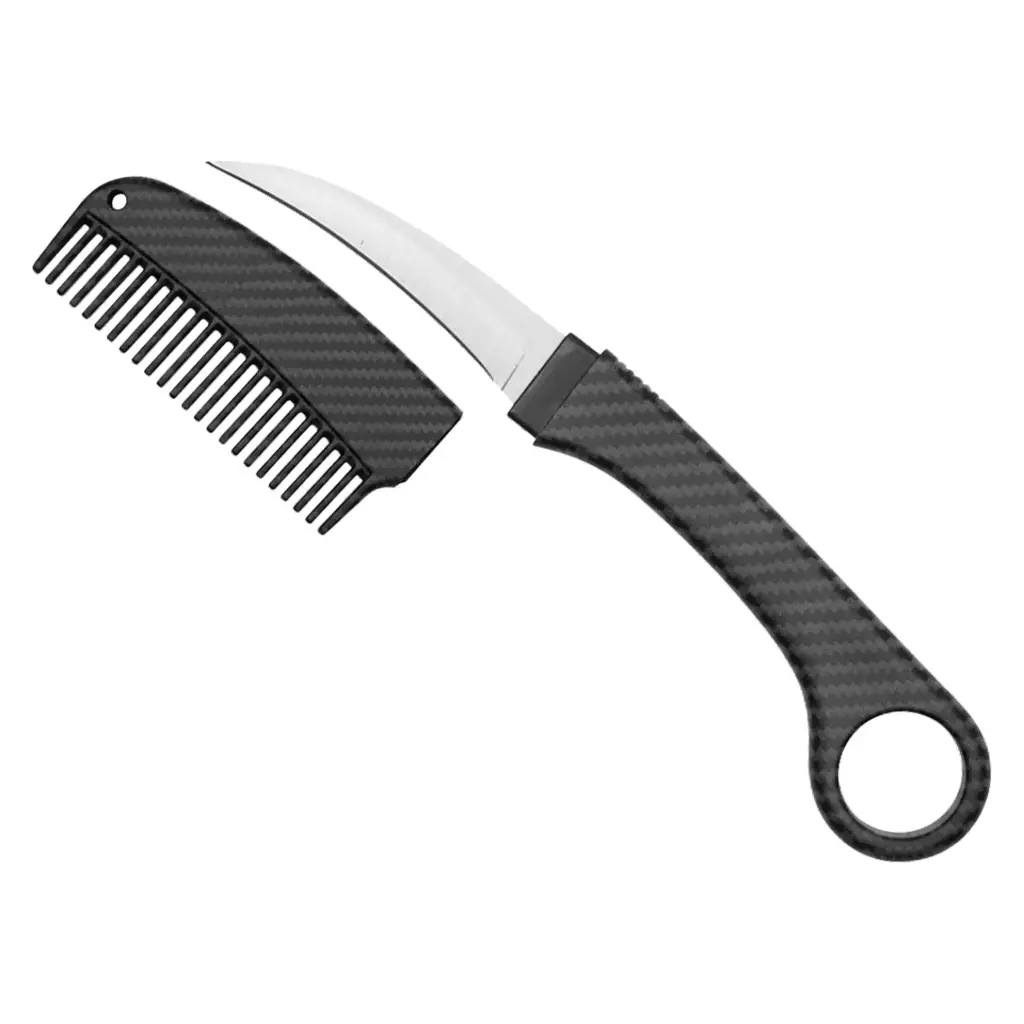
An automatic knife for sale doesn’t always need a button to disappear—it needs a believable disguise. This Carbon Veil Karambit Comb Knife hides a fixed hawkbill blade behind a carbon-weave comb sheath, then locks into your hand with a karambit ring for brutal control. No springs, no folders, just a straight fixed edge that goes from pocket-grooming to hard utility in one motion. It’s the kind of covert tool serious EDC users add when they’re done playing with obvious blades.
Why this disguised comb knife earns real pocket time
Some tools brag. Others just work. This Carbon Veil Karambit Comb Knife sits firmly in the second camp. It looks like a normal carbon weave comb until you slip the sheath free and reveal a fixed hawkbill blade with a karambit-style ring. No tacticool theatrics, just a low-profile, ringed edge that hides in plain sight until you actually need it.
At 7.5 inches overall with a 3-inch silver hawkbill and a featherlight 1.16 oz weight, it carries like grooming gear and cuts like a purpose-built utility claw. If you live in the world of EDC, concealed tools, and clever blades, this is the kind of piece that doesn’t replace your main knife—it fills the gap your obvious knife can’t.
Hidden control: a karambit-style comb knife with real intent
Forget novelty combs that happen to have a blade. This is a ringed, hawkbill fixed blade that happens to ride inside a comb. The hand already trusts the shape; the mind reads it as everyday grooming. That deception is the point.
The carbon fiber pattern handle and comb sheath give the whole package a modern, tech-forward look, but the real story is in the geometry. The curve of the hawkbill is tuned for controlled pulls—think cord, tape, straps, packaging—while the finger ring at the rear locks your grip in. You get the indexing and retention of a karambit without the visual red flags of a dedicated fighting knife.
Hawkbill geometry that actually earns its keep
A good hawkbill isn’t just a curved edge for show. The inside curve lets the material stay engaged with the edge through the entire cut, which is exactly what you want for pull cuts and close, controlled work. On this comb knife, that means:
- Better purchase on slick materials like strapping and heavy tape
- Less slipping off rounded objects or tight spaces
- More control in short, snappy utility cuts
Paired with the ring, you can drive the cut with the whole structure of your hand, not just fingertip pinch strength. That advantage stands out the first time your hands are wet, cold, or gloved.
Ring retention: why the karambit influence matters
The ring isn’t a gimmick—it’s the mechanical anchor. Slide a finger through and the knife stays indexed, even if your grip gets jostled. That matters for two reasons:
- Retention under stress: The blade stays seated in your hand instead of twisting or ejecting if you bump into something or get pulled off-line.
- Instant orientation: Even if you draw it blind from a pocket or kit, the ring tells you exactly where the edge is facing.
Plenty of ringed knives look the part. This one earns it by pairing the ring with a hawkbill profile that actually benefits from being pulled along a cut path.
Comb knife mechanics: fixed blade simplicity, disguised carry
This isn’t an automatic knife, OTF, or switchblade. Mechanically, it’s a fixed blade concealed inside a detachable comb sheath. That design choice matters more than any spring-loaded trick.
When the sheath is on, the package reads as a regular comb—teeth, profile, and length all signal grooming tool. When it’s time to work, the sequence is stupidly simple:
- Draw the comb from pocket or pouch
- Pop the comb sheath off
- Ring in, edge forward, cut
No locks to fail, no deployment timing to fumble, no button that might misfire in a tight pocket. You trade flashy action for reliability and disguise, which is exactly the point of a serious hidden knife.
Why some enthusiasts prefer disguised fixed blades over autos
Automatic knives, OTFs, and classic switchblades are addictive, but they share a weakness: everyone knows what they are the second they see them. A comb knife like this attacks the problem differently:
- Zero moving parts in the blade: Fixed geometry equals consistent performance.
- Faster from hand to cut in close quarters: No need to find a button or thumb stud.
- Visually deniable: Until the sheath comes off, it’s just a comb to casual observers.
If you already own your fair share of autos and OTFs, this is the piece that rounds out the "covert" side of the kit.
Discreet EDC: when a comb knife beats a pocket knife
A standard folding knife broadcasts intent the moment the clip peeks over your pocket. There are days that’s fine—and days it’s not. This comb knife is built for the latter.
At roughly 4.5 inches in its sheathed comb form and only 1.16 oz, it rides light in a pocket, bag, or organizer. No clip. No tactical silhouette. Just a comb profile with a carbon weave finish that doesn’t draw eyes. For EDC enthusiasts, that opens up carry options in environments where an obvious blade might invite questions you don’t feel like answering.
Is it your only cutting tool? Probably not. But when disguise matters more than flick speed, this is the one that quietly takes the job.
What Buyers Ask Before Purchasing an Automatic Knife
Are automatic knives legal?
In the U.S., federal law (the Switchblade Knife Act) mainly controls interstate commerce in automatic knives and traditional switchblades—knives where the blade opens automatically by button, spring, or similar mechanism. Actual carry laws are state and local, and they vary wildly: some states allow automatic knives and OTFs with few limits; others ban possession, concealment, or certain blade lengths.
This comb knife is a fixed blade disguised as a comb, not an automatic knife or switchblade under the usual legal definitions. That said, many jurisdictions still treat it as a concealed weapon because the blade is hidden inside an everyday object. Before you carry it, you need to:
- Check your state and local statutes on concealed knives and disguised weapons
- Pay attention to blade length and intent language in those laws
- When in doubt, limit carry to private property and transport it stored, not worn
Nothing here is legal advice, and laws change—serious buyers check current regulations where they live.
What's the difference between an automatic knife, OTF, and a switchblade?
Enthusiasts tend to be precise about these terms:
- Automatic knife: Any knife where a spring-driven blade deploys from the closed position using a button, lever, or concealed actuator. Many side-opening autos fall here.
- OTF (out-the-front) knife: A specific type of automatic where the blade travels out the front of the handle. Usually double-action (both deploy and retract via the slider) or single-action (spring deploy, manual reset).
- Switchblade: Legally, often used as the umbrella term for automatic knives; historically, it refers to traditional button-operated autos.
This comb knife is none of those. It’s a fixed blade housed in a comb-shaped sheath. No spring, no button, no auto mechanism. The “action” is you removing the sheath and indexing the ring—more akin to drawing a small fixed blade than firing an automatic.
What makes this comb knife worth buying?
For a serious buyer, a hidden knife has to be more than a gimmick. This one delivers on three fronts:
- Purpose-built geometry: Hawkbill curve plus ring retention is a proven combo for controlled, high-tension cuts.
- Legit disguise: The comb sheath doesn’t just nod at grooming—it convincingly passes visual inspection in most casual contexts.
- Fixed simplicity: No auto mechanism to wear, no pivot to loosen, no lock to second-guess. Just a straight, stable edge.
If your kit already has automatic knives, OTF blades, and classic folders covered, this is the stealth utility slot you probably haven’t filled yet.
Collector appeal: where this hidden comb knife fits in your lineup
Collectors who haunt knife shows and forums tend to appreciate pieces that do something different without slipping into toy territory. This Carbon Veil Karambit Comb Knife threads that needle nicely.
It’s a credible disguised fixed blade with recognizable design references (karambit ring, hawkbill profile, carbon weave aesthetic) that still stands on its own instead of cosplaying as something else. On a table next to your automatic knives, OTFs, and traditional switchblades, it becomes the conversation piece that doesn’t need “for the price” as a qualifier.
More importantly, it’s the kind of knife you’ll actually carry and test, rather than leaving sealed in a case. That’s usually how a tool earns long-term respect—by surviving the pocket, not just the display.
Carry it because it works, not because it shouts
In a world of loud autos and showpiece switchblades, this comb knife plays a quieter game. It hides a functional hawkbill behind a believable comb, locks into your hand with a karambit ring, and skips the mechanical drama for fixed-blade dependability. For the enthusiast who already owns the flashy automatic knife for sale and wants something smarter, subtler, and more deceptive, this is the logical next step.
You’re not buying a toy. You’re adding a purpose-built, disguised fixed blade to a kit that already understands the difference between mechanism and marketing.
| Blade Length (inches) | 3 |
| Overall Length (inches) | 7.5 |
| Closed Length (inches) | 4.5 |
| Weight (oz.) | 1.16 |
| Blade Color | Silver |
| Handle Finish | Carbon Fiber |
| Concealed Length (inches) | 4.5 |
| Concealment Type | Comb |