Nebula Veil Karambit Comb Knife - Galaxy Purple
9 sold in last 24 hours
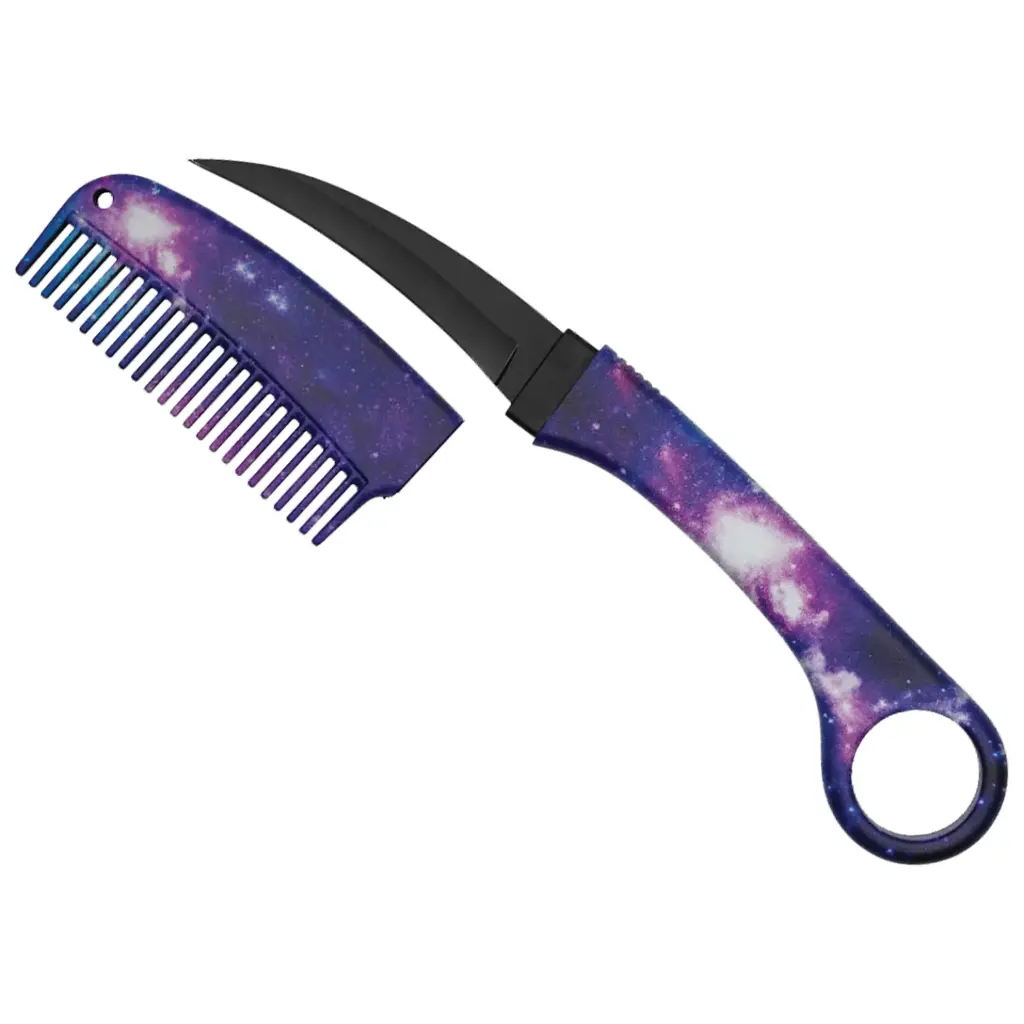
An automatic knife for sale doesn’t always look like a knife. This Nebula Veil karambit comb hides a fixed hawkbill blade under a functional galaxy‑print cover—no flipper, no giveaway hardware. Slide the comb free and the finger ring locks your grip, delivering instinctive karambit control in a tool that passes as grooming gear. For the collector who respects clever concealment and real cutting geometry, this is the discreet piece you choose on purpose, not as a novelty.
Automatic Knives for Sale Usually Announce Themselves. This One Doesn’t.
Scroll through any page of automatic knives for sale and you’ll see the same tells: button cutouts, scale breaks, hardware clusters that scream “mechanism lives here.” The Nebula Veil Karambit Comb Knife - Galaxy Purple is the opposite approach. It’s built for the buyer who knows blades, understands geometry, but wants a tool that reads as nothing more than a glossy galaxy comb until it’s time to work.
What you’re looking at is a disguised fixed blade in comb clothing: a 3-inch black hawkbill anchored to a finger ring, carried at 4.5 inches concealed and just 1.16 oz. It’s not an automatic knife in the mechanical sense—no spring, no button—but it absolutely competes for the same real estate in an enthusiast’s EDC rotation: fast access, controlled edge, and a profile that doesn’t invite questions.
Choosing This Over Another Automatic Knife for Sale
When you buy an automatic knife, you’re usually trading thickness and visible hardware for push-button deployment. With this comb knife, you trade the theatrics for something different: social invisibility. Closed, it’s a functional fine‑tooth comb with a galaxy‑purple finish that looks more like a convention pickup than a defensive tool. There’s no scale split, no firing button, nothing that trips the “knife” alarm in a casual glance.
Deployment is brutally simple: grip the comb cover, slide it off, and the hawkbill blade is live. No springs to gum up, no coil to fatigue, no timing to tune. In the time someone else is trying to clear a pocket clip and find a button on a new automatic knife for sale, you’ve already seated your finger ring and indexed the curve of the blade.
Mechanics That Matter: Hawkbill Geometry and Karambit Control
This isn’t a prop. The core of the design is a fixed hawkbill blade with a karambit‑style ring—two details that serious knife buyers recognize immediately.
Why the Hawkbill Works in the Real World
A hawkbill edge doesn’t push through material, it pulls. That inward curve bites and stays engaged, which is what you want when you’re cutting cord, stripping packaging, or working in tight angles. Plenty of automatic knives for sale rely on straight or shallow drop points that can skate off slick surfaces. Here, the hook keeps the edge planted, and the black finish kills reflections and visual noise.
The Finger Ring: Orientation, Retention, and Speed
The karambit-style ring at the rear is the mechanical advantage that makes this more than a novelty comb knife. Once your finger is in the ring, the handle can’t spin out of your grip easily. That means faster orientation—you always know where the edge is—and better retention under stress. It’s the same control benefit that makes ringed blades a permanent fixture at custom knife shows, whether they’re automatic, fixed, or folding.
Disguised Comb Knife vs. Automatic, OTF, and Switchblade Options
If you’re hunting for an automatic knife for sale, you’re also wading through OTF and switchblade listings whether you like it or not. Mechanically, here’s where this comb knife stands:
- Automatic knife: Blade deploys via a spring when you hit a button or lever. Side‑opening or OTF, the spring does the work.
- OTF (out‑the‑front): A subset of automatic knives where the blade travels straight out of the handle through a front slot.
- Switchblade: Legally and colloquially, usually the same as a traditional automatic knife—press a button, blade snaps open by spring tension.
- This comb knife: A disguised fixed blade. No spring, no button, no sliding internal carriage. You remove the comb cover, and the blade is immediately in hand.
So why does it belong on the same shelf as the automatic knives for sale? Because the buyer psychology overlaps: you want rapid access, mechanical reliability, and something that doesn’t look like the hardware aisle at a big box store. Where a typical switchblade announces itself, this comb knife stays quiet until you decide otherwise.
Everyday Carry Reality: How It Actually Rides
Specs are simple and honest: 7.5 inches overall, 4.5 inches concealed, and 1.16 oz. That concealed length is short enough to drop into shallow pockets, organizer sleeves, or a bag admin panel without printing oddly. There’s a small lanyard hole on the comb cover if you run retention cords or like to stage gear in packs.
Closed, it behaves like grooming gear, not a knife. No clip to advertise, no jimped spine poking from a pocket. For collectors who already own a dozen different automatic knife models, this becomes the low‑profile option for environments where a push‑button blade would draw the wrong sort of attention.
Galaxy Finish: More Than Just Flash
The purple/blue galaxy print isn’t just there for impulse‑buy appeal. Visually, it pulls the eye to the comb identity and away from the blade concept. The same aggressive curve that would look overtly tactical in matte black scales reads as playful and cosmetic under the nebula pattern. That contrast—cosmic artwork over a serious karambit silhouette—is exactly what makes it an interesting add for a seasoned collector.
Legal Context: Disguised Blades, Not Automatic Knife Laws
With any automatic knife for sale, the first legal question is federal restrictions and state switchblade statutes. This comb knife sidesteps the federal automatic/switchblade definition because it lacks a spring‑driven opening or button‑based deployment. It’s a fixed blade hidden inside a comb housing.
That doesn’t make it universally safe from regulation. Many jurisdictions have separate rules—or outright bans—on disguised or concealed blades, including items that look like combs, pens, or other everyday objects. Some areas focus purely on blade length; others care more about the deceptive form factor than whether it’s technically an automatic knife.
Translation: don’t treat this like a legal loophole. Before you carry or stock it, check your state and local laws on both fixed blades and disguised knives. Automatic knife statutes may not apply, but hidden-weapon rules very well might.
Retail and Collector Value: Why It Earns Space Next to Automatics
On a shelf, the galaxy handle pulls people in. In hand, the reveal—sliding the comb cover off and seeing a black hawkbill with a ringed grip—creates that instant “I didn’t see that coming” moment. Retailers live for that beat; collectors remember it.
From a buyer’s perspective, you’re not replacing your best automatic knife for EDC with this. You’re adding a specific tool to your rotation: covert profile, fixed reliability, hawkbill performance, and karambit‑style control under a cosmic paint job. For the serious automatic knife enthusiast, it’s the oddball piece that still respects core mechanics.
What Buyers Ask Before Purchasing an Automatic Knife
Are automatic knives legal?
Under U.S. federal law, automatic knives (switchblades) face restrictions mainly on interstate commerce and shipment, with carve‑outs for military, law enforcement, and certain uses. Day‑to‑day carry is controlled at the state and local level, and the rules vary wildly: some states allow autos outright, some allow them with blade‑length limits or permit conditions, and others restrict or ban them. This comb knife is not an automatic; it’s a disguised fixed blade, which falls under a different set of laws in many jurisdictions. Always check your specific state and city regulations on automatic knives, fixed blades, and disguised weapons before carrying or selling any of them.
What’s the difference between an automatic knife, OTF, and a switchblade?
Mechanically, an automatic knife uses a spring to drive the blade open when you hit a button, lever, or similar control. A switchblade is the traditional term—legally and in most collectors’ vocabularies, it’s the same class as an automatic. An OTF (out‑the‑front) is a type of automatic where the blade travels linearly out of the front of the handle instead of pivoting from the side. This Nebula Veil comb knife is none of those: the blade is fixed in place, and you simply remove the comb cover to access it. No spring, no sliding carriage, no button.
What makes this automatic-adjacent comb knife worth buying?
Three reasons: first, the mechanics—fixed hawkbill geometry and a ringed grip that give you real control, not gimmick behavior. Second, the disguise profile: it reads as a galaxy comb in a world where most automatic knives for sale are visually obvious. Third, collection value: this is the covert, space‑themed karambit comb you keep next to your autos and OTF pieces because it does something they don’t—stay invisible until you decide to show your hand.
For the Enthusiast Who Already Owns the Autos
If you’re the buyer who can tell a good double‑action OTF from a mediocre one by sound alone, you don’t need another generic automatic knife for sale. You need pieces that bring a different engineering story to the table. That’s where this Nebula Veil Karambit Comb Knife - Galaxy Purple earns its slot—a disguised fixed blade with real geometry, real control, and a galaxy finish that masks intent without insulting your mechanical standards.
| Blade Length (inches) | 3 |
| Overall Length (inches) | 7.5 |
| Closed Length (inches) | 4.5 |
| Weight (oz.) | 1.16 |
| Blade Color | Black |
| Handle Finish | Glossy |
| Concealed Length (inches) | 4.5 |
| Concealment Type | Disguised |