Command Visibility Double-Lock Duty Handcuffs - Pink Steel
3 sold in last 24 hours
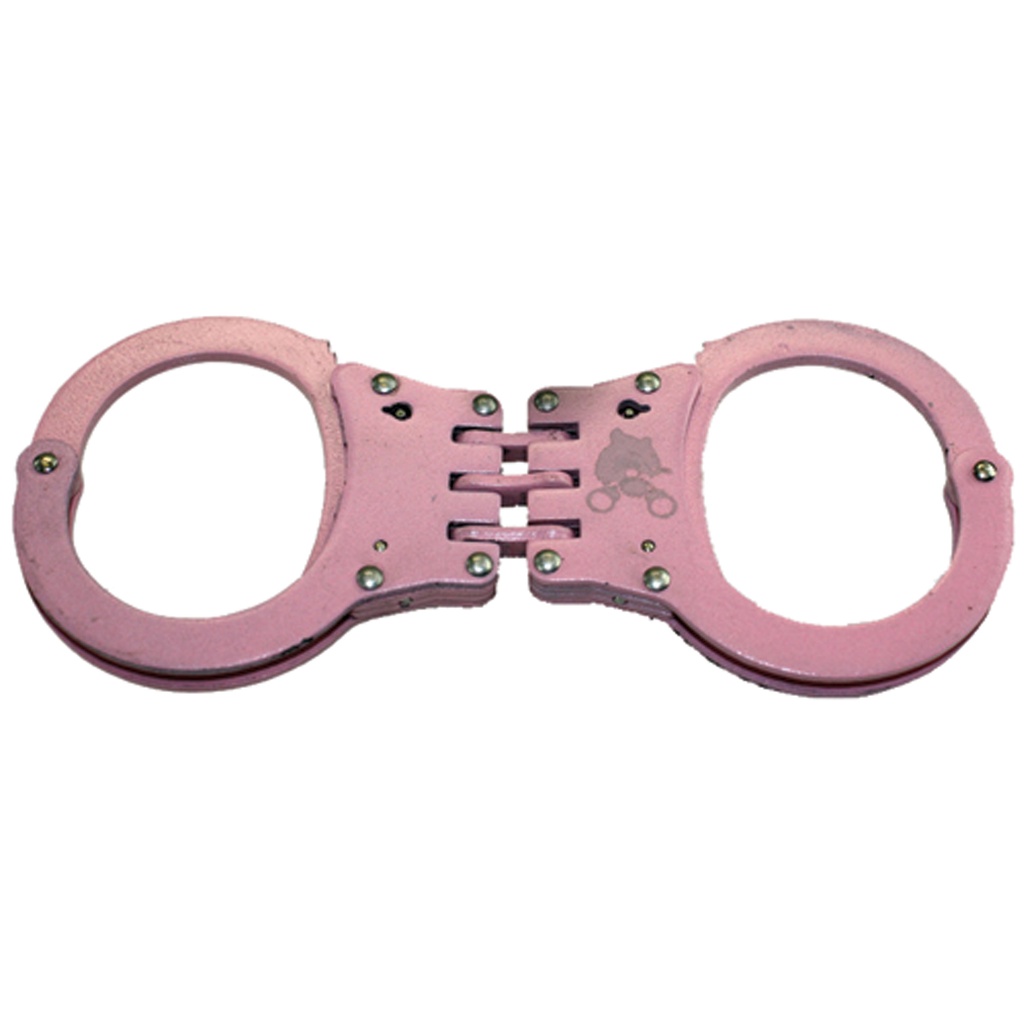
Built for professionals who understand restraint mechanics, these Command Visibility double-lock duty handcuffs use a rigid hinged design to turn minor wrist movement into decisive control. The high-visibility pink coated steel makes them instantly identifiable on the belt, in training rooms, or in the field, while the double-lock mechanism reduces over-tightening and tampering. Smooth to the touch but absolutely serious in function, they deliver reliable, repeatable performance for officers, instructors, and security teams who demand both control and clear visual differentiation.
Command Visibility Double-Lock Hinged Handcuffs Built for Real Control
On a real duty belt, handcuffs are not fashion accessories. They are control tools. These Command Visibility Double-Lock Duty Handcuffs start with what actually matters: a rigid hinged design for tighter control, a reliable double-lock mechanism to prevent over-tightening, and a high-visibility pink coated steel finish that makes them instantly identifiable in a bag, on a belt, or across a training room.
Why Hinged Handcuffs Change the Control Equation
Chain cuffs allow more movement. Hinged cuffs deliberately don’t. The three-link hinge on these restraints shortens the leverage arm between wrists, so even small adjustments from the officer translate into significant restriction of motion for the subject. For professional security, campus police, and instructors, that tighter control window means cleaner escort positions and less fighting the mechanics of the restraint itself.
Because the hinge is rigid and compact, these handcuffs present a flatter profile when folded and carried. That helps them sit closer to the body on the belt and reduces flop compared to looser chain designs. In training environments, that same rigidity lets instructors demonstrate proper grip and leverage without the distracting slack that chain cuffs introduce.
Double-Lock Mechanism: The Detail Pros Actually Care About
The double-lock on these handcuffs is the quiet safety feature that separates professional restraints from toys. Once applied to the correct tightness, the double-lock can be engaged to prevent further tightening on the wrist. That matters in two ways: it helps protect against injury from ratcheting down during movement, and it makes it harder for a subject to manipulate the locking arm by flexing or rubbing the cuff.
The mechanism here is tuned for field reality — deliberate enough that it won’t accidentally engage while cased or carried, but positive enough that an officer or instructor can feel and confirm it during application, even under stress. It’s the same engineering mindset serious knife buyers look for in a solid lockup: predictable, repeatable, and not gimmicked-up for marketing.
High-Visibility Pink Finish with a Professional Purpose
The pink coated steel isn’t a novelty; it’s a visibility feature. In a gear bag full of black nylon and dark hardware, these handcuffs stand out immediately. In training scenarios, instructors can visually confirm who is cuffed, which set is being used, and where the restraints are at a glance. On duty, the color can support role identification, specialized units, community outreach details, or administrative separation from standard-issue restraints.
That finish also creates instant differentiation in retail displays. For shops serving security professionals, law enforcement, and training academies, the pink coating signals something different: a serious mechanical restraint that refuses to disappear into the background. It’s approachable to the public eye without sacrificing the industrial hardware that actually does the work.
Built from Coated Steel for Duty-Grade Durability
Underneath the pink lies what matters: steel. The coated steel construction provides the rigidity hinged cuffs require, resists routine wear from training and duty use, and maintains structural integrity under torsion and impact loads that cheaper alloys can’t shrug off. The smooth coating reduces hotspots and rough edges, which matters when restraints are being applied and removed repeatedly in training environments.
Field Use, Training Rooms, and Storefronts
These hinged handcuffs live comfortably in three worlds: on duty belts, in training rotations, and in storefronts that actually understand their clientele. Duty users get tighter control, predictable double-locking, and fast visual identification. Trainers get cuffs that are easy to see from across the room and rugged enough to handle dozens of cycles per session. Retailers get a product that stands out immediately from a wall of standard silver and black restraints without compromising on professional-grade mechanics.
The compact hinge profile also makes these cuffs efficient to case and carry. They fold into a clean, narrow block, slip into standard handcuff pouches, and present in a consistent orientation — a small detail that becomes critical when drawing and applying them under pressure.
What Buyers Ask Before Purchasing an Automatic Knife
You’re on an automatic knife site, so let’s respect your focus. These are handcuffs, not a blade, but the mindset that chooses a precise automatic knife for sale is the same mindset that refuses commodity restraints. Mechanism, control, predictability — it all transfers.
Are automatic knives legal?
Under U.S. federal law, automatic knives (often called switchblades in statutes) are regulated primarily by the Federal Switchblade Act, which restricts interstate commerce and mailing but does not flatly ban ownership. The real complexity is at the state and local level. Some states allow automatic knives for everyday carry with few restrictions, some limit blade length or carry method, and others prohibit possession or carry entirely. Before you buy an automatic knife or consider it for EDC, you need to check the current laws in your state and any jurisdiction where you’ll be carrying. Statutes change, and enforcement attitudes differ, so serious buyers verify with up-to-date state code or qualified local legal guidance.
What’s the difference between an automatic knife, OTF, and a switchblade?
An automatic knife is any knife where the blade deploys from the closed position using an internal spring or stored energy, activated by a button, lever, or switch in the handle — no manual blade start needed. A switchblade is the legal term used in many statutes for that same broad class of automatic deployment knives.
OTF (out-the-front) is a specific subtype of automatic knife where the blade travels linearly out of the front of the handle, instead of pivoting out from the side like a traditional automatic folder. OTFs can be single-action (spring-driven open, manually reset) or double-action (spring-driven both open and closed via the same control). All OTFs that deploy by spring are automatic knives, but not all automatic knives are OTF; side-opening autos are the more traditional format.
What makes this automatic knife worth buying?
When you buy an automatic knife here, you’re not paying for vague “tactical” marketing. You’re paying for a tuned action: clean lockup, controlled spring tension, and steel that holds an edge instead of surrendering after a weekend. The difference between a drawer-grade switchblade and a serious automatic knife for sale is in the repeatability of its deployment and the integrity of its lock under real-world pressure. Side-opening or OTF, the pieces we stock earn their spot by mechanical honesty — precise grinds, reliable mechanisms, and build quality that stands up to daily carry, not just social media photos.
Why These Handcuffs Belong Beside Serious Blades
If you care enough to choose the right automatic knife for EDC instead of settling for a gas-station special, you already understand why hardware like this matters. The Command Visibility Double-Lock Duty Handcuffs are built with that same mentality: mechanism first, honest materials, and a design that favors control and clarity over show. On the belt next to a well-chosen automatic knife, they complete the picture — a kit built by someone who actually respects the tools they carry.