
Templar Heraldry Ceremonial Display Sword - Black & Gold
8 sold in last 24 hours
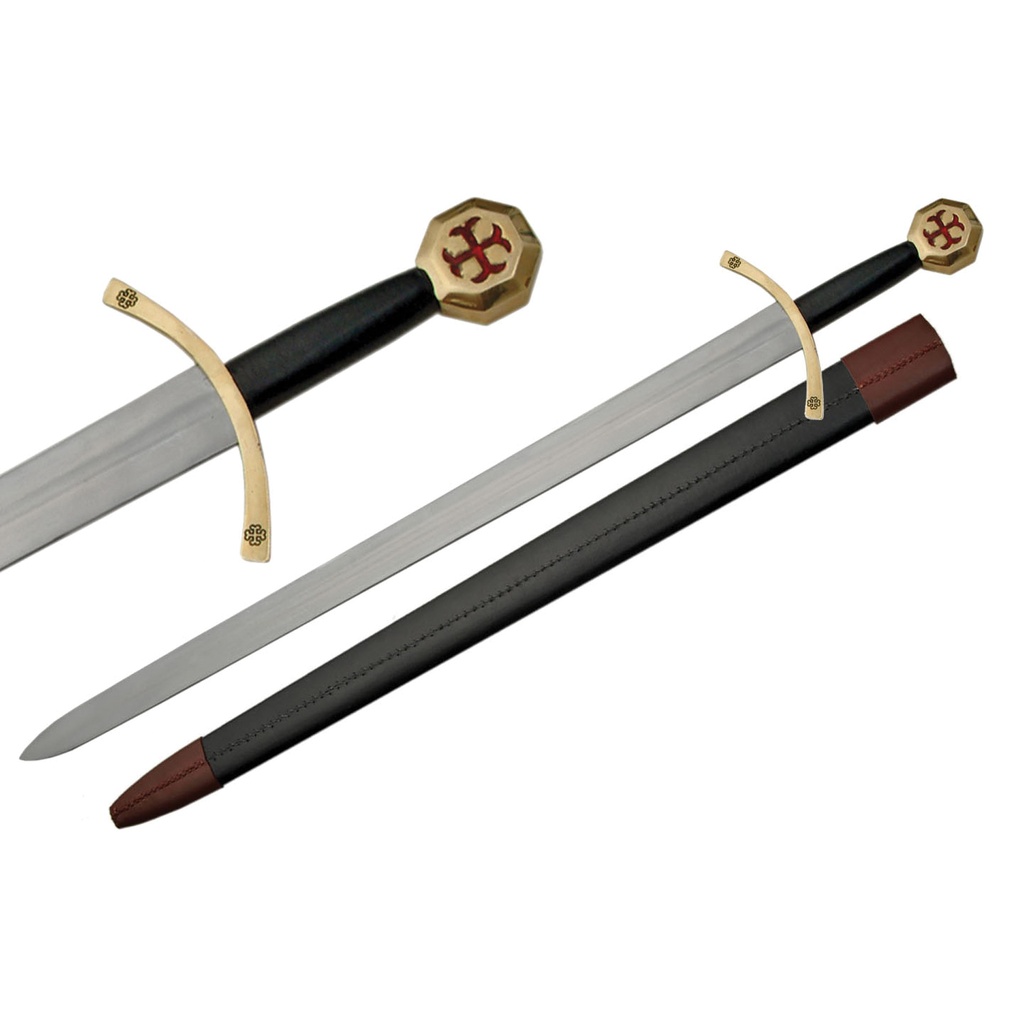
A crusader sword lives or dies on its lines, and this one gets them right. The Templar Heraldry Ceremonial Display Sword carries a polished 41-inch profile, gold cruciform guard, and octagonal pommel set with a bold red cross. The unsharpened blade and stitched black scabbard mark it as a true display sword—built to anchor a wall, office, or collection with clean medieval geometry and unmistakable Templar identity.
Crusader Cross Heraldry Display Sword – Medieval Presence, Ready for the Wall
The Crusader Cross Heraldry Display Sword - Black & Gold is not a stage prop and it’s certainly not a fantasy toy. It’s a purpose-built medieval replica display sword: 41 inches of clean lines, cruciform geometry, and unmistakable crusader iconography designed to own a wall, mantle, or storefront. The unsharpened blade tells you exactly what it is—ceremonial-style decor with historically aware styling, not a backyard chopper.
Templar Heritage in Steel: What Defines This Display Sword
Start at the pommel. That octagonal gold cap with the red crusader cross is the entire story in one glance—European crusader era, knightly, and clearly Templar-inspired. From there, the design runs forward in a straight line: a black grip, a gold cruciform guard with subtle rosette details at the tips, then a long silver blade with a clean, polished finish. No wild engraving, no fantasy spikes, just controlled medieval form.
The scabbard follows the same discipline. A black, leather-like sheath with straight stitching, finished with brown throat and chape accents. It reads as a medieval-inspired wall piece, not a cosplay afterthought. This is decor that respects the visual language of historical swords.
Why This Isn’t a Combat Blade – and Why That’s the Point
The blade is intentionally unsharpened with a display edge. That single choice defines its role as a display sword. You’re not buying a cutting tool; you’re buying silhouette, heraldry, and presence. The straight, double-edged style profile tapers cleanly to a point, giving you the authentic look of a medieval arming or knightly sword without pretending to be a hardened, differentially tempered workhorse.
On the wall, across a mantle, or flanking a shield, the proportions do the work. At 41 inches overall, it occupies vertical space the way a real sword should—long enough to dominate a display, balanced enough in hilt-to-blade ratio to look right at a glance.
Display Sword Engineering: Balance, Grip, and Visual Weight
Even for a decorative sword, the physical details matter. The straight grip offers a neutral hand position that feels immediately familiar if you’ve handled any medieval replica. The gold crossguard adds visual width that stabilizes the profile, giving the sword a strong "anchor" at the hilt when hung horizontally or vertically.
Blade and Hilt Proportions That Read as Medieval
The polished silver blade runs long and relatively narrow, which keeps the sword from looking cartoonish. The cruciform hilt—crossguard, grip, pommel—sits in a visually correct ratio to that blade length, so when it’s on the wall, it looks like a knight’s sidearm, not a movie prop. That’s what collectors and history enthusiasts recognize from across the room.
Scabbard Details That Complete the Presentation
The black scabbard with visible stitching adds a textural contrast to the smooth blade. Brown chape and throat accents break up the dark length and keep it from disappearing against a similarly dark wall. In a shop, office, or home display, that contrast helps the sword read clearly even from a distance.
Legal and Practical Context: Owning a Display Sword
Unlike an automatic knife, OTF, or switchblade, this is a full-size decorative sword with an unsharpened blade. In most regions, that places it in a different legal and practical category from edged tools meant for carry. You’re not slipping this into a pocket or onto a belt; you’re putting it on a wall or into a themed room.
Local laws vary on sword ownership, display, and transport, especially in public or event settings. In many areas, owning a decorative medieval replica sword at home is unrestricted, while public carry can be limited or prohibited. The smart move is simple: treat it as decor, check your local regulations before taking it out of your property, and display it responsibly—especially where children or customers can access it.
Collector Value: Where This Crusader Display Sword Fits in a Collection
For a sword collector, this piece lives in the heraldic and thematic lane. It’s the kind of display sword that anchors a Templar or crusader section: shield on the wall, banners or tapestries nearby, maybe a helmet on a stand. The red cross on the pommel is the focal cue, immediately calling out its crusader theme without crowding the blade with busy artwork.
If your collection leans toward production medieval replicas, fantasy blades, or historical wall pieces, this sword fills the role of "clean Templar showpiece"—recognizable, bold, and visually disciplined. It’s the one you hang where guests will actually notice the details: the octagonal pommel, the rosettes on the guard tips, the contrast between black, gold, silver, and the single red emblem.
Display Scenarios: Where This Sword Makes Sense
Home and Office Decor: In a home theater, study, or office, the Crusader Cross Heraldry Display Sword is that one serious medieval accent that doesn’t look like a toy. The black-and-gold palette fits modern interiors more easily than heavily ornate, bright-finished replicas.
Retail and Event Display: In a store or showroom, it’s a reliable attention hook. The profile is tall enough to cut through visual noise, and the red cross is a built-in branding focal point. It pairs well with shields, helmets, and other medieval replicas to build a dedicated crusader feature wall.
Costume and Reenactment Decor: As a backdrop piece for events or themed rooms, it hits the right visual cues for Templar or crusader imagery. The unsharpened edge makes it more practical for decorative use where safety and visual impact both matter.
What Buyers Ask Before Purchasing an Automatic Knife
Are automatic knives legal?
Automatic knife laws and switchblade laws in the United States are a mix of federal and state rules. Federal law (the Switchblade Knife Act) restricts interstate commerce in automatic knives and switchblades, with exceptions for military, law enforcement, and certain collectors, but it does not outright ban ownership nationwide. The real limits usually come from state and local statutes: some states allow you to buy an automatic knife or OTF for collection and even carry, others restrict blade length, mechanism type, or concealment, and a few prohibit possession entirely. Before you buy an automatic knife for sale online and expect to carry it, you check your state and city laws first—especially for any "automatic knife legal to carry" conditions, transport rules, and age requirements.
What’s the difference between an automatic knife, OTF, and a switchblade?
Mechanically, an automatic knife is any folding knife that opens by pressing a button, lever, or switch that releases spring tension to deploy the blade. A classic side-opening automatic pivots the blade out from the handle like a standard folder, just powered by a spring. An OTF knife (out-the-front) is a specific type of automatic where the blade travels linearly out the front of the handle rather than pivoting from the side. Double-action OTF knives both deploy and retract via the same sliding control. The term switchblade is often used in law and casual speech to describe automatic knives in general, especially side-openers, but among enthusiasts and many makers, "automatic," "OTF," and "side-opening" are the more mechanically precise terms.
What makes this automatic knife worth buying?
Applied to the broader category: an automatic knife is worth buying when the mechanism is tuned correctly—consistent spring strength, reliable lockup, and a deployment speed that feels deliberate rather than violent. Enthusiasts look for clean machining around the button or actuator, a solid interface between blade and lock, and steel that justifies repeated use. In the same way, a display sword like the Crusader Cross Heraldry Display Sword earns its place when the lines are right, the theme is clear, and the fit and finish hold up from across the room and up close. You buy it because it nails its job as a Templar-inspired wall piece, the same way a good automatic knife earns pocket time by nailing its action.
Closing the Loop: A Collector’s Eye for Steel and Story
If you’re the kind of buyer who cares about how a double-action OTF feels as it tracks on its rails, you also care how a medieval replica reads on the wall. The Crusader Cross Heraldry Display Sword - Black & Gold delivers on the visual mechanics: balanced proportions, strong heraldic focus, and a clear Templar identity centered on that red cross pommel. It doesn’t try to be a battlefield weapon; it commits to being a serious, knightly display sword and does the job with clean lines and disciplined design.