
Imperial Laurel Legionnaire Gladius Sword Replica - Wood Handle
8 sold in last 24 hours
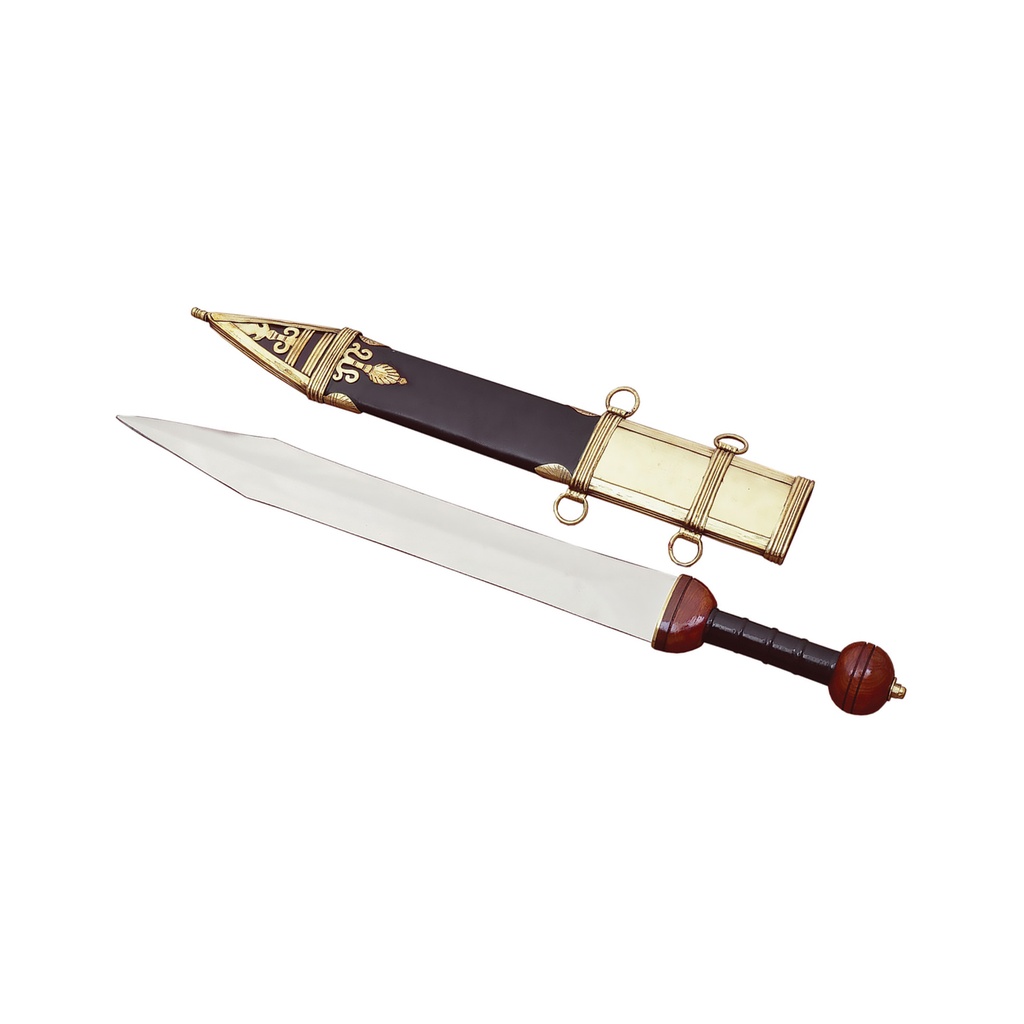
A Roman gladius lives or dies on proportion and balance, and this Imperial Laurel Legionnaire Gladius Sword Replica gets both right. The 27-inch short sword profile, polished double-edged blade, and segmented wood handle echo battlefield originals, while the black-and-gold scabbard with laurel detailing pushes it into display-grade territory. It’s sized to read as a real weapon, finished to stand as decor, and detailed enough that any Roman history enthusiast or sword collector will recognize the intent.
Imperial Laurel Roman Gladius Sword for Sale – Display-Grade, History-Driven
The gladius was never a wallhanger in its day. It was the workhorse of the Roman legions—short, fast, and brutally efficient. This Imperial Laurel Roman Gladius Sword is a handcrafted replica built for collectors who care about proportion, profile, and presence. You’re not just buying another decorative sword; you’re picking up a Roman-inspired short sword that actually respects the lines of the originals.
Why This Roman Gladius Sword for Sale Stands Out in a Sea of Replicas
Most “Roman swords” on the market are vague fantasies with a Latin name stamped on the box. This piece leans into the essentials a serious collector looks for in a gladius-style sword for sale: a straight, double-edged blade, a true short-sword length around 27 inches overall, and a handle that actually looks like someone intended to hold it under stress.
The 19.75-inch polished blade lands squarely in historical gladius territory—long enough for reach, short enough to feel quick in the hand. The spear-point tip gives you that classic thrust-oriented profile the legions favored, and the clean, straight edges read correctly across the room. You don’t need to be a reenactor to appreciate that; any sword collector will spot the intent on sight.
Blade, Balance, and Build: How This Gladius Replica Is Put Together
This is a fixed blade short sword, not a folding or automatic knife. No gimmicks, no hidden mechanisms—just a solid, display-focused build. The polished blade runs nearly 20 inches, with a straight, double-edged layout and a spear-point tip that pulls the eye forward. The finish is bright enough to catch light on a wall, but not so overdone that it looks like a toy.
Handle and Grip: Segmented Wood with Roman Character
The handle is where a lot of replicas fall apart. Here, you get a segmented cylindrical wood grip in a warm reddish brown, echoing the stacked or carved grips seen on period-inspired gladius designs. The guard is a compact gold-tone piece at the base of the blade—just enough to visually and physically separate blade from hand. At the rear, a round wood pommel with a gold finial ties everything together and anchors the silhouette.
In hand, the 7.25-inch handle gives you a secure one-handed grip with room for adjustment. It feels like a fighting short sword, not an oversized letter opener.
Scabbard and Laurel Detail: Where the Display Value Really Lives
Collectors know a sword’s scabbard can make or break its presence on the wall. This gladius sword ships with a decorative Roman-style scabbard that does the heavy lifting on aesthetics: black body, gold accents, and a laurel motif at the throat that instantly signals Imperial Rome. Multiple gold bands and four suspension rings run the length, giving you flexible mounting options for a wall, rack, or costume rig.
The contrast—silver blade, black scabbard, gold hardware, reddish wood—makes this piece pop in a collection. Put it next to generic fantasy blades and it will immediately read as historical and intentional.
Who Buys a Roman Gladius Like This—and Why It Belongs in a Collection
This isn’t a training cutter or a battlefield repro meant for full-contact use. It’s a visually accurate Roman gladius sword for sale aimed at three serious audiences: history enthusiasts, sword collectors, and decor buyers who want their walls to say something more than “I bought the cheapest thing online.”
For the history‑minded owner, the gladius profile is unmistakable. For the collector, it fills a specific slot: a short Roman sword with a fully dressed scabbard and cohesive color palette. For the decor buyer, it’s a centerpiece—something that turns a blank wall into a conversation about legions, conquest, and the way a short sword can change the course of history.
Display, Handling, and Care: Living with a Short Roman Sword
At 27 inches overall, this gladius sits in an ideal zone: compact enough for easy wall mounting, long enough to feel like a real weapon. The multiple scabbard rings let you get creative—horizontal above a desk, angled beside a bookshelf, or paired with a shield for a dedicated Roman display.
Because the blade is polished, basic care is straightforward: light oil if you live in a humid climate, keep it dry, and don’t abuse the edge against hard targets. Treat it as a historical replica, not a pry bar, and it’ll hold its looks for the long haul.
Legal Context: Owning a Roman Gladius Sword vs. Carrying an Automatic Knife
Buyers who also collect automatic knives and switchblades are used to navigating a patchwork of laws. This gladius sword lives in a different legal lane. Under U.S. federal law, automatic knife and switchblade regulations focus on spring‑loaded folding blades and their interstate commerce. A fixed blade sword like this, built as a Roman replica, typically falls under local and state regulations about length, display, and public carry.
In most U.S. jurisdictions, owning a decorative sword in your home is legal. Public carry, display at events, or transport—in a vehicle, for example—can be more tightly controlled, especially in urban areas. Unlike an automatic knife for EDC, you’re not pocketing this gladius; you’re mounting it, displaying it, or transporting it to a show, convention, or costume event. Always check your local and state regulations before carrying any edged weapon outside your home.
What Buyers Ask Before Purchasing an Automatic Knife
Are automatic knives legal?
On the federal level in the U.S., automatic knives and switchblades are regulated primarily by the Federal Switchblade Act, which restricts interstate commerce and certain imports of spring‑loaded, button‑activated folding knives. That law does not ban simple ownership at the federal level. The real complexity comes from state and local laws: some states fully allow automatic knife carry, some allow ownership but restrict concealed carry or blade length, and a few still prohibit them outright.
This Roman gladius sword is a fixed‑blade historical replica, not an automatic knife, OTF, or switchblade. It usually falls under a different set of rules covering swords and large fixed blades. As with any edged weapon—automatic knife, switchblade, OTF knife, or sword—responsible buyers check their specific state and municipal codes before carrying or displaying in public.
What’s the difference between an automatic knife, OTF, and a switchblade?
Mechanically, an automatic knife is a folding knife that opens via a spring when you hit a button, lever, or switch on the handle. A side‑opening automatic looks like a traditional folder; the blade pivots out from the side, powered by an internal spring. An OTF (out‑the‑front) automatic knife drives the blade straight out of the handle through a front opening, either single‑action (auto deploy, manual retract) or double‑action (auto in and out). “Switchblade” is the older, popular term that U.S. law uses for automatic knives in general.
This gladius, by contrast, is a fixed blade Roman short sword: no springs, no deployment mechanism, no OTF action. It’s a different category entirely, aimed at display and collection rather than pocket carry.
What makes this Roman gladius worth buying?
Collectors don’t buy this piece because it’s the cheapest sword for sale; they buy it because it hits the right Roman notes without drifting into fantasy. The proportions are on target for a gladius‑style short sword, the spear‑point double‑edged blade reads correctly, and the segmented wood handle with gold guard and pommel gives it a period‑inspired grip silhouette.
The scabbard is where it separates itself from commodity decor: black and gold with laurel detailing, four suspension rings, and enough hardware that it looks deliberate rather than stamped out. If you’re building a collection that ranges from modern automatic knives and OTFs to historical fixed blades, this gladius slots in cleanly as your Roman centerpiece—recognizable, display‑ready, and grounded in a specific martial tradition.
From Automatic Knives to Roman Steel: Building a Serious Collection
A lot of serious buyers start with an automatic knife for EDC—a well‑tuned side‑opener, maybe a double‑action OTF—then work backward into the history that made modern blades possible. This Imperial Laurel Roman Gladius Sword is a logical next step if you live in that world. It won’t ride in your pocket, but it will anchor a display above the bench where you tune your automatics.
You get a historically grounded short sword with a polished spear‑point blade, a Roman‑inspired wood handle, and a laurel‑trimmed scabbard that looks like it belongs in a legionary officer’s kit. For the enthusiast who knows the difference between an automatic knife, an OTF, and a fixed‑blade gladius—and cares about all three—this is the kind of piece that rounds out a collection with real historical weight.