
Lineage Steel Curved-Guard Medieval Sword - Black Leather
8 sold in last 24 hours
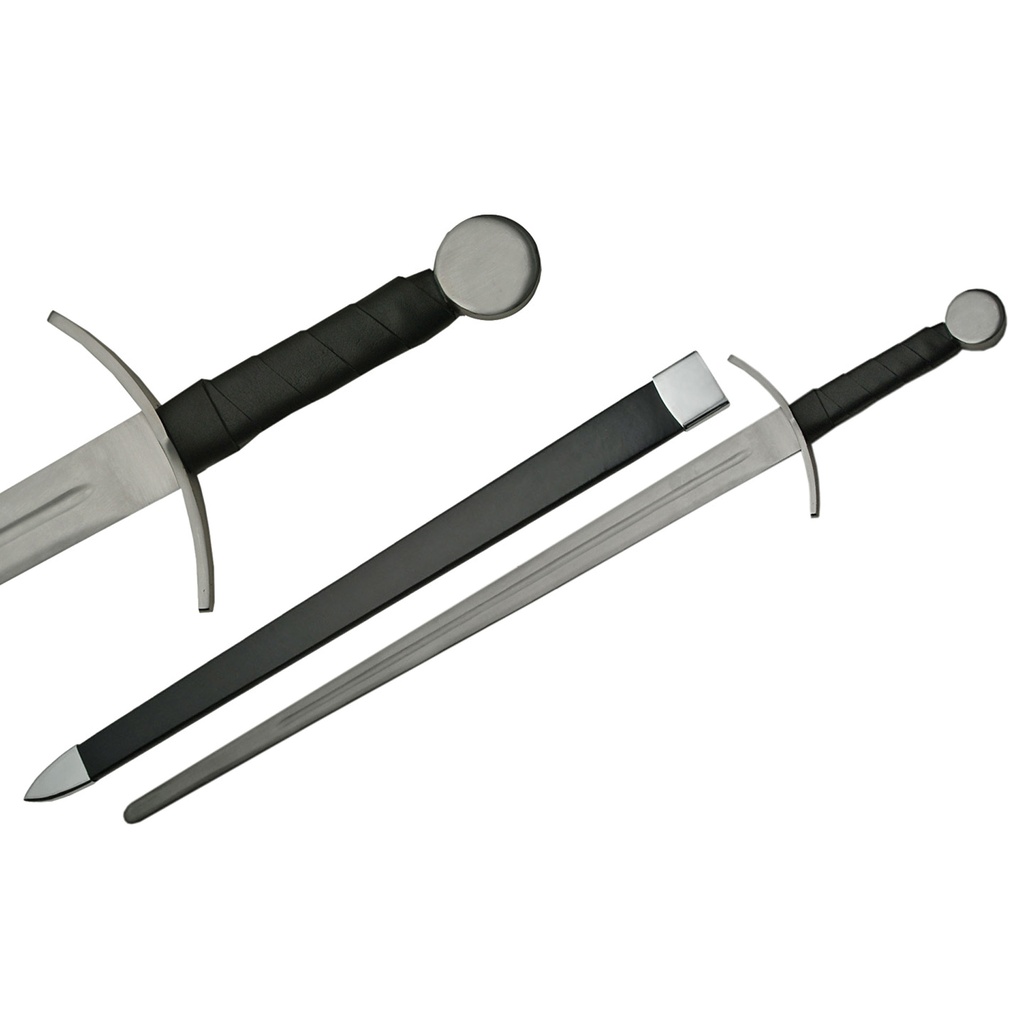
This battle-ready medieval sword is built like a working knight’s tool, not a wall-hanger. A straight 33-inch double-edged blade with central fuller rides on a full tang, locked in by a curved steel guard and round disc pommel. The black leather-wrapped grip and matching sheath keep the profile clean and functional. At 40 inches overall, it’s sized right for reenactment, stage combat, or a serious old-world centerpiece in your collection.
Curved-Guard Medieval Sword Built for Real Use, Not Fantasy
The Lineage Steel Curved-Guard Medieval Sword - Black Leather is exactly what most collectors say they want but rarely find: a battle-ready medieval sword that looks like it stepped out of the 14th century, not a video game. Straight 33-inch double-edged blade, central fuller, full tang, curved crossguard, disc pommel, and black leather wrap—every line reads functional arming sword, not decorator prop.
Battle-Ready Medieval Sword for Sale with Authentic Arming Sword Geometry
When you buy a medieval sword for real training or reenactment, geometry matters more than ornament. This piece runs 40 inches overall with a 33-inch blade—classic arming sword proportions. The straight double-edged blade gives you true cut-and-thrust capability, while the central fuller lightens the spine without compromising structural integrity.
Full tang construction is the non-negotiable here. The tang runs the length of the handle, tying blade, guard, grip, and pommel into a single working unit. Under load—whether that’s controlled stage combat or heavy bag work—that full tang helps soak and distribute shock instead of letting the hilt twist or separate like cheap rat-tail tang display pieces.
Curved Crossguard and Disc Pommel: Working Hardware, Not Costume Jewelry
The curved crossguard isn’t an affectation; it’s a subtle functional choice. The guard sweeps just enough to protect the hand while keeping a low profile that won’t snag on clothing or costume layers. The round disc pommel acts as a counterweight, pulling the balance point back toward the hand for better point control and shorter recovery time between cuts. You feel it the first time you move through a basic cut sequence—the sword wants to track straight and return to line.
Black Leather Grip and Sheath: Stage-Ready and Display-Clean
The black leather-wrapped handle gives a secure, slightly textured grip without chewing up gloves. The matching black leather sheath with steel throat and tip cap does double duty: safe carry to and from events, and a clean, minimalist display profile when the sword is on the wall or in a stand. No faux runes, no chrome, just leather and satin-finished steel that reads as serious kit from across the room.
Why This Medieval Sword Belongs in a Serious Collection
This is a heritage-style medieval arming sword aimed squarely at reenactors, stage performers, and collectors who are tired of flashy fantasy blades that fold in a bind. The fuller is straight and true, the guard and pommel are visually in period, and the overall silhouette honors the workhorse swords that actually got carried—simple, efficient, and built to work.
If you’re used to wall-hangers, the first surprise here will be the balance. At 40 inches overall, many mass-market swords feel tip-heavy and clumsy. This one balances cleanly under the disc pommel, bringing the center of gravity back toward your lead hand so you can control thrusts, cuts, and transitions without fighting the blade. That balance is what separates a usable medieval sword from a decorative bar prop.
Construction, Handling, and Edge Potential
While this isn’t an automatic knife or a switchblade, the same enthusiast mindset applies: steel, fit, and how the weapon moves matter. The straight double-edged blade with a central fuller is designed to take and hold a working edge suitable for training and controlled striking. Paired with full tang construction and solid hardware fit-up, you get a medieval sword that feels like a single piece in motion instead of a blade rattling inside cheap fittings.
Collectors who handle a lot of production medieval swords will notice the minimalist, almost tool-like approach: no gaudy plating, no plastic, just satin steel and leather. That restraint is what makes it play well in a serious collection. It doesn’t try to be everything; it tries to be a clean, honest arming sword—and it succeeds.
Reenactment, Stage, and Training Utility
For reenactors and stage combat professionals, length and profile are everything. This 33-inch blade gives you the reach you expect from a knightly sidearm while keeping overall length manageable in close quarters and choreography. The curved guard and round pommel leave no sharp corners to snag costuming, and the straight, double-edged profile reads clearly on camera and from the audience—people see “medieval sword,” not “Halloween prop.”
What Buyers Ask Before Purchasing an Automatic Knife
Are automatic knives legal?
Federally in the United States, automatic knives (true push-button or switch-operated knives where the blade opens automatically under spring tension) are regulated under the Federal Switchblade Act. That law mainly controls interstate commerce and shipping, not simple ownership. The real deciding factor is state and sometimes local law. Some states allow automatic knives and switchblades for everyday carry, some restrict blade length, others limit who can carry them, and a few still prohibit them outright. Before you buy an automatic knife or switchblade online, you need to check the current knife laws for your state and city, including any rules on carry, concealed carry, and transport. This medieval sword is not an automatic knife or OTF; it falls under an entirely different legal category as a fixed-blade sword, which is usually governed by separate length and carry regulations.
What’s the difference between an automatic knife, OTF, and a switchblade?
Mechanically, an automatic knife is a folding knife whose blade is driven open by a spring when you press a button, lever, or similar control. A side-opening automatic works like a traditional folder that opens sideways from the handle. An OTF (out-the-front) knife is a specific type of automatic where the blade travels linearly out of the front of the handle, usually in a tracked channel. OTFs can be single-action (spring-driven out, manually retracted) or double-action (spring-driven both out and back in using a sliding control). “Switchblade” is the older legal and cultural term for an automatic knife; in most legal texts, switchblade and automatic knife are effectively the same category. By contrast, this product is a full-length medieval sword—a fixed blade with no folding or automatic mechanism at all.
What makes this sword worth buying?
For a serious buyer, three things make this medieval sword stand out. First, the proportions and hardware are rooted in real arming sword forms: straight double-edged blade, central fuller, curved guard, and disc pommel that actually work together in the hand. Second, the full tang construction and battle-ready build mean it’s more than a display piece—you can use it for reenactment, stage work, or training without babying it like a hollow wall-hanger. Third, the black leather and satin steel aesthetic gives it range: it looks correct on the belt at an event, in a rack beside other historical blades, or as a minimalist centerpiece in a themed room.
Collectors Who Choose Tools Over Toys
If you’re the kind of buyer who cares how an automatic knife deploys, how an OTF tracks in its rails, or how a switchblade lockup feels, you already understand why construction details matter on a medieval sword. The Lineage Steel Curved-Guard Medieval Sword - Black Leather is for that same mindset—collectors and reenactors who respect clean lines, honest materials, and hardware that’s built to work.
It won’t compete with your custom automatic knife for pocket time, but it will stand just as tall in your collection: a serious, battle-ready medieval sword that earns its place by how it handles, not by how much fake engraving it wears.