Red Crest Minimalist Wakizashi Sword - White Wood
12 sold in last 24 hours
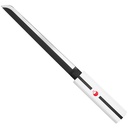
This is not a wall-hanger pretending to be a katana. The Silent Guardian Minimalist Shirasaya Wakizashi is a modern short sword with clean shirasaya lines, a straight two-tone stainless blade, and a pure white wood handle marked only by a black line and red crest. At 17.5 inches overall, it balances like a true wakizashi while reading as minimalist art. It’s the piece in your collection that quietly tells people you care about design, not just steel.
Silent Guardian Minimalist Shirasaya Wakizashi - White Wood
The Silent Guardian Minimalist Shirasaya Wakizashi - White Wood is what happens when you take a traditional Japanese short sword, strip away everything that doesn’t absolutely need to be there, and let the lines speak for themselves. No faux dragons. No overdone fittings. Just a straight, two-tone stainless blade and a white shirasaya-style handle with a single black line and a red crest that does all the talking.
Why This Modern Wakizashi Belongs In A Serious Sword Collection
Collectors who already own the usual curved katanas and ornate fantasy blades will recognize what this piece is doing. At 17.5 inches overall, it sits in that classic wakizashi footprint: a short sword that reads as compact, controlled, and purposeful. The blade is straight, single-edged stainless with a two-tone finish: bright cutting edge, darker flats. That contrast pulls the eye down the line of the blade and makes it look sharper, more defined, and more architectural when displayed.
The shirasaya-style handle is the counterpoint. Instead of traditional fittings, you get a minimalist white wood block grip — rectangular, clean, and unadorned except for a bold vertical black line and a small red crest. Those two marks are enough to give it identity without drowning it in fake symbolism. It looks like a piece you’d see mounted in a gallery or a modern studio space, not just on a cluttered weapons wall.
Design & Proportion: How The Lines Actually Work
Traditional shirasaya were storage mounts — plain wooden scabbard and handle protecting the blade without combat hardware. This modern interpretation nods to that idea: no guard, no wrappings, just a smooth white handle that lets the blade do the visual heavy lifting.
Blade Geometry & Finish
The blade runs straight, single-edged, wakizashi-style, which immediately shifts the feel from fantasy to disciplined. The two-tone stainless finish isn’t just for show; the darker flat and bright edge create a visual separation that makes the cutting line pop under even average room lighting. For display, that matters — it’s the difference between a blur of silver and a blade your eye keeps returning to.
Handle Minimalism With Intent
The white wood handle carries a deliberate graphic language: one black vertical line and a red crest near the end. The black line lengthens the silhouette and visually anchors the piece. The red crest acts like a simplified mon — a family emblem shorthand — without claiming any specific clan or story. It’s enough detail to give it character while staying aggressively minimalist. That restraint is what separates this from mass-market novelty swords.
Wakizashi For Display: Quiet Authority On The Wall Or Stand
This sword is clearly built first and foremost as a display wakizashi. Stainless steel keeps maintenance low for the average collector or retailer who wants a clean blade that won’t demand oiling rituals. The overall 17.5-inch length makes it easy to stage on shelves, desks, or wall mounts without overpowering the space.
In a row of aggressive, overly tactical pieces, this one calms the layout. In a minimalist room with a lot of white and black, it reads like sculpture that just happens to have an edge. It’s the kind of sword that makes non-collectors say, “Okay, that one I get.”
What Buyers Ask Before Purchasing an Automatic Knife
Even though this piece is a fixed wakizashi sword, collectors who cross-shop automatic knives, OTFs, and switchblades often ask the same legal and category questions across the board. Let’s clear up the framework so you can position this sword correctly alongside your autos.
Are automatic knives legal?
Under U.S. federal law, automatic knives and true switchblades are regulated mainly in terms of interstate commerce and import, not simple ownership. The real nuance lives at the state level: some states allow automatic knives and switchblades freely, some restrict blade length, some limit carry (especially concealed carry), and a few still prohibit them outright. OTF knives — a subset of automatic knives where the blade deploys out the front — usually fall under the same statutory definitions as switchblades when they’re push-button or slide-activated.
This Silent Guardian Wakizashi is a fixed-blade sword, not an automatic knife, OTF, or switchblade. It doesn’t deploy via spring, button, or mechanism, so it doesn’t fall under automatic knife or switchblade statutes. That said, swords and large fixed blades can still be restricted for carry or public display in some jurisdictions. As always, buyers should check their local and state laws for both automatic knives and swords before carrying or displaying anything in public.
What's the difference between an automatic knife, OTF, and a switchblade?
For buyers building a collection that includes this wakizashi and modern folders, the distinctions matter:
- Automatic knife: A folding or out-the-front knife where the blade deploys via spring or stored energy when you actuate a button, lever, or slide. The mechanism does the work once you trigger it.
- OTF knife: “Out-the-front” automatic where the blade travels straight out of the handle. Most serious OTFs are double-action — they deploy and retract on the same control — but single-action versions exist too.
- Switchblade: Legally, often synonymous with automatic knife. In knife culture, it usually refers to side-opening automatics with a button-activated leaf or coil spring.
This Silent Guardian is none of those: it's a fixed wakizashi sword with no deployment mechanism. That makes it closer, mechanically, to a traditional katana than any automatic knife or switchblade, even if you display them side by side.
What makes this wakizashi worth buying?
Collectors don’t add another sword just because it has steel and an edge. They add the piece that fills a gap. This wakizashi earns its place three ways:
- Minimalist interpretation of a classic form: It takes the respected wakizashi profile and shirasaya style, then executes them with modern restraint.
- Display-first design: The two-tone stainless blade, white wood handle, and bold but simple crest read cleanly from across a room — it looks intentional in any display.
- Versatility in collections and retail: It fits Japanese-themed displays, modern interiors, manga/anime-inspired setups, and serious sword shelves without looking cheap or overdecorated.
If your wall is already heavy with black tactical steel and bright fantasy swords, this is the silent piece that pulls the whole layout together.
Collector Identity: The Enthusiast Who Chooses This Sword
The buyer who takes home the Silent Guardian Minimalist Shirasaya Wakizashi - White Wood is the same type of enthusiast who knows the difference between a double-action OTF and a side-opening automatic knife: detail-driven, design-conscious, and allergic to gimmicks. You’re not just filling space on a rack; you're curating. This wakizashi brings quiet authority, modern lines, and a nod to Japanese tradition that respects the form instead of parodying it.
Whether it sits next to your best automatic knife, above a row of folders, or as the lone blade in a clean office, it reads the same way: chosen on purpose by someone who actually cares what they’re looking at.