Devil Dog Rapid-Rescue Assisted Knife - Black Pakkawood
7 sold in last 24 hours
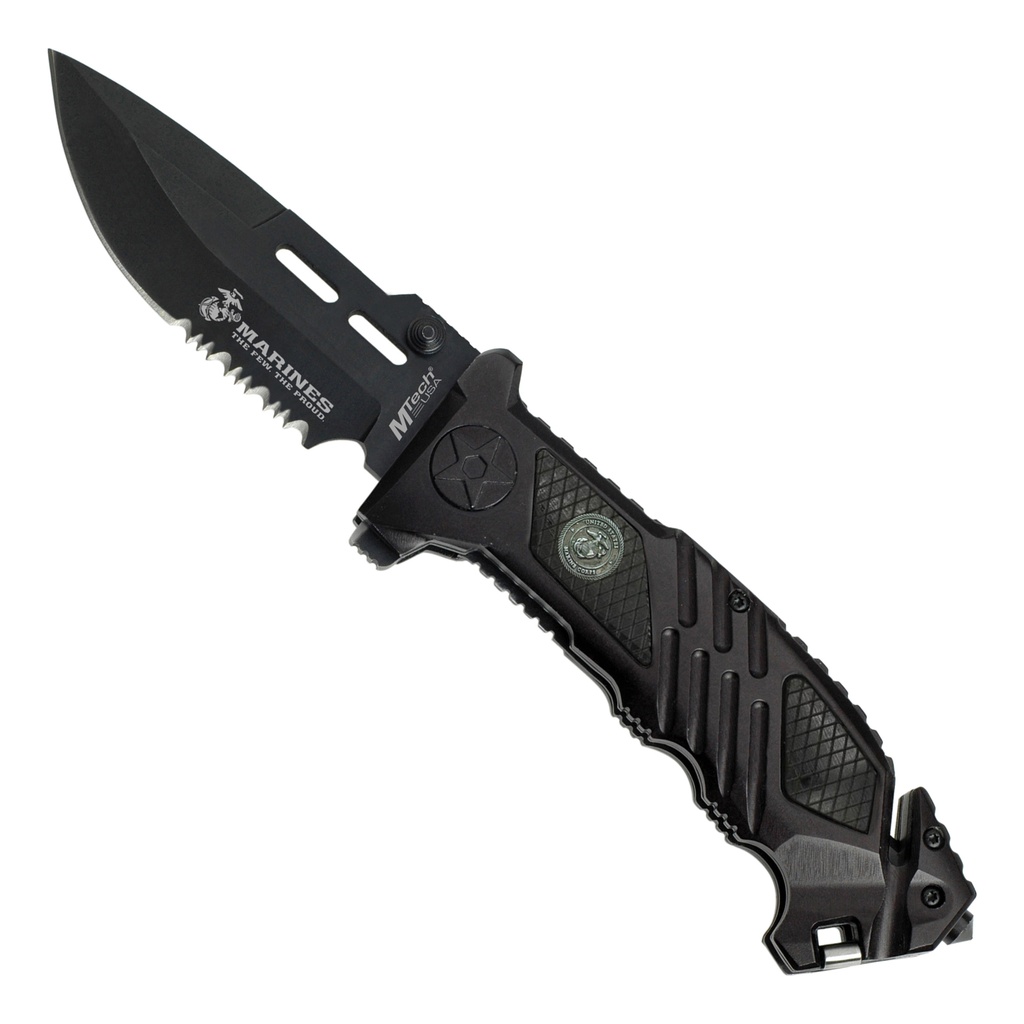
This is a spring-assisted rescue knife built with a Marine mindset. The black 440 stainless blade snaps out with authority, backed by a liner lock you can trust under pressure. Partial serrations bite through webbing, while the integrated seat belt cutter and glass breaker give you options when a door won’t open and seconds count. Black Pakkawood scales, Marine crest inlay, and a deep-carry clip make this a tactical folder that rides ready without advertising itself.
Automatic Knife-Level Speed, Spring-Assisted Control
If you care more about action, steel, and purpose than hype, this spring-assisted rescue knife will make sense the second you feel it fire. It isn’t an automatic knife, it isn’t an OTF, and it doesn’t pretend to be a switchblade. What it does is deliver automatic-like deployment with the added control and legal breathing room of a well-tuned assisted folder.
The black 440 stainless blade runs 3.75 inches with a drop point profile that’s honest about its job: cut fast, cut clean, and survive hard use. Spring assist gets that blade moving the instant you load the flipper or thumb stud, then the liner lock takes over and locks it down with the kind of positive engagement you want in a rescue scenario.
Automatic Knives for Sale vs. Assisted Rescue Tools
When you’re browsing automatic knives for sale, it’s easy to lump every fast-deploying folder into the "automatic" bucket. This one is deliberately built as a spring-assisted knife, not a true automatic knife, and that distinction matters to both mechanics and legality.
On a true automatic knife for sale, pressing a button or hidden actuator releases spring tension and drives the blade from fully closed to fully open. Here, the spring only kicks in once you start the blade moving with a flipper tab or thumb stud. You provide the initial motion; the torsion assist does the rest. That’s why the action feels so decisive without crossing over into full switchblade territory in most jurisdictions.
For a buyer who’s already looked at more than one automatic knife for sale and understands the nuances, this is the middle ground: rapid deployment, one-handed opening, but with a mechanism that keeps you on more solid legal footing in many areas.
Mechanics That Earn Enthusiast Respect
This knife is built around a simple formula: familiar materials used correctly, tuned action, and a profile that doesn’t fight your hand.
Dialed-In Spring-Assisted Action
The deployment is classic spring-assisted engineering done right. The detent holds the blade secure in the closed position, but the moment you nudge the flipper or thumb stud past that break, the assist spring takes over and snaps the blade into lockup. There’s no lazy halfway wobble, no feeling that you need to “help” it along; it’s a decisive, single-stage motion. That’s what separates a real tool from the bargain-bin folders that pretend to be fast.
Dual deployment — flipper tab and thumb stud — gives you options depending on grip and gloves. It’s the kind of detail you appreciate after the third or fourth hour on a shift, when fine motor skills aren’t at their best, but muscle memory still is.
440 Stainless Steel, Honest and Workable
The blade is 440 stainless steel, which, when heat-treated correctly, hits a pragmatic balance between edge retention, toughness, and corrosion resistance. It’s not boutique powder steel, and it doesn’t need to be. On a rescue-oriented assisted knife, you want steel that won’t rust out if it lives in a sweaty waistband or wet duty pocket, that sharpens quickly on a basic field stone, and that shrugs off mild abuse. 440 checks those boxes and has been doing it for decades.
Rescue-Driven Design: More Than Just a Tactical Look
Everything about the handle and hardware is aimed at real-world use, not just looking aggressive in photos.
Seat Belt Cutter and Glass Breaker, Built-In
The integrated seat belt cutter at the butt of the handle is there for the day you hope never comes. Instead of dragging the main blade near a patient, you can slide webbing, straps, or belts into the dedicated cutter and let the protected edge do the work. It’s faster, safer, and it keeps the primary edge free for other tasks.
Right next to it lives a glass breaker — a hardened tip built to concentrate force on tempered glass. It’s not for show. Used correctly at a window corner, it’ll pop automotive glass far cleaner than hammering away with a knife spine or flashlight bezel.
Black Pakkawood Handle with Real Ergonomics
The handle scales are black Pakkawood, a resin-stabilized wood that gives you the look and warmth of wood with the dimensional stability of a synthetic. Finger grooves and subtle texturing provide indexed grip points without turning the handle into a cheese grater on your pocket. At 5 inches closed and around 7 ounces, it rides as a full-size tactical folder — substantial enough for gloved hands, still manageable for daily carry.
The Marine crest medallion inlaid into the handle and the US Marines logo on the blade aren’t a gimmick. They anchor the knife in a specific culture: people who understand that gear is there for the moment things go sideways, not just for Instagram.
Buying an Automatic Knife vs. Choosing This Spring-Assisted Folder
If you came here to buy automatic knife designs purely for the snap and spectacle, this knife will still scratch that itch — but it earns its place differently. The spring-assisted action mimics the speed of many automatic knives for sale, yet gives you more mechanical feedback and deliberate engagement. That’s a trade a lot of experienced carriers are willing to make, especially where automatic knife legal restrictions are an issue.
Deep-carry pocket clip placement keeps the profile low, with enough handle showing to index the draw. The matte black blade finish kills reflections and hides hard-use scuffs. Partial serrations near the handle chew through fibrous material that plain edges hate — rope, webbing, heavy synthetic straps — leaving the forward section of the edge cleaner for controlled cuts.
Legal Context: Where This Fits Beside an Automatic Knife for Sale
Every serious buyer should understand how a spring-assisted folder sits legally compared to an automatic knife or switchblade. Under U.S. federal law, the term "switchblade" generally refers to knives that open automatically by hand pressure applied to a button or similar device in the handle. An automatic knife, in that sense, is what most collectors would call a button-activated or lever-activated folder — often, but not always, what the general public calls a switchblade.
This knife is an assisted-opening folder: you start the blade moving with a flipper tab or thumb stud mounted on the blade, not with a button in the handle. Only after you initiate that motion does the internal spring assist complete the deployment. Many states treat assisted-openers differently — and often more leniently — than true automatic knives or OTF switchblades. That said, state and even local laws vary widely. Some jurisdictions lump assisted-opening knives into broader "gravity or spring" language; others specifically allow them.
Translation: this design is generally easier to carry legally than a true automatic knife for sale, but you still need to check your state and local statutes before you clip it into your pocket or mount it on duty gear.
What Buyers Ask Before Purchasing an Automatic Knife
Are automatic knives legal?
In the U.S., federal law (the Switchblade Knife Act) restricts the interstate commerce of automatic knives and switchblades but does not directly control simple possession for most civilians. The real complexity is at the state and local level. Some states fully allow automatic knives; others limit blade length, restrict carry methods, or ban them outright. Assisted-opening knives like this one are often treated more favorably, because you must manually start the blade before the spring engages. Still, definitions differ — always verify your state and municipal codes, especially if you plan to carry for duty or EDC.
What’s the difference between an automatic knife, OTF, and a switchblade?
An automatic knife (what many people call a switchblade) opens by pressing a button, lever, or similar control in the handle. The internal spring drives the blade from fully closed to fully open in one motion. An OTF (out-the-front) automatic does the same thing, but the blade travels straight out of the handle rather than swinging from a pivot — and may be single-action (button deploy, manual reset) or double-action (button deploy and retract). A switchblade is essentially a legal and cultural term that usually refers to automatic knives, including many OTFs. This Marine rescue knife is neither an automatic nor an OTF; it’s a spring-assisted folder, where you move the blade first and the spring only assists the last part of the opening.
What makes this automatic-style assisted knife worth buying?
Collectors and serious users will appreciate three things: first, the action — it gives you automatic-level speed with assisted-opening control. Second, the configuration — 440 stainless, partial serrations, and a blacked-out drop point optimized for real cutting and rescue work. Third, the details: Marine crest branding, black Pakkawood scales, integrated seat belt cutter and glass breaker, and a deep-carry clip that makes this a legitimate tactical EDC, not a toy. You’re not just buying a knife that looks the part; you’re buying a piece of kit that behaves like it was designed by someone who’s had to use a blade when time was not on their side.
For Enthusiasts Who Choose Tools on Purpose
If you’re the kind of buyer who can tell the difference between marketing and mechanism, this spring-assisted Marine rescue folder belongs in your rotation. It lives in the same world as the automatic knives for sale you’ve been comparing, but it earns its keep through thoughtful engineering and rescue features, not just the label on the box. Own it because you understand why the action feels the way it does, why the steel was chosen, and why a dedicated cutter and glass breaker might matter more than a fancier name on the blade.
| Blade Length (inches) | 3.75 |
| Overall Length (inches) | 9 |
| Closed Length (inches) | 5 |
| Weight (oz.) | 7.12 |
| Blade Color | Black |
| Blade Finish | Matte |
| Blade Style | Drop Point |
| Blade Edge | Partial-Serrated |
| Blade Material | 440 Stainless Steel |
| Handle Finish | Anodized |
| Handle Material | Pakkawood |
| Theme | None |
| Safety | Seat belt cutter |
| Pocket Clip | Yes |
| Deployment Method | Spring-assisted |
| Lock Type | Liner lock |