
Doctrine Yellow Special Forces Field Manual - Cold War Print
9 sold in last 24 hours
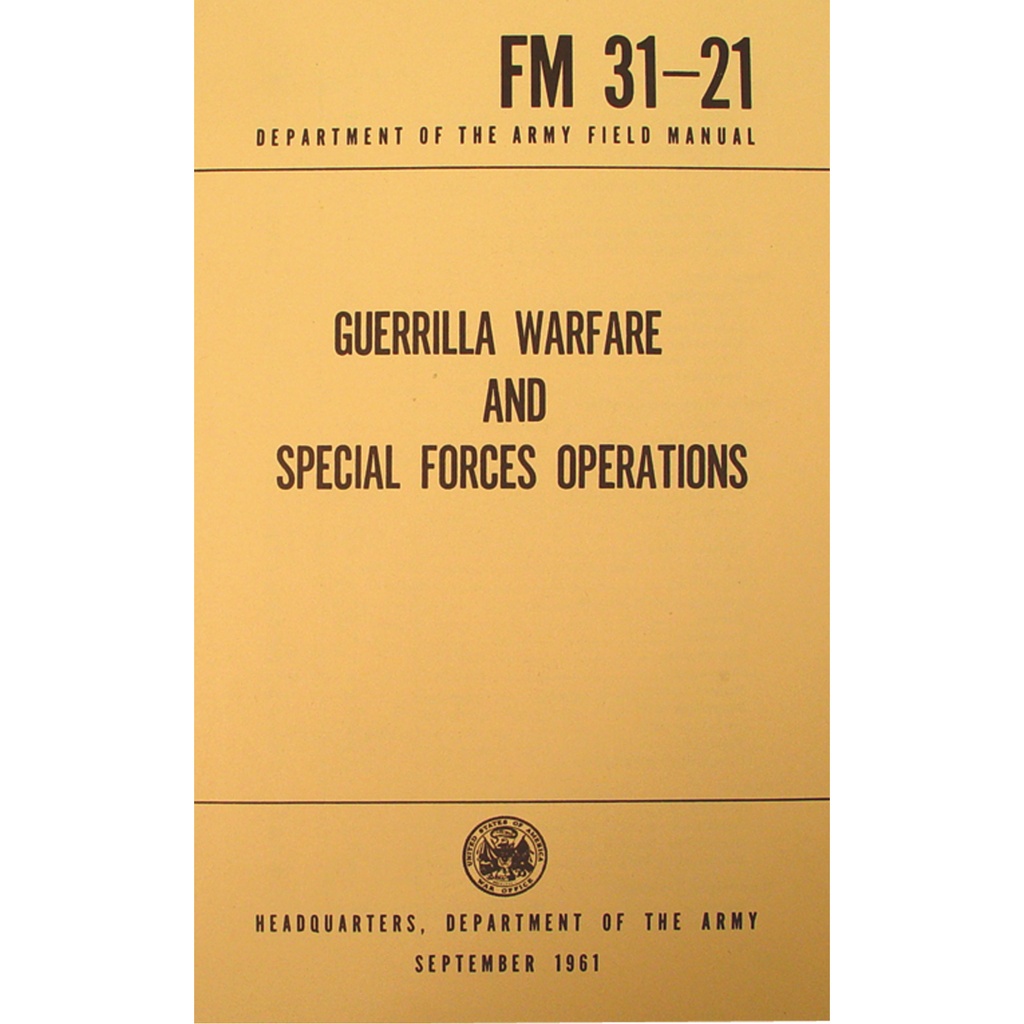
This isn’t a coffee-table prop; it’s doctrine. The Cold War Doctrine Special Forces Field Manual reprints the 1961 FM 31-21 on guerrilla warfare and Special Forces operations exactly as issued. You get structure, not fluff—organization, logistics, communications, and area command the way U.S. Army thinkers framed it in the real Cold War. The bold yellow cover and Army seal make it stand out on any shelf, while the content rewards instructors, historians, and serious students of irregular warfare.
Cold War Doctrine Special Forces Field Manual - Why This One Matters
If you collect serious gear, you already know the difference between marketing fantasy and issued reality. The Cold War Doctrine Special Forces Field Manual - Yellow Cover is firmly in the second category. This is a faithful reprint of the 1961 U.S. Army FM 31-21: Guerrilla Warfare and Special Forces Operations—the doctrine that framed how American Special Forces were expected to think, plan, and operate in the early Cold War.
Where a lot of modern "tactical" books riff on buzzwords, this one reads like what it is: a primary document from the Headquarters, Department of the Army. Clean black type, no-nonsense layout, and that bold yellow cover that might as well say: pay attention, this is official.
Inside the Manual: How Cold War Special Forces Actually Structured Operations
This field manual is valuable for the same reason a well-made automatic knife is valuable: the mechanics are exposed. You see how the system is supposed to work, step by step, without sales gloss. FM 31-21 breaks guerrilla warfare and Special Forces operations into practical, interlocking components:
- Fundamentals of guerrilla warfare – how the Army defined the mission, the environment, and the political context
- Control and organization – command structures, cells, and how to manage dispersed forces
- Logistics in denied areas – supply, caches, and sustaining operations where you technically shouldn’t be
- Intelligence and counterintelligence – gathering information while denying it to the other side
- Communications doctrine – how Special Forces were expected to move information, not just people
- Area command and coordination – the bigger-picture structure above the team level
It’s all laid out in that particular Army voice: dry, exacting, and far more revealing than it realizes. If you teach, train, or design scenarios, you’re not guessing at how things might have been done; you’re looking at how they were supposed to be done.
Collector Detail: The FM 31-21 Designation and 1961 Date Line
For collectors, details matter. The FM 31-21 code and the September 1961 date on the cover pin this manual to a very specific moment in Cold War history—post–World War II, pre–Vietnam escalation, when guerrilla warfare was shifting from theory to pressing reality. That alone makes it a clean reference point in any collection of doctrine, Cold War material, or Special Forces history.
Visual Presence: The Yellow Cover That Signals “Official”
The solid yellow cover isn’t an accident; it’s a visual language anyone who has handled U.S. military publications will recognize. High-visibility color, black block text, circular Army emblem—the whole design says issued reference, not "inspired by." On a shelf of field manuals, that yellow spine pops immediately. In a training room, it reads as authoritative from across the space.
Who This Field Manual Is Really For
This isn’t written for casual browsing. It’s for people who either work with doctrine, study it, or build on it. Typical buyers include:
- Instructors and trainers who want historical context behind modern irregular warfare concepts
- Military historians mapping how Special Forces doctrine evolved from the early 1960s onward
- Serious collectors of U.S. Army manuals and Cold War-era publications
- Writers and scenario designers who need the texture of authentic planning language and structure
It also plays well in retail environments that cater to tactical gear, military surplus, or serious outdoor and survival audiences. The yellow cover and Army emblem draw attention; the FM designation and subject matter close the sale.
Not a Novel, a Tool: How to Actually Use This Manual
Think of this manual the way you’d think of a well-built piece of kit: its value is in application. The structure lends itself to practical use:
- Lesson planning – use the doctrine sections as clean modules for classroom or field instruction
- Scenario construction – build exercises that mirror how SF teams were expected to think in 1961
- Comparative study – set this beside modern doctrine to see what’s changed and what hasn’t
- Reference and citation – because it’s an official Army manual, it carries weight in research and writing
The language is straightforward, institutional, and surprisingly accessible if you’re used to modern manuals. No fluff, no dramatics—just the framework.
What Buyers Ask Before Purchasing an Automatic Knife
This product is a book, not an automatic knife, but our core audience overlaps heavily with automatic knife enthusiasts and collectors. You care about legality, mechanism accuracy, and real-world application in your blades—and you bring that same standard to the references you buy. So we address those key questions here for your broader kit buying, while keeping the manual’s role clear.
Are automatic knives legal?
Under U.S. federal law, automatic knives (often called switchblades in statutes) are regulated by the Federal Switchblade Act. In simple terms, federal law mainly restricts interstate commerce and shipment of automatic knives, especially via the U.S. Postal Service, with narrow exceptions for military, law enforcement, and certain occupational uses. Possession and carry, however, are primarily state and local issues.
Some states allow automatic knives for general carry, others restrict blade length, opening mechanism, or where you can carry them, and a few still prohibit them outright. City ordinances can further tighten the rules. If you’re the sort of buyer who cares enough to read a 1961 field manual, you already know the drill: check your current state and local laws before you buy, carry, or ship an automatic knife. Laws change; treat online summaries as starting points, not final authority.
What’s the difference between an automatic knife, OTF, and a switchblade?
The terminology gets sloppy fast, so let’s keep it clean:
- Automatic knife – Mechanically, this is a knife whose blade opens from a closed position to a locked position by pressing a button, switch, or similar device in the handle. A spring or stored energy drives the blade open. Side-opening autos are the classic example.
- OTF (out-the-front) knife – A subtype of automatic (or manual) where the blade deploys along the axis of the handle, straight out the front instead of pivoting from the side. A double-action OTF automatic uses the same control to open and retract the blade; a single-action OTF fires automatically but must be manually reset.
- Switchblade – In most U.S. legal contexts, this is just the statutory term for an automatic knife. The law doesn’t care if it’s side-opening or OTF; if a button or similar device releases a spring-driven blade, it’s usually treated as a switchblade.
This field manual doesn’t teach you how to use an automatic knife; it teaches you how the U.S. Army thought about guerrilla warfare and Special Forces operations. But the same mindset applies: understand the mechanism and vocabulary before you start making decisions.
What makes this automatic knife worth buying?
Applied correctly: wrong category, right attitude. You’re not buying an automatic knife here—you’re buying context for the kind of operations where serious tools matter. What makes this manual worth buying is similar to what makes a good auto worth carrying:
- Authentic origin – Official Department of the Army field manual, not a secondhand summary.
- Clear structure – The doctrine is laid out logically, easy to reference and teach from.
- Defining era – 1961 Cold War perspective, before later conflicts rewrote large sections of doctrine.
- Collector credibility – FM designation, Army seal, and date line give it immediate shelf authority.
- Practical utility – Still usable today as a framework for understanding irregular warfare and SF employment.
In short: you’re not just stacking another book. You’re adding a primary-source tool to the same ecosystem as your blades, gear, and training materials.
Why This Manual Belongs Next to Your Blades
Enthusiasts who hunt for the right automatic knife for EDC or obsess over double-action OTF mechanisms are the same kind of people who want real doctrine on their shelves, not movie props. The Cold War Doctrine Special Forces Field Manual - Yellow Cover earns that space.
It’s a snapshot of how Special Forces were meant to think about unconventional war at a time when the stakes were existential. That makes it more than a collectible—it’s a reference you can actually use, a teaching tool you can lean on, and a conversation piece that stands up when someone who knows their history starts reading the fine print.
If your collection is built on authenticity, this belongs in it.