

Armory Bench M1 Garand Procedures Manual - Army Yellow
11 sold in last 24 hours
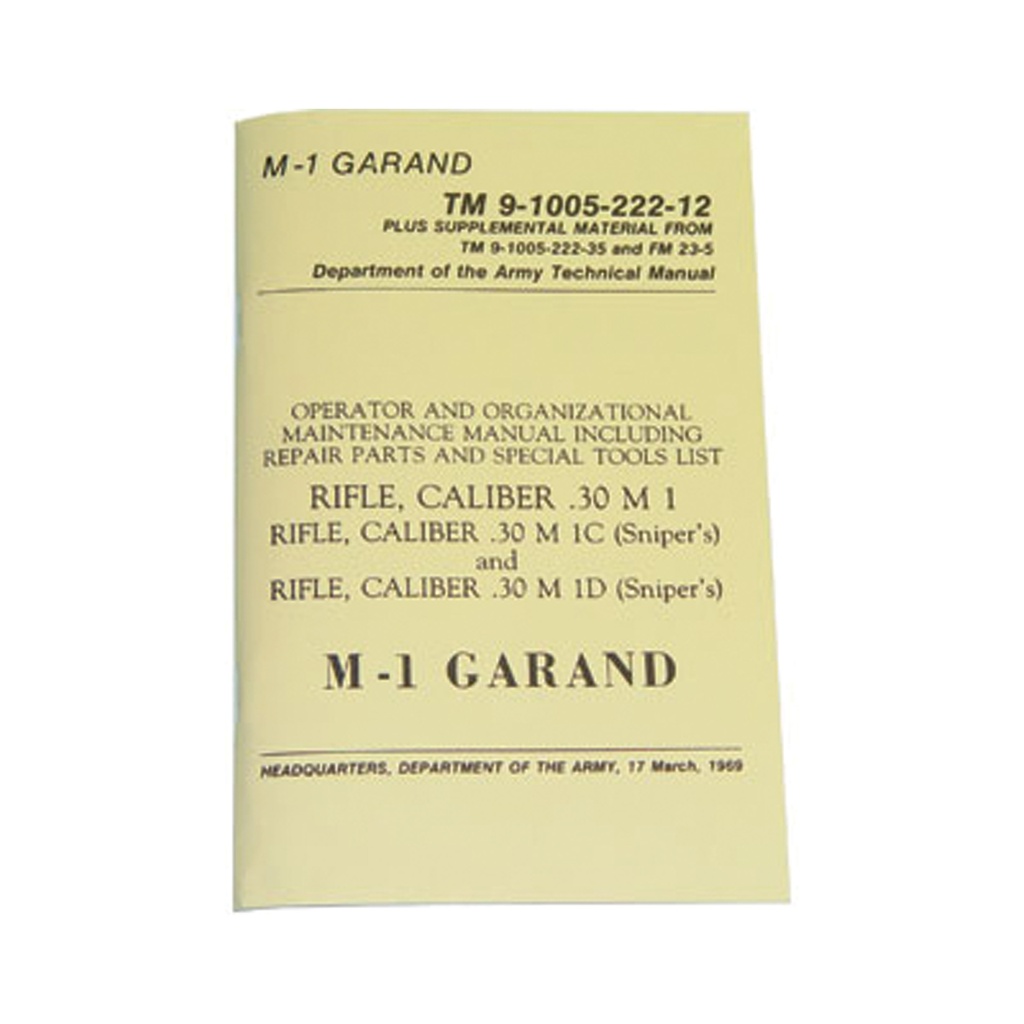
This isn’t coffee-table nostalgia; it’s the Armory Bench M1 Garand Procedures Manual in true Army yellow. A straight reissue of the Department of the Army technical format, it walks you through operator and organizational maintenance on the M1, M1C, and M1D with checklists, exploded diagrams, and repair parts breakdowns. If you run a Garand hard—across a match course or on a range line—this is the no-fluff reference that lives on the bench, not in a display case.
Why This M1 Garand Technical Manual Still Belongs on Your Bench
The Ordnance Yellow Armorer Edition wasn’t designed to look pretty on a coffee table. It was built in the Army tradition: softcover, stapled, and straight to the point. If you own an M1 Garand, M1C, or M1D and actually shoot it, this technical manual is the closest thing to having an old-school armorer leaning over your shoulder, walking you through what to do—and just as important, what not to do.
Originally published 17 March 1969 as a Department of the Army Technical Manual, this is the operator and organizational maintenance reference that keeps rifles running. No myth, no forum hearsay—just the ordnance-approved procedures, checklists, and diagrams that kept service rifles alive long before the internet existed.
Beyond the Brochure: What’s Actually Inside This Armorer Edition
Forget generic "field guides." This manual is structured the way armorers think: task-driven, procedural, and brutally clear. It covers the standard M1 rifle plus the M1C and M1D sniper configurations, and it pulls supplemental material from TM 9-1005-222-35 and FM 23-5. That means you’re not just getting surface-level care; you’re getting the connective tissue between operation, maintenance, and parts.
Procedures Written for People Who Actually Turn Wrenches
Every step is laid out in the Army’s technical format: sequence, tools, cautions, and what "right" actually looks like. From basic operator checks to organizational-level tasks, the manual breaks things down so you’re not guessing whether a symptom is normal wear or a problem in the making.
- Operator checks and function tests before firing
- Field-stripping and reassembly that match original doctrine
- Organizational-level maintenance that goes beyond wiping down cosmoline
If you’ve ever tried to diagnose a sluggish return-to-battery or odd ejection pattern and ended up in a rabbit hole of opinions, this is the book that anchors your decision-making.
Parts, Tools, and Diagrams: The Real Armorer Value
The real magic for collectors and shooters isn’t just the procedures—it’s the exploded diagrams and repair parts breakdowns. The manual doesn’t just name components; it shows you where they live in the assembly and how they interact.
- Exploded views of the M1, M1C, and M1D assemblies
- Repair parts lists that help you identify what’s actually missing or worn
- Special tools called out by function, not just mysterious stock numbers
For the modern owner, that matters. Whether you’re tracking down a correct replacement part for a restoration or just trying to confirm that the odd spring in your parts bin actually belongs in a Garand, this manual gives you ordnance-correct reference instead of internet guesswork.
Collector Authority in Ordnance Yellow
The cover tells you exactly what you’re dealing with: ordnance yellow, TM 9-1005-222-12 across the top, and the rifles spelled out in crisp black type—RIFLE, CALIBER .30 M1, M1C (Sniper’s), M1D (Sniper’s). This wasn’t designed as a lifestyle accessory; it was designed to be issued, used, and eventually oil-stained.
For collectors, that authenticity matters. Owning an M1C or M1D without the proper technical documentation is like owning a custom automatic knife without ever seeing the maker’s original notes. The manual completes the system: rifle, accessories, and the ordnance instructions that governed how they were supposed to be used and maintained.
Even if your Garand lives in a safe and only sees occasional range time, this manual adds context and credibility to the collection. It’s the difference between "I have a Garand" and "I keep my Garand to ordnance standard." Serious buyers recognize that distinction immediately.
Mechanics, Not Myth: How This Manual Changes How You Run a Garand
The M1 Garand is a mechanical system—gas-driven, timing-sensitive, and unforgiving when neglected or tinkered with blindly. This manual pulls you out of the realm of rumor and puts you squarely in the world of designed intent.
Running the Rifle the Way It Was Designed
Everything from lubrication points to function checks is presented as a system. The manual shows you:
- Where lubrication actually matters—and where too much can cause problems
- How to verify proper operation after reassembly, not just "it seems fine"
- Which components are serviceable at the operator or organizational level, and which are not
If you tune gas plugs, swap stocks, or push your rifle in competition, staying grounded in the original technical doctrine is how you avoid turning a historic service rifle into an unreliable parts blend.
Legal and Practical Context: Why a Technical Manual Still Matters
Modern firearms ownership comes with a legal and practical reality: when something goes wrong, "I saw it online" doesn’t carry much weight. Following factory and military technical standards does. A manual like this isn’t legal advice, but it is evidence that you maintain your M1 Garand according to recognized procedures, not improvised experiments.
On the practical side, a correct technical manual helps you avoid unsafe modifications, out-of-spec repairs, and guesswork on critical parts. That’s especially important on a rifle with historical value and a gas system that was never designed for abuse or casual tinkering. This is how you keep a World War II and Cold War workhorse running without turning it into a wall-hanger—or a liability.
What Buyers Ask Before Purchasing an Automatic Knife
Are automatic knives legal?
Legally, automatic knives in the United States sit under a different framework than rifles like the M1 Garand. At the federal level, the Switchblade Knife Act restricts interstate commerce of automatic knives, but it doesn’t outright ban ownership. The real complexity is at the state and sometimes local level, where laws can govern everything from blade length to whether you can carry an automatic knife concealed, openly, or at all. Some states are effectively wide open; others still treat automatic knives as prohibited weapons. Anyone looking for an automatic knife for sale needs to know their own state and local statutes cold—no manual or dealer can override bad law. Check current law before you buy, and before you carry.
What’s the difference between an automatic knife, OTF, and a switchblade?
Collectors love to argue terminology, but mechanically the distinctions are straightforward. An automatic knife is any knife where a spring-driven blade deploys from a closed position at the press of a button, lever, or similar actuator. Most side-opening autos swing the blade out on a pivot, like a conventional folder that’s spring-launched. An OTF—out-the-front—automatic knife drives the blade straight forward through a channel in the handle. Double-action OTFs both deploy and retract under spring tension with the same control; single-action OTFs fire open automatically but require a manual reset. "Switchblade" is the older, catch-all term that shows up in law and pop culture; enthusiasts typically use it as a legal category, not a mechanical one, and reserve "automatic" and "OTF" for precise action types.
What makes this automatic knife worth buying?
In the same way this M1 Garand Armorer Edition manual earns its keep by being mechanically correct and procedurally specific, the only automatic knife worth buying is one that respects its own mechanics. That means a clean, consistent action with positive lockup; a blade steel that can hold an edge under real-world use rather than just spec-sheet bragging rights; and hardware that stays tight without constant babying. Collectors look for tuned springs, well-machined channels on OTFs, and pivot geometry that keeps the blade tracking true. If the dealer can’t explain why that action feels the way it does—and why it will still feel that way after a few hundred cycles—you’re not looking at a serious piece.
For Enthusiasts Who Actually Use What They Own
If you’re the kind of buyer who cares how an automatic knife’s action is tuned, you’re the kind of owner who should care how an M1 Garand is maintained. The Armory Bench M1 Garand Procedures Manual in Army yellow is the same philosophy in paper form: original-spec procedures, honest engineering, and no fluff. It belongs on the bench next to your rifle, the same way a well-made automatic knife belongs in your pocket—not because it looks good on a shelf, but because it works exactly the way it was meant to.