Dual Assurance Backup Handcuff Keys - Brushed Steel
3 sold in last 24 hours
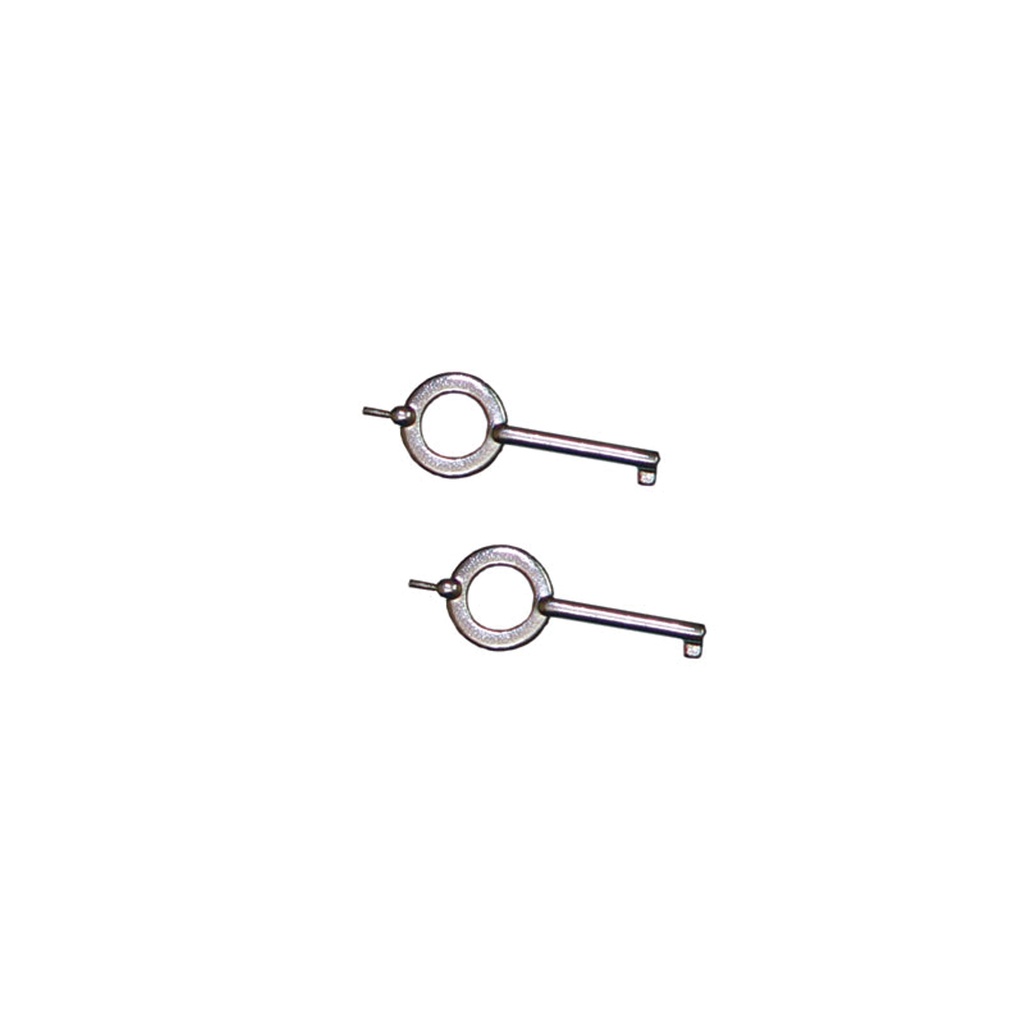
You don’t notice handcuff keys until one goes missing. These Dual Assurance Backup Handcuff Keys are built for that moment. Twin brushed steel keys with ring heads give you positive indexing by feel and a standard bit compatible with common duty cuffs. The compact profile rides clean on your keyring or in a backup stash pocket. Redundant, low-profile, and purpose-built—so when a cuff locks, you already know you’ve got a second way out of trouble.
Dual Assurance Backup Handcuff Keys - Brushed Steel
When you work around restraints, failure is never theoretical. It’s the guy twisting in the backseat, the transport that suddenly turns sideways, or the routine search that stops dead because a single handcuff key decided to disappear. These Dual Assurance Backup Handcuff Keys in brushed steel are built for that exact moment—quiet, compact redundancy that lives on your kit without demanding attention.
Serious Gear for Serious Restraint Work
These aren’t novelty keys or throw-in freebies. Each piece is a standard-pattern duty handcuff key cut from brushed steel, with a round ring head and a clean, cylindrical shaft ending in a classic handcuff bit. Opposite the shaft, you’ve got the small protruding peg designed for engaging the double-lock mechanism found on most modern law enforcement and security handcuffs.
The visual language is pure functional industrial: no logos, no decoration, no coating to chip off. Just brushed steel that shrugs off pocket time, keyring abrasion, and the grime that comes with shift work. Two identical keys give you the one thing most restraint failures come down to—a backup that’s already where you need it.
Why Twin Backup Handcuff Keys Matter in Real Workflows
Ask anyone who’s spent time on patrol, in corrections, or running private security: the weakest point in a restraint system isn’t the cuff, it’s the human with one key and too much going on. These twin ring backup handcuff keys solve that in the simplest, most reliable way—physical redundancy.
Redundancy You Don’t Have to Think About
Run one key on your main duty keyring. Stash the second in a backup location—vest pocket, belt-mounted admin pouch, inside a transport kit. If your primary goes missing in a scuffle, drops out during a vehicle transition, or simply gets left in the wrong lock at the wrong time, you’re not stuck improvising. You reach for the backup and keep working.
Tactile Indexing by Feel, Not by Sight
The round ring head isn’t a style choice; it’s a tactile advantage. Under stress, with gloved or wet hands, or in low-light conditions, the circular head lets you identify and orient the key by feel alone. That’s the difference between fumbling at the cuff and having it off in one clean, practiced movement.
Mechanical Details That Separate Duty Keys from Trinkets
Handcuff keys are simple tools, but the details still matter. The standard bit geometry is cut to interface cleanly with common duty cuffs from major manufacturers—not gimmick cuffs, not toy-store hardware. The shaft length is short and direct, reducing flex and minimizing the leverage you don’t want in a key that might be used at odd angles.
Standard Bit, Double-Lock Peg
The working end of each key is a classic, duty-style bit designed to engage the main locking mechanism reliably. Opposite that, the small peg on the ring body is there to release the double-lock—critical when you’re taking cuffs off without driving the bow deeper into the wrist. Anyone who’s seen double-locked cuffs mishandled knows how quickly that goes from routine to medical paperwork.
Brushed Steel That Takes a Beating
Brushed steel isn’t about flash; it’s about function. The finish masks minor wear, looks professional on a clean duty rig, and resists the cosmetic scars that cheaper plated keys accumulate. On a crowded keyring, these will pick up marks and keep working without flaking, peeling, or turning into pocket trash.
Carry Reality: Keyring-Ready, Pocket-Friendly, Always There
The twin ring design makes these backup handcuff keys ideal for everyday duty carry. The circular head threads easily onto a keyring, carabiner, or lanyard, and the overall profile stays flat enough not to jab through pockets or snag on gear. There’s no oversized novelty head or folding gimmick to complicate draw and deployment—just a direct, ready-to-use key.
For off-duty or low-visibility roles, one key can ride quietly in a minimalist EDC setup while the other stays staged with your active restraint kit. The compact form factor means you can hide it in places you’d never stash a full-sized training or oversized emergency key.
Legal and Policy Context: Where These Backup Keys Fit
Unlike automatic knives, OTF knives, or anything that fits the legal definition of a switchblade, handcuff keys live in a quieter corner of the law—but they’re not invisible. In most U.S. jurisdictions, owning and carrying a standard handcuff key is legal for civilians. Where things get serious is context and intent.
Many correctional facilities, courthouses, secure transport operations, and contracted security agencies have strict policies about who may carry restraint keys and how they are controlled. Unauthorized possession in those environments can be a serious offense, regardless of whether the key itself is contraband under state law. If you work in law enforcement, corrections, or private security, your agency or employer’s key-control policy comes first—full stop.
For prepared civilians, these twin ring backup handcuff keys are tools, not toys. They’re appropriate for those who legitimately run restraints as part of professional or vetted defensive training. As with any restraint gear, misuse can carry real legal consequences. Know your local laws, know the policies of any controlled environment you enter, and treat these keys with the same respect you’d give a set of cuffs.
What Buyers Ask Before Purchasing an Automatic Knife
Are automatic knives legal?
On the federal level in the U.S., automatic knives—often called autos or switchblades—are regulated mainly in terms of interstate commerce under the Federal Switchblade Act. That law restricts how automatic knives and OTF (out-the-front) knives move across state lines, but it does not outright ban ownership. The real deciding factor is state and sometimes local law. Some states allow automatic knives for everyday carry with blade length limits, some allow ownership but restrict carry, and a few still ban autos outright. Before you buy an automatic knife for sale online, you check your state and local statutes, then verify any specific rules on OTF or double-action mechanisms. When in doubt, talk to a knowledgeable dealer who respects the law as much as the hardware.
What’s the difference between an automatic knife, OTF, and a switchblade?
An automatic knife is any knife where the blade is opened by a spring or stored energy, triggered by a button, lever, or similar actuator in the handle. A side-opening automatic swings the blade out from the side like a traditional folder—just powered. An OTF knife is a specific kind of automatic where the blade deploys straight out the front of the handle. Many OTFs are double-action, meaning the same control both deploys and retracts the blade under spring tension. “Switchblade” is the older legal term that usually covers both side-opening automatics and OTF knives under the law. Enthusiasts use the more precise terms—automatic, OTF, single-action, double-action—because the mechanism matters.
What makes this automatic knife worth buying?
When you evaluate an automatic knife, you’re looking beyond “it opens fast.” You want a reliable, repeatable action—no hesitation, consistent lockup, and minimal side play in the blade. You look at the pivot design, spring geometry, and how the lock engages under pressure. Steel choice matters too: a good automatic pairs robust deployment with a heat-treated blade steel that holds an edge without being impossible to maintain. The best automatic knives for EDC also balance carry profile, ergonomics, and legal realities—blade length, configuration, and how low-profile the clip rides in pocket. A well-built double action automatic knife for sale isn’t just a toy; it’s a precision mechanism that earns its place in your daily rotation or collection case.
Built for People Who Take Their Gear—and Their Job—Seriously
If you’re the kind of buyer who can tell the difference between a sloppy OTF and a tuned automatic by feel alone, you already understand why something as simple as a handcuff key deserves the same no-nonsense approach. These Dual Assurance Backup Handcuff Keys in brushed steel are restraint tools built with that mindset: no gimmicks, no pretense, just reliable access when the cuffs are already on and the margin for error has disappeared.
Add them to your duty rig, transport kit, or prepared EDC loadout and move on. Like a well-built automatic knife for sale from a dealer who respects the mechanics, the real satisfaction is knowing that when you need this piece, it will do its job the first time, every time.