Engine Company Quick-Deploy Rescue Folder - Red Black Aluminum
5 sold in last 24 hours
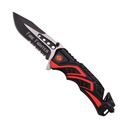
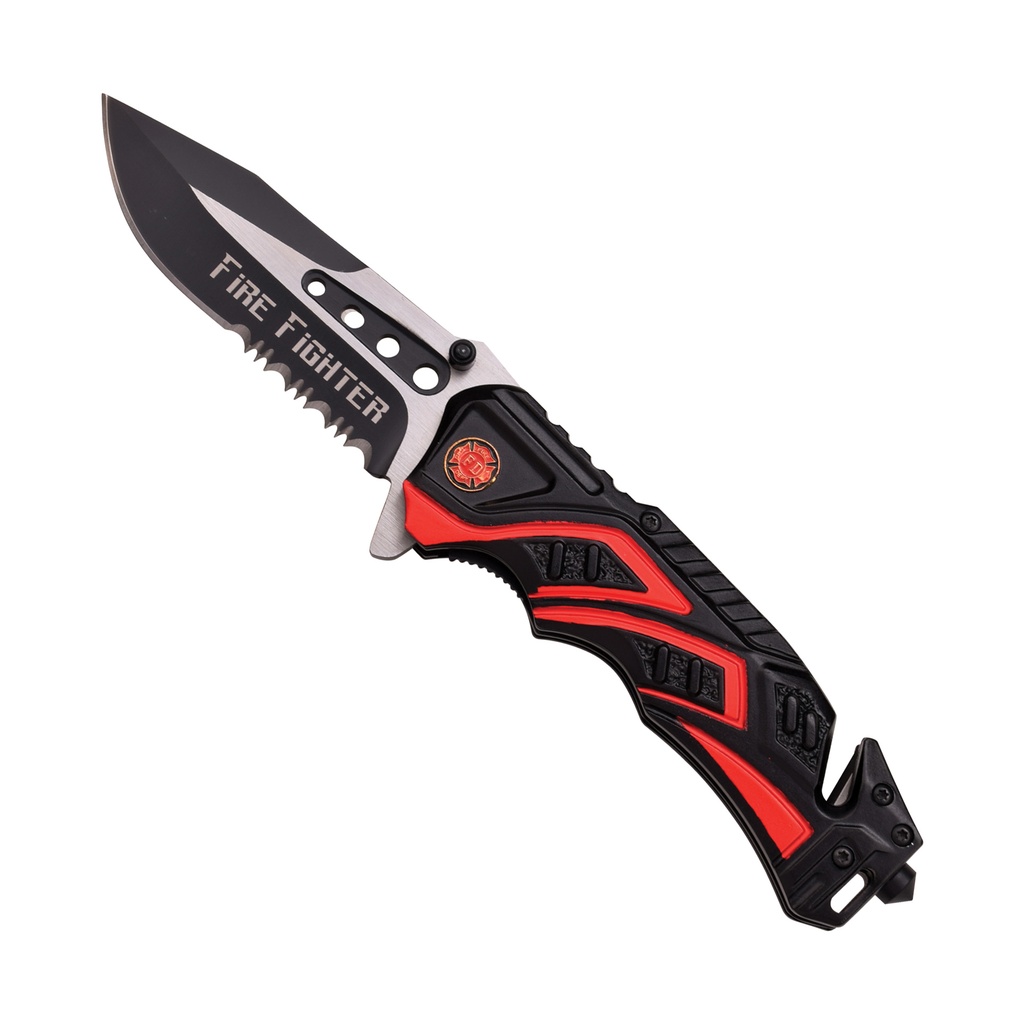
This is the spring assisted rescue knife built for the moment everything goes sideways. A two-tone, partially serrated drop point snaps out fast from thumb-stud pressure, locking up on a liner lock you can trust under stress. The red-and-black aluminum handle carries a firefighter crest, glass breaker, and strap cutter, turning a pocket-sized folder into a real rescue tool. At 4.5" closed, 8" open, it rides light, deploys quick, and earns its place on your gear every single shift.
Engine Company Quick-Deploy Rescue Folder – Built for Real Emergencies
This isn’t a novelty "firefighter knife." It’s a spring assisted rescue folder built for the seconds that actually matter. A two-tone, partially serrated drop point blade, a tuned assisted action, and dedicated rescue tools in the handle turn this into the kind of knife that belongs in a turnout pocket, on a duty belt, or clipped into your everyday kit if you’re the one people look to when things go bad.
Why This Spring Assisted Rescue Knife Deserves Space in Your Kit
Mechanically, this is a classic assisted-opening folding knife with rescue priorities baked in. Closed, it runs 4.5 inches; open, 8 inches with a 3.5-inch blade. That puts it squarely in the sweet spot for real control under gloves without becoming a brick in the pocket. The stainless steel drop point gives you a strong tip and a generous plain edge up front, with partial serrations at the base for chewing through webbing, nylon, and heavy clothing when a clean draw cut isn’t an option.
The spring assist handles deployment: start the blade with the thumb stud, and the internal torsion bar snaps it into lockup. No fumbling for a flipper tab, no awkward wrist tricks—just a positive, gloved-friendly motion and a decisive snap into the liner lock. If you’ve ever tried to open a cheap assisted folder with cold, wet hands, you know exactly why a predictable, indexed thumb stud matters.
Action, Lock, and Rescue Geometry: The Mechanics That Matter
The core of any assisted knife is the relationship between detent, spring tension, and lockup. On this rescue knife, the detent is tuned so it stays closed in the pocket but doesn’t fight you when you need it. Once you nudge the stud, the spring takes over and drives the blade to full open with a clean, audible click as the liner lock seats behind the tang.
Liner Lock You Can Read by Feel
The liner lock isn’t some thin afterthought. It presents a clear, tactile engagement point you can feel even with light gloves. That matters when you’re cutting a seatbelt from an awkward angle or using the serrations hard—your fingers need to know the lock is set without visually checking it. Disengaging is equally simple: push the liner aside and fold, exactly the muscle memory most users already have with modern folders.
Two-Tone Partial-Serration Done for Work, Not Decoration
The two-tone black-and-silver blade finish looks good, but it also helps with quick visual orientation in low light—your eye finds the edge faster against dark material. The partial serrations are cut aggressively enough to bite into webbing and synthetic straps without turning the entire knife into a serrated-only specialist. You get a plain edge forward for controlled push cuts and detail work, and a serrated section back by the handle for sawing through tough material with leverage.
Firefighter-Themed, Rescue-First: Design That Matches the Job
The handle is where this knife stops being a generic assisted folder and becomes a dedicated rescue tool. Black aluminum scales with red inlays carry a firefighter crest medallion near the pivot and the FIRE FIGHTER etch on the blade telegraphs its purpose. But the important details are at the back of the handle.
There’s a hardened glass breaker at the butt—shaped to focus impact at a small point so tempered side glass gives way with minimal strikes. Right alongside it, a strap/seatbelt cutter is cut into the handle. Slide a belt or webbing into the slot and pull: the internal edge does the work while keeping the point of the main blade away from the victim. It’s faster and safer than trying to fish a folder blade into a tight space around someone’s body.
A pocket clip on the reverse side keeps the knife riding ready without printing like a brick. At 4.5 inches closed and aluminum-handled, it’s light enough for all-day carry on duty pants, turnout pockets, or everyday jeans if you’re carrying it as a tribute piece or backup rescue tool.
Steel, Maintenance, and Real-World Cutting
The stainless steel blade is spec’d for the realities of a rescue knife: corrosion resistance first, easy field maintenance second, and long-term edge retention in a respectable middle. In the real world, this steel is going to see sweat, humidity, maybe blood, maybe salt, definitely grime. Stainless keeps rust from eating your edge between calls or shifts, and it sharpens back up without exotic stones or elaborate routines.
For the enthusiast, this isn’t a boutique powder steel showpiece; it’s a working stainless profile chosen because you can touch it up quickly and get back to service. Combine that with the partial serrations and you have a cutting tool that remains useful even after some abuse—the serrated section will continue to bite long after the plain edge is due for a tune-up.
What Buyers Ask Before Purchasing an Automatic Knife
Are automatic knives legal?
Under U.S. federal law, automatic knives (true switchblades that open fully by a button, slide, or similar device in the handle) are regulated primarily for interstate commerce, not simple ownership. The Federal Switchblade Act restricts shipping and import, with specific exemptions for military, law enforcement, and certain occupational uses. The real complexity is at the state and local level: some states allow automatic knives for everyday carry, some limit blade length or carry method, and some still restrict or prohibit them outright.
This knife, however, is a spring assisted folder, not an automatic knife or switchblade in the legal sense. You must start the blade manually with the thumb stud; the spring only completes the opening. In many jurisdictions, assisted opening knives are treated the same as standard folding knives, but you still need to check your local and state laws before carrying any edged tool—especially in duty roles, schools, government buildings, or restricted zones.
What’s the difference between an automatic knife, OTF, and a switchblade?
Collectors and serious users make sharp distinctions that matter both mechanically and legally:
- Automatic knife / switchblade: In U.S. legal language, these are essentially the same. A button, slide, or similar device releases the blade and drives it to full open under spring pressure with no continued input from your hand.
- OTF (out-the-front) automatic: A subtype of automatic where the blade travels straight out of the front of the handle. Many are double action: the same slider both deploys and retracts the blade under spring tension.
- Assisted opening knife (this knife): A folding knife where you begin opening the blade with a thumb stud or tab, and an internal spring assists the last part of the motion. Legally and mechanically, this is not a switchblade because it requires manual initiation.
This Engine Company rescue folder is firmly in the assisted opening category: thumb stud start, spring-assisted finish, liner lock hold.
What makes this spring assisted rescue knife worth buying?
For a serious buyer, it’s the combination of tuned assisted action, real rescue tools, and purpose-built firefighter identity at a size you’ll actually carry. The action is fast and predictable without crossing into automatic knife territory, the liner lock is substantial enough for hard cuts, and the glass breaker plus strap cutter turn it from "just a folder" into a legitimate emergency tool.
Add the firefighter crest, FIRE FIGHTER blade etch, and red-and-black aluminum handle, and you’ve got a piece that works as both functional rescue gear and a tribute to the job. It’s a knife you can clip into your pocket for everyday use, knowing that when someone yells for a knife, what you draw is designed for that moment.
For the Enthusiast, the First Responder, and the Everyday Hero
If you’re the kind of buyer who cares how a spring assist feels on deployment, who notices whether a liner lock truly seats, and who actually uses serrations for what they’re meant to do, this rescue folder was built with you in mind. It’s not an automatic knife showpiece or an OTF conversation starter—it’s the knife that quietly rides with you until it suddenly becomes the most important tool in your hand.
Clip it on because you respect the mechanics, you respect the job, and you want a rescue knife that earns its keep every time it opens.
| Blade Length (inches) | 3.5 |
| Overall Length (inches) | 8.0 |
| Closed Length (inches) | 4.5 |
| Blade Color | Black |
| Blade Finish | Two Tone |
| Blade Style | Drop Point |
| Blade Edge | Partial-Serrated |
| Blade Material | Stainless Steel |
| Handle Finish | Matte |
| Handle Material | Aluminum |
| Theme | Firefighter |
| Pocket Clip | Yes |
| Deployment Method | Spring-assisted |
| Lock Type | Liner lock |