Rescue Signal Spring-Assisted EMT Knife - Orange Aluminum
7 sold in last 24 hours
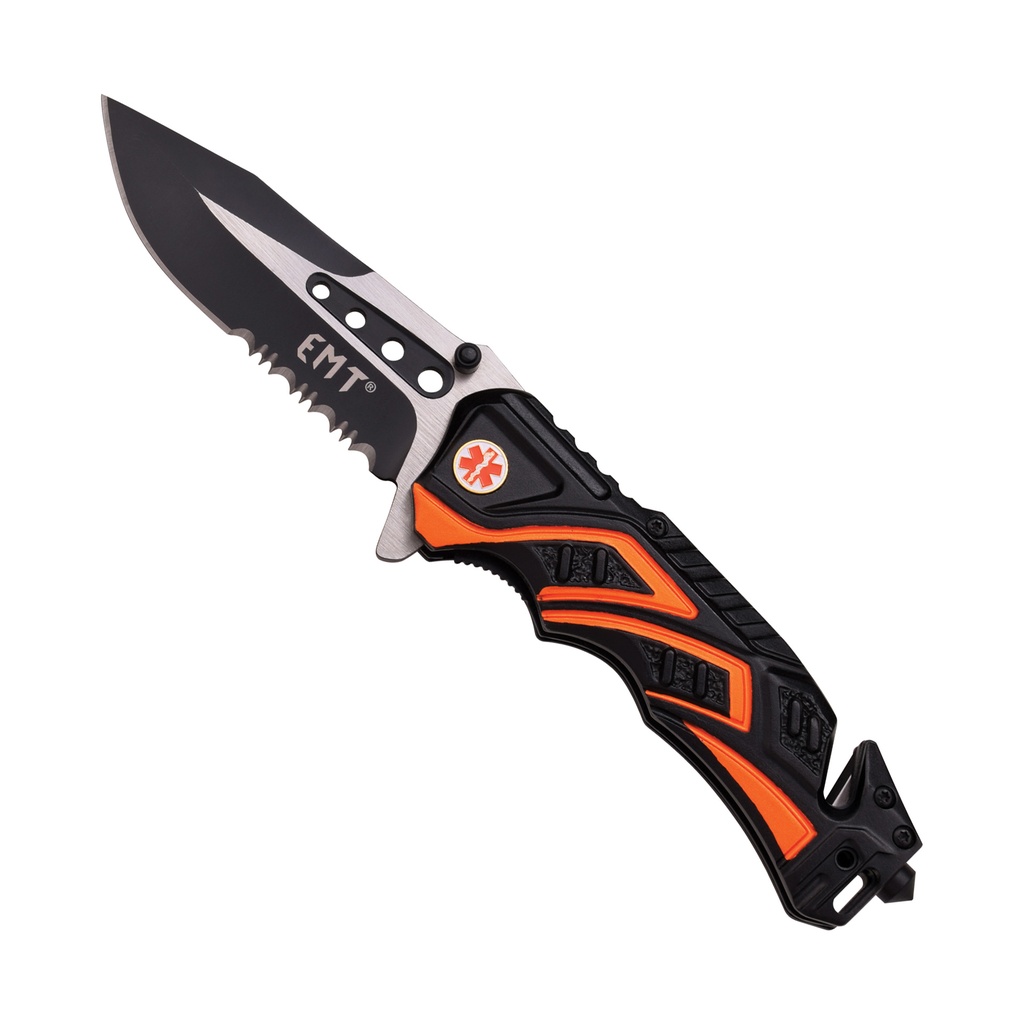
This is a spring-assisted EMT knife built for real emergencies, not just catalog photos. The 3.5" partially serrated drop point snaps open fast with a positive, liner-locking click, giving you clean push-cuts up front and aggressive serrations for seatbelts and webbing. High‑visibility orange aluminum scales, Star of Life inlay, glass breaker, and spine-mounted belt cutter turn one tool into a compact rescue kit. It carries like a regular EDC folder but works like proper EMT gear when seconds count.
Automatic Knives for Sale vs. Purpose-Built Rescue Tools
If you spend your nights browsing automatic knives for sale, you already know the difference between a toy and a tool. This spring-assisted EMT knife lives in that same world of fast deployment and purposeful engineering, but it’s tuned for rescue first, EDC second. Think of it as the EMT cousin to your favorite automatic knife: one-hand opening, confident lockup, and a blade geometry that’s actually designed to cut what needs cutting when things go sideways.
Spring-Assisted Action with Automatic Knife Intent
Mechanically, this is a spring-assisted folder, not a true automatic knife or OTF. That matters. Instead of a button-fired coil spring like a classic side-opening switchblade, you’re working with a torsion assist that takes over once you start the blade moving via the dual thumb studs. The result is a deployment that feels very close to an automatic knife in speed, but gives you a bit more control in tight spaces like a crushed vehicle interior.
The 3.5-inch partially serrated drop point is the business end: straight edge up front for push cuts and controlled puncture, with a serrated section tuned for seatbelts, straps, and heavy clothing. Paired with a matte black stainless blade and a secure liner lock, you get a tool that can be opened one-handed and trusted to stay open under load—exactly what an EMT or prepared EDC carrier actually needs.
Why the Spring Assist Matters in Real Rescue Work
With full automatics and OTF switchblades, you get violence of motion—great for quick show-and-go, not always ideal around patients, cramped cabins, or nervous bystanders. A spring-assisted mechanism gives you that fast, positive opening, but only after intentional input. You nudge the blade; the torsion bar takes it home. That reduces accidental deployment risk in pockets, gear bags, and medical kits, but keeps the knife ready for one-handed use when your other hand is bracing a patient or clearing glass.
Automatic Knife for Sale? No, This Is a Complete EMT Package
Look past the blade and you see the rest of the system. High-visibility orange aluminum scales aren’t a style choice; they’re a retrieval strategy. Drop this in a dimly lit vehicle, roadside gravel, or the back of an ambulance, and it doesn’t vanish into the background. The Star of Life inlay and EMT blade etch aren’t just graphics—they’re a reminder of the mission this knife is built around.
At the butt, the glass breaker is more than a decorative spike. It’s a dedicated point for side window access when doors won’t open and time is bleeding out with the patient. On the spine, the integrated belt/seatbelt cutter gives you a way to strip webbing and clothing without introducing a free, exposed tip near skin. Combined with the partially serrated edge, you’re effectively carrying a compact rescue suite in a familiar folding-knife footprint.
Handle Ergonomics and Real-World Control
Aluminum scales with molded finger grooves and texturing do a specific job: they lock your hand in when your grip is compromised by sweat, rain, or worse. Under stress, fine motor skills go out the window; chunky ergonomics and defined grooves take over. The liner lock engages with a clear, tactile feel so you know the blade is set before you lean into a cut. A pocket clip on the reverse side keeps it where you expect it—tip-down and ready for a consistent draw.
Buying an Automatic Knife vs. Buying a Rescue-Driven Folder
When you buy automatic knives, you’re usually chasing action, steel, and build. This piece checks the deployment box with its spring-assisted opening, but it earns its keep with purpose. It’s not a generic tactical folder painted orange; the EMT theming is backed up by hardware: glass breaker, belt cutter, high-vis scales, and a blade configuration that favors real-world rescue cutting tasks over Instagram-ready profiles.
That makes it a smart addition to the rotation for anyone who already owns a few automatics, OTFs, and classic side-opening switchblades but wants something they can toss into an emergency kit, glove box, or range bag and actually rely on in the field. It’s the knife you won’t mind abusing when the situation calls for it.
Legal Reality: Where This Sits in the Automatic Knife Landscape
From a legal standpoint, this is important: this is a spring-assisted opening knife, not a button-activated automatic knife or switchblade under most U.S. statutes. You initiate opening manually using the thumb studs, and the internal spring completes the travel. That typically puts it in a different legal category than a true automatic or OTF switchblade. Many jurisdictions that restrict automatic knives and certain OTF designs allow assisted openers for everyday carry.
That said, knife laws are a patchwork. Some states and cities write broad language that can blur the distinction between assisted opening and automatic knife mechanisms. Before you carry this or any fast-deploying folder, check your state and local regulations, especially if you’re used to navigating switchblade laws by state for your automatic collection. The short version: this is generally more carry-friendly than a full automatic, but you’re still responsible for knowing your local rules.
What Buyers Ask Before Purchasing an Automatic Knife
Are automatic knives legal?
At the federal level in the U.S., automatic knives (what many statutes call switchblades) are regulated primarily by the Federal Switchblade Act. It restricts interstate commerce and mailing of automatic knives, but doesn’t outright ban possession at the federal level. The real story is at the state and local level, where laws vary wildly: some states allow automatic knives and OTFs with no issues, others limit blade length, restrict carry to certain professions, or ban them entirely.
This knife is spring-assisted, not a true automatic knife, which usually gives it a friendlier legal profile. Still, some jurisdictions lump fast-assist folders in with automatics. Bottom line: always verify your state and local laws before buying, carrying, or using an automatic knife, OTF, or assisted opener like this as part of your EDC or duty gear.
What’s the difference between an automatic knife, OTF, and a switchblade?
“Switchblade” is the legal and cultural term most statutes use for what enthusiasts call an automatic knife: a blade that opens fully with the push of a button, slide, or similar control, thanks to an internal spring. Most classic automatics are side-opening—they pivot out like a normal folder, just under spring power.
An OTF (out-the-front) automatic knife is a subset of automatics where the blade travels linearly out the front of the handle. These can be single-action (button deploys, manual reset) or double-action (button or slider both deploys and retracts).
This EMT knife is neither. It’s a spring-assisted folder: you start the opening with a thumb stud, and a torsion spring finishes it. No button, no slider, and no fully automatic action. It gives you automatic-like speed without crossing into full switchblade territory under most definitions.
What makes this automatic-style knife worth buying?
If you already own an automatic knife or an OTF, this earns its slot because it’s unapologetically mission-driven. The high-vis orange aluminum handle, EMT markings, integrated glass breaker, and spine-mounted belt cutter aren’t gimmicks—they’re a checklist of what you actually need at a vehicle accident or medical emergency. The spring-assisted action delivers near-automatic deployment with better legal footing in many areas, and the partially serrated drop point is tuned for the materials you’ll really cut: seatbelts, clothing, cordage, and stubborn plastic.
For the collector, it’s a focused rescue piece that sits nicely alongside your more exotic switchblades and OTFs. For the EMT, first responder, or prepared civilian, it’s a tool you can carry daily and not baby. Either way, you’re choosing something built with intent, not just another black tactical folder lost in the pile of automatic knives for sale.
For Enthusiasts Who Respect Purpose-Driven Blades
If your collection already spans automatic knives, OTFs, and classic switchblades, you know that not every knife needs to be a high-end showpiece. Some need to earn their keep in the real world. This spring-assisted EMT knife brings that same enthusiast attention to action, fit, and function to a rescue platform, giving you a high-visibility, mission-built folder that actually deserves a slot next to your favorite automatic knife for sale—because when it’s time to cut, this one shows up ready.
| Blade Length (inches) | 3.5 |
| Overall Length (inches) | 8.0 |
| Closed Length (inches) | 4.5 |
| Blade Color | Black |
| Blade Finish | Matte |
| Blade Style | Drop Point |
| Blade Edge | Partial-Serrated |
| Blade Material | Stainless Steel |
| Handle Finish | Two Tone |
| Handle Material | Aluminum |
| Theme | EMT |
| Pocket Clip | Yes |
| Deployment Method | Spring-assisted |
| Lock Type | Liner lock |