Field-Saw Survival Hunting Knife - Coyote Rubber
11 sold in last 24 hours
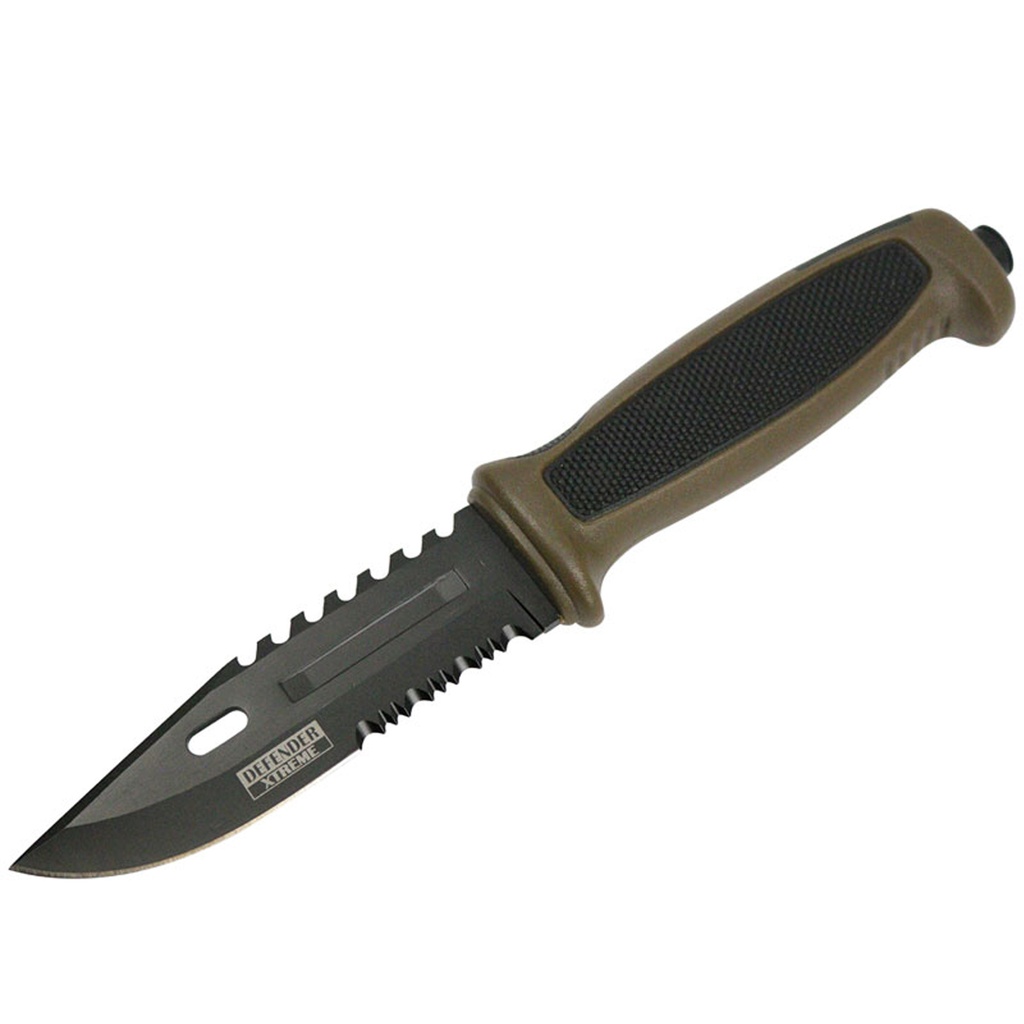
This fixed blade isn’t pretending to be pretty – it’s built to work. The Field-Saw Survival Hunting Knife pairs a 4.5" black drop point blade with upper sawback teeth and lower partial serrations, giving you bite in both directions. A full-size 5" coyote rubber handle with aggressive texturing and exposed pommel keeps the knife anchored in wet, cold hands. If your hunting and camp chores run from cutting cordage to light batoning, this is the disposable-workhorse you won’t baby.
Field-Saw Survival Hunting Knife - Built As a Tactical Field Tool
The Field-Saw Survival Hunting Knife - Coyote Rubber is exactly what it looks like: a compact, fixed blade field knife that doesn’t care about your Instagram photos. Black drop point, sawback spine, partial serrations, and a grippy coyote rubber handle – this is a tool for hunters and campers who expect a knife to live in mud, brush, trucks, and camp kits.
At 9.5" overall with a 4.5" blade, it sits in that sweet spot between nimble hunting knife and compact survival blade. It’s not a safe-queen. It’s the one you loan a buddy, beat up at camp, and don’t cry over when it comes back scraped and scarred.
Why This Fixed Blade Works in the Field
Most budget fixed blades try to look tactical while cutting corners where it matters. This one at least puts its design effort into useful geometry. The drop point profile gives you a strong tip with enough belly for general slicing – dressing game, trimming branches, breaking down cardboard back at the truck. The matte black finish cuts glare and helps hide wear, which is exactly what you want on a knife that’s going to get dragged through brush and dirt.
The sawback on the spine isn’t a precision wood saw, but it will chew through light branches, plastic, and cord when you don’t want to dull the main edge. Pair that with the lower partial serrations near the handle and you’ve got a blade that actually wants to cut rope, straps, and fibrous material instead of skating across them.
Blade Geometry and Edge Layout
The working edge is split into three functional zones:
- Plain edge at the front for controlled slicing and point work.
- Partial serrations at the base to rip through nylon, webbing, and tough packaging.
- Sawback spine for notching and rough cuts where finish doesn’t matter.
That combination makes sense on a camp and hunting knife where your "cuts" range from dressing kindling to opening feed bags.
Handle, Grip, and Real-World Control
The 5" coyote rubber handle is where this knife quietly earns its keep. Rubber isn’t glamorous, but when your hands are cold, wet, or bloody, it’s what you want. The handle is contoured with finger guard shaping to lock the hand in, and the textured black inset panels add directional grip so the knife stays put when you lean into a cut.
Rubber over metal also does something people forget about: it damps vibration. When you’re batoning light wood, prying, or doing ugly camp work, that soft overmold keeps the shock out of your hand. The exposed pommel gives you a dedicated striking surface for cracking ice, breaking light debris, or tapping in tent stakes without torturing the edge.
Size, Balance, and Carry Reality
At 9.5" overall, this is a full-hand fixed blade, not a neck knife. It’s long enough to do camp chores and short enough not to feel clumsy around game. The weight biases slightly forward thanks to the sawback and spine thickness, which helps when chopping small branches or feathering kindling – let the blade’s mass do some of the work.
Steel, Edge Holding, and the Honest Truth
The blade is a basic field-grade steel – think tough enough to take abuse, straightforward to resharpen, and not so hard you chip it the first time you hit a staple in a fence post. You’re not buying a premium powdered steel hunter here; you’re buying a work beater you can hit with a simple stone or pull-through sharpener and get back to cutting.
For a hunting knife in this price and design class, that trade-off makes sense. You get an edge that rolls before it chips, responds quickly to a field touch-up, and doesn’t punish you for rough use. On a knife meant to live in a truck box or camp tote, that’s exactly the right call.
Legal and Carry Context for a Fixed Blade Hunting Knife
Unlike an automatic knife, OTF, or switchblade, this knife is a straightforward fixed blade hunting and survival tool. That puts it under a different legal lens in most regions. Many states that tightly regulate automatic knives or folding switchblades are more flexible with fixed blade hunting knives, especially in legitimate outdoor and sporting contexts.
That said, fixed blade laws are highly local. Some states set maximum blade lengths for carry, others distinguish between open carry and concealed carry, and a few treat anything "designed for combat" more harshly. This knife clearly presents as a hunting and camp fixed blade, but it’s still on you to confirm your state and local regulations before carrying it beyond the field.
What Buyers Ask Before Purchasing an Automatic Knife
Are automatic knives legal?
On the federal level in the U.S., automatic knives and classic switchblades fall under the Federal Switchblade Act, which mainly restricts interstate commerce and shipping across state lines under certain conditions. Actual day-to-day carry is governed by state and local law. Some states now allow automatic knives and OTF designs for general or open carry; others limit them to law enforcement or have blade-length caps; a few still ban them outright.
This particular knife is not an automatic knife – it’s a fixed blade hunting knife with no spring, no button, and no deployment mechanism. It doesn’t fall under automatic or switchblade statutes in most jurisdictions, but you still need to verify your local fixed blade rules. If you’re shopping for an automatic knife for sale alongside this piece, treat legality as a separate research task for each mechanism type.
What's the difference between an automatic knife, OTF, and a switchblade?
Mechanically, here’s how they break down:
- Automatic knife: A folding knife that opens via an internal spring when you press a button, lever, or similar control. The blade usually pivots from the side like a standard folder.
- OTF knife (out-the-front): A specific kind of automatic where the blade travels linearly out the front of the handle. Single-action OTF knives deploy automatically but must be manually retracted; double-action OTF knives both deploy and retract via the same actuator.
- Switchblade: In U.S. legal language, "switchblade" largely overlaps with "automatic knife" – a knife that opens by button or similar device using a spring. Enthusiasts tend to reserve "OTF" for out-the-front designs and "automatic" for side-opening automatics, though law text often lumps them together.
The Field-Saw Survival Hunting Knife is neither automatic, OTF, nor a switchblade. It’s a fixed blade: the steel is permanently exposed and ready, with no moving parts in the mechanism.
What makes this hunting knife worth buying?
For an enthusiast or serious user, value is about honest design, not marketing. This knife gives you:
- A drop point profile that can actually process game and do camp chores.
- Partial serrations and a sawback that make sense cutting cord, webbing, and small branches.
- A full-length rubber handle in coyote that stays in your hand when it’s wet, cold, or greasy.
- An exposed pommel you won’t feel bad about pounding on.
- A steel that’s easy to tune up in the field instead of babying like a safe-queen.
It’s not a custom piece. It’s a rough-use fixed blade you can throw in a kit and forget about until you need it – and for a lot of hunters and campers, that’s exactly the knife that sees the most real-world use.
For the Enthusiast Who Owns Autos but Still Needs a Beater Fixed Blade
If you’re the kind of buyer who already knows the difference between an automatic knife, an OTF, and a classic switchblade, you also know none of those replace a solid, disposable fixed blade in the field. The Field-Saw Survival Hunting Knife - Coyote Rubber fills that role: a tough, uncomplicated companion to your more refined pieces.
Keep your precision automatic knife for sale-worthy action and collector satisfaction. Keep this fixed blade where it belongs – in the truck, at camp, and in the dirt doing the ugly work.
| Blade Length (inches) | 4.5 |
| Overall Length (inches) | 9.5 |
| Blade Color | Black |
| Blade Finish | Matte |
| Blade Style | Drop Point |
| Blade Edge | Partial-Serrated |
| Blade Material | Steel |
| Handle Finish | Textured |
| Handle Material | Rubber |
| Theme | Tactical |
| Handle Length (inches) | 5 |
| Pommel/Butt Cap | Exposed pommel |