Ridgeline Sawback Field Fixed Blade Knife - Gray Rubber
3 sold in last 24 hours
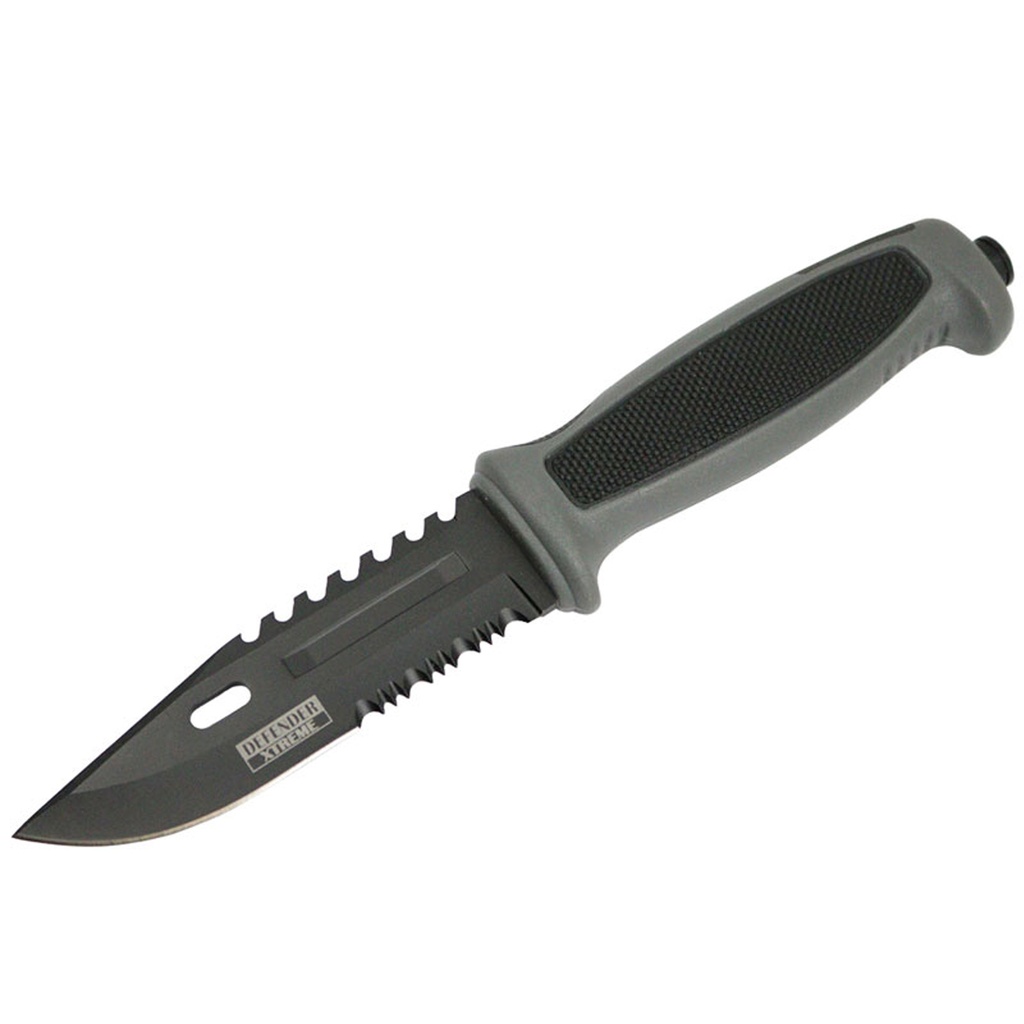
This is a fixed blade built for real field work, not glass cases. The Ridgeline Sawback Field Fixed Blade Knife pairs a 4.5" black drop point with partial serrations and a sawback spine for camp chores, game breakdown, and emergency cutting. The gray rubber handle locks into your hand when it’s wet, cold, or gloved. If you want a no-nonsense hunting and survival companion you won’t hesitate to beat on, this one earns its spot in the pack.
Ridgeline Sawback Field Fixed Blade Knife - Gray Rubber
Some knives are made to be admired. This one is made to get dirty, stay in the truck, and ride on your belt until the job is done. The Ridgeline Sawback Field Fixed Blade Knife takes the classic hunting profile and drags it firmly into tactical-survival territory with a blacked-out blade, sawback spine, and a grip that doesn’t care if your hands are cold, bloody, or soaked.
Fixed Blade Workhorse for Buyers Who Don’t Baby Their Gear
When you reach for a field knife in camp, you don’t want to wonder if the lock will hold or if the pivot has picked up enough grit to choke. A fixed blade hunting knife solves that problem at the design level: no moving parts, no deployment lag, no lock geometry to fail. You draw, you cut, every single time.
At 9.5" overall with a 4.5" drop point blade, this is right in the sweet spot for a do-everything camp and game knife. Long enough to baton kindling, spine-scrape tinder, and open a rib cage, but compact enough that you still have fine control at the tip when you’re working inside an animal or carving a notch. The partial serrations on the lower edge chew through rope, nylon straps, and tough hide without asking for a perfect slicing stroke.
Blade Geometry Built for Real Field Use
The black drop point profile is the quiet hero here. Drop points are hunting classics for a reason: you get a strong tip, plenty of belly for slicing, and a spine that can take real pressure when you’re bearing down. On this knife, that spine has been turned into a sawback, giving you a dedicated aggressive cutting surface up top while keeping a clean working edge below.
Sawback Spine and Partial Serrations: Why They Matter
The sawback isn’t just an aesthetic flex. Those teeth on the spine are there for rough work: notching stakes, scoring branches, and working through small limbs when you don’t feel like unpacking a saw. Meanwhile, the partial serrations on the primary edge give you a separate cutting zone for fibrous material—paracord, webbing, light brush—so your plain edge stays tuned for cleaner work like field dressing and food prep.
Both edges share the same steel, so maintenance stays simple: stone or rod for the plain edge, tapered rod or small file for the serrations and sawback when they eventually need attention.
Steel and Finish: Field Reality Over Hype
This is straightforward carbon steel designed to be tough, easy to touch up, and forgiving in the field. You’re not dealing with a brittle super steel here; you’re dealing with something you can throw across a workbench and not cry about. The matte black coating cuts reflection in bright sun and adds a layer of corrosion resistance—handy when the knife goes back into a damp sheath after cleaning game or cutting wet rope.
Gray Rubber Handle That Stays Put When Everything Else Is Slick
The handle is where a lot of budget fixed blades betray themselves—slab-sided plastic, hot spots, or pretty scales that get treacherous when slick. This knife goes the opposite direction with a molded gray rubber handle that’s unapologetically about grip, not glamour.
The contouring builds a natural index point so you know exactly where the edge is without looking. Textured black inlays bite just enough to keep the knife rooted when you twist or pry. There’s an integrated guard molded into the handle so your hand doesn’t slide up onto the edge when you’re driving the tip into something stubborn.
The flat pommel does double duty as a light impact surface—tapping in tent stakes, cracking ice, or giving a stuck object a convincing nudge. You’re not carrying a dedicated hammer, but you absolutely can get a few hard hits out of the butt without babying it.
Field Role: Hunting, Camp, and Rough Utility
On paper this is sold as a hunting knife. In practice, it’s a general-purpose field tool that happens to break down game just fine. The blade length is ideal for deer-sized animals, and the drop point keeps you from punching through organs when you’re careful with your angle. The serrated section handles cartilage, joints, and stubborn connective tissue without forcing you to muscle the plain edge through.
Outside the hunt, this becomes a camp knife: baton small logs, strip bark, make pot hangers, cut line, and prep food. The full-size handle works well with gloves, which matters when you’re working in cold or wet conditions. Once you’ve used a true fixed blade around camp, the idea of relying on a pocket knife for all that feels like a compromise.
What Buyers Ask Before Purchasing an Automatic Knife
This particular knife is a fixed blade, not an automatic knife, OTF, or switchblade—but the same buyers who pick up a hard-use field knife are usually the ones eyeing an automatic knife for EDC or backup. So the legal and mechanical questions still deserve straight answers.
Are automatic knives legal?
Under U.S. federal law, automatic knives (often called autos) are regulated primarily by the Federal Switchblade Act. Federal law restricts interstate commerce and shipment of automatic knives but does not outright ban simple possession by civilians. The real complexity is at the state and local level. Some states allow automatic knives with few or no restrictions, some limit blade length, some restrict carry (especially concealed carry), and a few still prohibit civilian autos altogether.
If you’re considering an automatic knife for sale alongside this fixed blade, you must check your state and local laws before you buy or carry. What’s perfectly legal in one state can be a problem across the border. When in doubt, consult current statutes or a trusted knife rights organization rather than relying on hearsay.
What’s the difference between an automatic knife, OTF, and a switchblade?
Mechanically, they’re not all the same, even if the terms get tossed around like they are:
- Automatic knife (side-opening auto): Press a button or lever and a spring drives the blade out from the side, pivoting around a hinge like a standard folder, just powered.
- OTF (out-the-front) automatic: The blade travels in and out through the front of the handle. In a double-action OTF, the same control both deploys and retracts the blade; in a single-action, the spring fires the blade out and you manually reset it.
- Switchblade: In U.S. legal language, this is essentially the umbrella term for automatic knives—any knife where the blade opens automatically by a button, switch, or similar mechanism. Enthusiasts tend to reserve “switchblade” for classic side-opening autos, but the law often treats most autos the same.
The Ridgeline Sawback is none of the above. It’s a fixed blade: no pivot, no spring, no lock, no deployment delay—just a solid piece of steel ready the moment it clears the sheath.
What makes this fixed blade worth buying?
Value on a knife like this isn’t about exotic materials; it’s about how much honest work you can get out of it without worrying. You’re getting:
- A field-proven blade length and drop point geometry that handle hunting, camp, and utility without drama.
- A sawback spine and partial serrations that give you distinct cutting zones for wood, rope, and rough material so you don’t trash your primary edge immediately.
- A rubber handle that’s engineered for grip first, with contouring and texturing that make sense in wet, cold, and bloody conditions.
- A fixed blade format that sidesteps all the mechanical failure points of folders and autos when you’re doing real work.
If you want a knife you can toss in a pack, lend to a buddy, or hammer through a weekend of hard use without flinching, this one justifies its slot in your lineup.
Carry Identity: The Knife You’re Not Afraid to Use
You don’t buy a knife like this to impress anyone at a custom show. You buy it because when something needs cutting, prying, scraping, or pounding, you reach for the tool you trust to survive bad decisions. The Ridgeline Sawback Field Fixed Blade Knife is that tool—simple, rugged, and ready to work as hard as you do.
For the enthusiast who owns high-end automatics and OTFs but still needs a fixed blade that can live in the truck or on the belt without special treatment, this is the pragmatic choice. It’s not precious. It’s useful.
| Blade Length (inches) | 4.5 |
| Overall Length (inches) | 9.5 |
| Blade Color | Black |
| Blade Finish | Matte |
| Blade Style | Drop Point |
| Blade Edge | Partial-Serrated |
| Blade Material | Steel |
| Handle Finish | Matte |
| Handle Material | Rubber |
| Theme | Tactical |
| Handle Length (inches) | 5 |
| Pommel/Butt Cap | Flat pommel |