Frontier Heritage Field Survival Knife - Brown Wood
9 sold in last 24 hours
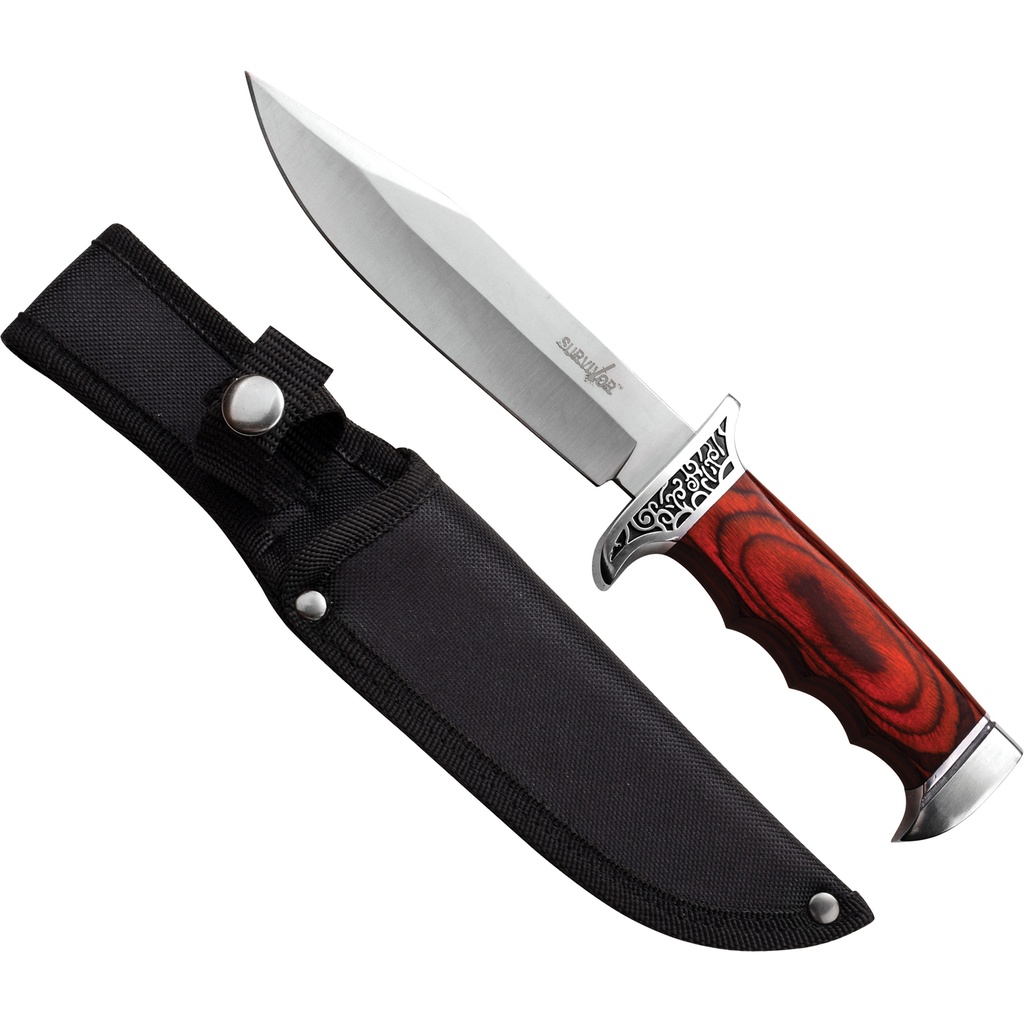
This isn’t a toy camp blade, it’s a true fixed survival knife built on a full tang and a 5.75-inch satin clip point that actually bites into wood. The brown wood handle with finger grooves locks into your grip, while the decorative guard and metal pommel keep control honest when things get slick. At 10.25 inches overall, it rides comfortably on your belt in the 600D nylon sheath, ready for camp chores, fire prep, and the kind of decisions you only make once.
Frontier Heritage Field Survival Knife - Brown Wood
Some survival knives look tactical for the catalog. This one looks like it actually belongs on your belt next to a bedroll and a coffee pot. The Frontier Heritage Field Survival Knife - Brown Wood is a classic fixed blade built around real use: full tang, honest clip point, and a handle that feels familiar the second you close your hand on it.
Why This Fixed Survival Knife Earns Its Place on Your Belt
At 10.25 inches overall with a 5.75-inch blade, this survival knife walks the line between camp utility and controlled detail work. The spine sits at about 4mm (0.157 inches), which is the sweet spot for a field knife that can split kindling, carve notches, and still slice food without feeling like a pry bar. A satin-finished clip point gives you a defined tip for precision and penetration without turning the blade into a fragile needle.
Instead of chasing trends, this knife leans into proven geometry: straight spine, subtle swedge, and a plain edge you can actually sharpen on a stone in camp. No serration gimmicks, no mall-ninja curves—just a working profile that generations of hunters and campers would recognize instantly.
Mechanics of a Trustworthy Field Blade
There’s no button, spring, or automatic action here—this is a full-tang fixed blade survival knife. The mechanism is simplicity itself: steel running continuously from tip to pommel, sandwiched in contoured wood scales. When knives live hard lives—rain, grit, campfire smoke—simple is what survives.
Full Tang Strength You Can Feel
Full tang isn’t a buzzword; it’s a guarantee that the blade and handle are one piece of steel, not a stub hidden under plastic. On this knife, you can see the tang line running the length of the handle. That means when you torque the blade through a stubborn knot or twist it out of a cut, you’re not asking a tiny hidden joint to do the work—you’re letting the entire spine carry the load.
Clip Point Geometry That Actually Works
The satin clip point gives you a real working tip without sacrificing belly. The clipped spine reduces drag in penetration cuts, while the broad primary grind maintains enough meat behind the edge for durability. For camp use, that translates to an easy transition from feathersticks and pot hooks to food prep and light game processing.
Handle Ergonomics: Brown Wood That Locks In, Not Just Looks Good
The brown polished wood handle is more than a nod to tradition. Three finger grooves index your grip every time you pick it up, wet or dry. They’re cut deep enough to matter, shallow enough not to force your hand into one position. That’s critical when you’re choking up for fine carving versus backing off for power cuts.
The decorative metal guard isn’t just show, either. Its forward quillons and scrollwork give your fingers a hard stop when you’re working in the rain or with gloves, and they add a bit of heritage character without getting caught on everything. A matching metal pommel caps the handle, helping with balance and giving you a solid end for light tapping or clearing ice and bark.
Carry, Sheath, and Real-World Survival Use
A survival knife you leave in a drawer is just decor. This one ships with a 600D nylon sheath built for belt carry so it actually rides with you. 600D nylon is the working-class standard: tough enough for brush, abrasion, and repeated draws, but light enough not to feel like armor on your hip.
The overall package is tuned for camp and backcountry: long enough for batoning smaller rounds, compact enough to stay out of the way when you’re climbing over deadfall or crawling into a tent. The satin blade shrugs off food acids and cleans up quickly, while the wood handle takes on the kind of patina collectors actually value—small scratches, stain from campfire smoke, the story of where you’ve taken it.
Collector Value in a Traditional Survival Knife
Collectors don’t just chase exotic steels and wild grinds. There’s a place in any serious collection for a classic survival knife that gets the fundamentals right. The Frontier Heritage Field Survival Knife sits in that lane: traditional clip point, full tang, and a brown wood handle with visible grain that reads more “passed down” than “pumped out.”
The scrollworked guard and matching pommel give it an old-school visual signature you don’t see on modern tactical blades. It’s the kind of piece that fills the gap between pure users and high-art customs—something you can actually take into the woods without feeling like you’re abusing a safe queen.
What Buyers Ask Before Purchasing an Automatic Knife
Even though this model is a fixed survival knife and not an automatic knife, a lot of buyers cross-shop categories. They’re looking at an automatic knife for sale for pocket carry and a fixed survival knife like this for camp and field. The questions below come up constantly when people are comparing gear and planning what rides on the belt versus in the pocket.
Are automatic knives legal?
Under U.S. federal law, automatic knives (the kind that open by a button, switch, or other device in the handle) are restricted mainly in terms of interstate commerce and import, not simple possession. The real legal friction happens at the state and local level. Some states allow automatic knives and switchblades with few or no restrictions, others limit blade length, carry method, or who can own them, and a handful still prohibit them outright.
If you’re looking for an automatic knife legal to carry, you need to check your specific state and city statutes, plus any local ordinances. This fixed survival knife avoids those automatic knife and switchblade rules entirely because it has no spring or push-button mechanism—it’s a standard fixed blade. That said, some jurisdictions still regulate blade length or fixed-blade carry, so you’re always responsible for knowing your local laws before strapping on any knife.
What’s the difference between an automatic knife, OTF, and a switchblade?
In serious knife circles, definitions matter:
- Automatic knife: A knife that opens by pressing a button, switch, or similar control in the handle. A spring or stored energy drives the blade open. Many side-opening autos fall into this category.
- OTF (out-the-front) knife: A specific type of automatic where the blade travels linearly out the front of the handle. Double-action OTF knives both deploy and retract via the mechanism; single-action OTFs deploy automatically and retract manually.
- Switchblade: In U.S. legal language, “switchblade” is essentially the statutory term that covers most automatic knives—blades that open automatically by a button, spring, or similar device.
This Frontier Heritage Field Survival Knife is none of those. It’s a fixed blade: no pivot, no spring, no automatic deployment at all. That’s exactly why many buyers pair an automatic knife for pocket EDC with a fixed survival knife like this for camp and serious field work.
What makes this survival knife worth buying?
Mechanically, it’s the full tang and 4mm spine thickness that matter first—those are the bones of a trustworthy survival knife. The 5.75-inch satin clip point keeps the geometry versatile: long enough to baton small rounds and feather sticks, fine enough at the tip for food prep and light game work. The brown wood handle with finger grooves and decorative guard gives you real control under load, not just showroom looks.
From a collector’s perspective, the classic wood-and-steel combination, visible grain, and scrollworked guard set it apart from the sea of black synthetic survival blades. It presents as a heritage-style camp knife you won’t be afraid to actually use. That balance—traditional aesthetics, functional geometry, and full-tang construction—is what makes it worth a spot in your kit or on your wall.
For Buyers Who Know Why Their Knives Matter
If you’re the kind of buyer who chooses a belt knife for batoning and camp chores, then picks an automatic knife for sale as your pocket companion, you already understand roles. The Frontier Heritage Field Survival Knife - Brown Wood is the role-player that doesn’t need a spring, button, or hype to earn trust. It’s a straightforward, full-tang survival knife that looks like it came out of your grandfather’s pack and works like something you can rely on today.
| Blade Length (inches) | 5.75 |
| Overall Length (inches) | 10.25 |
| Blade Color | Silver |
| Blade Finish | Satin |
| Blade Style | Clip Point |
| Blade Edge | Plain |
| Blade Material | Stainless Steel |
| Handle Material | Wood |
| Theme | None |
| Spine Thickness (inches) | 0.157 |
| Sheath/Holster | Nylon Sheath |