Samurai Rhythm Katana-Inspired Butterfly Knife - Silver
14 sold in last 24 hours
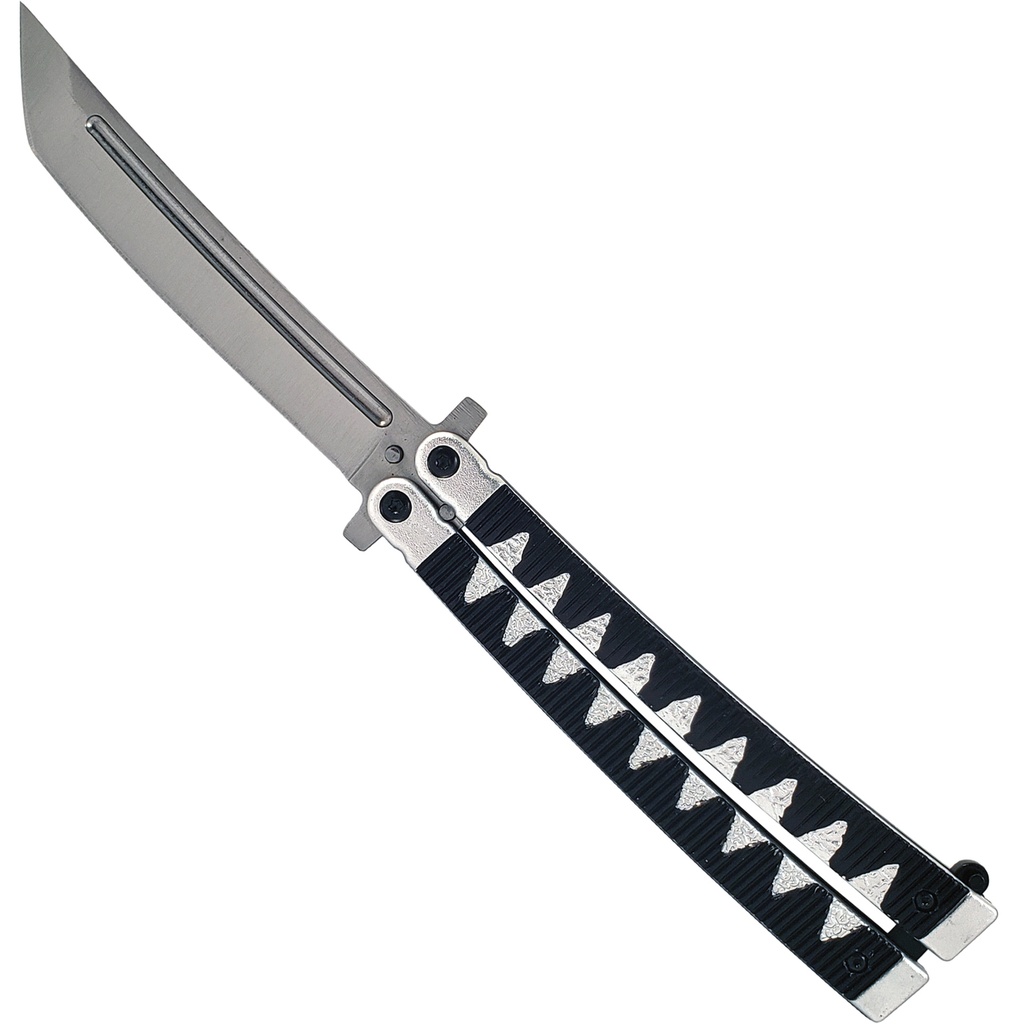
This butterfly knife brings katana lineage into a one-hand balisong platform. The stainless tanto blade rides on smooth pivots, balanced across 5.1 oz for controlled flipping and repeatable openings. A cast metal tsukamaki-style handle pattern gives you the visual of traditional sword wrap without ever loosening or fraying. At 9.75" open and 5.75" closed, it carries comfortably yet still reads "full blade" in hand—built for enthusiasts who appreciate both Japanese sword cues and clean, mechanical butterfly action.
Katana-Inspired Butterfly Knife for Sale with True Tsukamaki Lineage
If you care about how a knife moves as much as how it looks, this katana-inspired butterfly knife hits both sides of the equation. You’re getting a stainless tanto balisong with a tsukamaki-influenced handle that doesn’t pretend to be a sword—it borrows the right design language and marries it to honest, functional butterfly mechanics.
Open, it runs 9.75 inches; closed, 5.75 inches. At 5.1 ounces in the hand, this isn’t a toy-light trainer—it’s a real, live blade with enough mass in the handles for stable flipping and enough blade presence to feel like a compact sword every time it swings open.
Butterfly Knife for Sale Built Around Balance, Not Gimmicks
This isn’t some hollow-handled novelty. The solid metal handle construction and stainless blade give the knife a predictable, repeatable swing. That matters if you actually flip your butterfly knives instead of just parking them in a display case.
The latch locks the handles closed for carry, and the two-piece handle design gives you enough real estate to index, roll, and transition between grips without hunting for the sweet spot. The mass distribution is closer to a classic, neutral balisong: the 4.25-inch blade and 5.1 oz total weight keep the center of gravity where experienced flippers expect it—near the pivot, not way out at the tip or buried in the latch.
Mechanics That Make a Difference to Balisong Enthusiasts
The pivot hardware anchors the action: twin pivots set into the guard-style bolsters give the blade a straight, linear swing with less side play than cheap, riveted imports. The long fuller on the stainless tanto blade isn’t just decorative—it shaves a bit of weight off the blade, helping keep the rotation smooth instead of sluggish.
Pair that with the handle length and consistent metal construction, and you get a butterfly knife that will actually track the way your hands expect, instead of randomly over- or under-rotating mid-trick. Enthusiasts will feel that difference on the first open–close cycle.
Tsukamaki Styling, Balisong Function: Why This Butterfly Knife Works
Most so-called “samurai” knives are costume pieces: fake wraps, painted blades, manga and nothing more. This piece does something smarter. The tsukamaki-inspired pattern is cast directly into the handle, so you get the iconic diamond segments over the dark underlayer without any of the downsides of real cord—no fraying, no loosening, no soaking up sweat and grime.
The result is a butterfly knife that reads katana without being precious about it. The silver/black contrast keeps the geometry visible as the handles move, which is surprisingly useful when you’re refining openings and closings; your eye can track handle orientation faster than on a flat, monochrome slab.
Japanese Tanto Blade with Modern Stainless Practicality
The blade shape is a Japanese-style tanto: straight primary edge with a defined secondary point. That gives you a robust tip geometry that shrugs off the kind of casual abuse that would chip a more delicate profile. It’s stainless steel, matte finished to cut glare and fingerprints. Is it a boutique super steel? No. It’s an honest, corrosion-resistant stainless that sharpens easily and holds enough edge for real-world cutting without demanding a diamond bench setup every weekend.
For buyers who want something that looks like it belongs next to a katana but still wipes clean after regular use, that’s the right choice.
Butterfly Knife Carry, Use, and Where It Fits in a Collection
At 5.75 inches closed, this is in the full-size butterfly knife category, but it’s still manageable for pocket or bag carry if your local laws allow it. The weight sits in that sweet spot where you know it’s there, but it doesn’t drag like a brick. The latch keeps it locked down when closed, so you’re not fishing around a loose live blade.
In a collection, this piece pulls double duty. It’s visually strong enough to anchor a Japanese-themed row—next to tantos, wakizashi-inspired fixed blades, or anime-adjacent swords—but mechanically it belongs with the working balisongs. Flip it, don’t just look at it. The metal tsukamaki motif will outlast textiles, and the stainless blade is forgiving if you actually cut things instead of saving it for a glass case.
Collector Detail: Where This Balisong Earns Its Keep
Collectors notice small choices. Here, that’s the combination of the guard-like bolsters at the pivot and the long fuller cut into the blade. Together, they visually echo a miniaturized katana-and-tsuba layout without straying from true butterfly knife architecture. You get the cultural nod without compromising the integrity of the balisong design.
That hybrid identity—balisong function, katana visual language—is exactly what makes this worth adding if you already own a stack of standard, slab-handled butterflies.
What Buyers Ask Before Purchasing an Automatic Knife
Even though this is a butterfly knife, not an automatic knife, buyers shopping across categories—automatic knives, OTFs, switchblades, and balisongs—tend to ask the same questions about legality, mechanism, and why one design is worth owning over another.
Are automatic knives legal?
Under U.S. federal law, automatic knives (including many knives commonly called switchblades) are regulated primarily by the Federal Switchblade Act. That law restricts interstate commerce and shipment of automatic knives, but it does not outright ban simple possession for most individuals. The real complexity is at the state and local level: some states allow automatic knives and OTF knives with few restrictions; others limit blade length, opening mechanism, or carry type (open vs. concealed); a handful still prohibit possession entirely.
This particular piece is a manually operated butterfly knife. It requires intentional manipulation of the handles to open and close—no buttons, no springs, no automatic deployment. In many jurisdictions, balisongs are treated differently than automatic knives or switchblades, but some states group them together under broader definitions of restricted knives. The bottom line: before you buy or carry any automatic knife, OTF, switchblade, or butterfly knife, you need to check your specific state and local laws, and if you travel, check each destination’s rules as well. Laws change, and it’s your responsibility to stay current.
What’s the difference between an automatic knife, OTF, and a switchblade?
Mechanically, they’re not all the same thing, even though people often use the words loosely:
- Automatic knife: A folding knife that opens the blade via an internal spring when you press a button, lever, or similar control. Side-opening autos look like a normal folder until they fire.
- OTF knife (Out-The-Front): A specific type of automatic where the blade travels linearly out of the front of the handle. Many OTFs are double-action automatics—you push the slider forward to deploy and back to retract using the same spring system.
- Switchblade: In U.S. legal language, this is usually a catch-all term for automatic knives that open by spring when a button or other device is activated. In enthusiast circles, people often say “switchblade” when they mean any automatic, side-opening or OTF.
This katana-inspired knife is none of those. It’s a butterfly knife (balisong)—a manual mechanism where two handles rotate around the tang of the blade. The action comes from your hands, not from a coil spring or button. For enthusiasts, that distinction matters; for the law, it often does too.
What makes this automatic knife worth buying?
When buyers ask this, what they really mean is, “Why this knife instead of yet another generic piece?” Applied to this butterfly knife, the answer is specific:
- The tsukamaki-inspired handle pattern is cast metal, not fabric, so you get katana visuals with long-term durability and no maintenance.
- The 4.25-inch stainless Japanese tanto blade with a long fuller balances the swing, giving you predictable, smooth flipping rather than clumsy rotations.
- The weight and dimensions put it in the serious-enthusiast category—substantial enough for controlled manipulation, not just a flimsy prop.
- The guard-like bolsters and overall silhouette make it a natural bridge piece between Japanese sword-themed collections and working balisongs.
If you already own autos, OTFs, and standard butterfly knives, this one earns its slot by doing the “modern samurai balisong” thing with mechanical integrity instead of cosplay fluff.
For Enthusiasts Who Know Their Knives—Butterfly, Automatic, and Beyond
Whether your primary interest is an automatic knife for sale, a double-action OTF, or a well-tuned butterfly knife, you’re here because mechanism matters to you. This katana-inspired balisong respects that. It uses samurai cues without lying about what it is, and it gives you honest stainless steel, solid metal handles, and real flipping balance instead of empty marketing.
If you’re the kind of buyer who can explain the difference between an automatic knife, an OTF, a switchblade, and a balisong without blinking, this piece will feel like it was built for your side of the table.
| Blade Length (inches) | 4.25 |
| Overall Length (inches) | 9.75 |
| Closed Length (inches) | 5.75 |
| Weight (oz.) | 5.1 |
| Blade Color | Silver |
| Blade Finish | Matte |
| Blade Style | Japanese Tanto |
| Blade Edge | Plain |
| Blade Material | Stainless Steel |
| Handle Finish | Matte |
| Handle Material | Metal |
| Theme | Katana Wrap |
| Latch Type | Latch |
| Is Trainer | No |