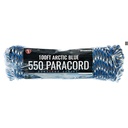
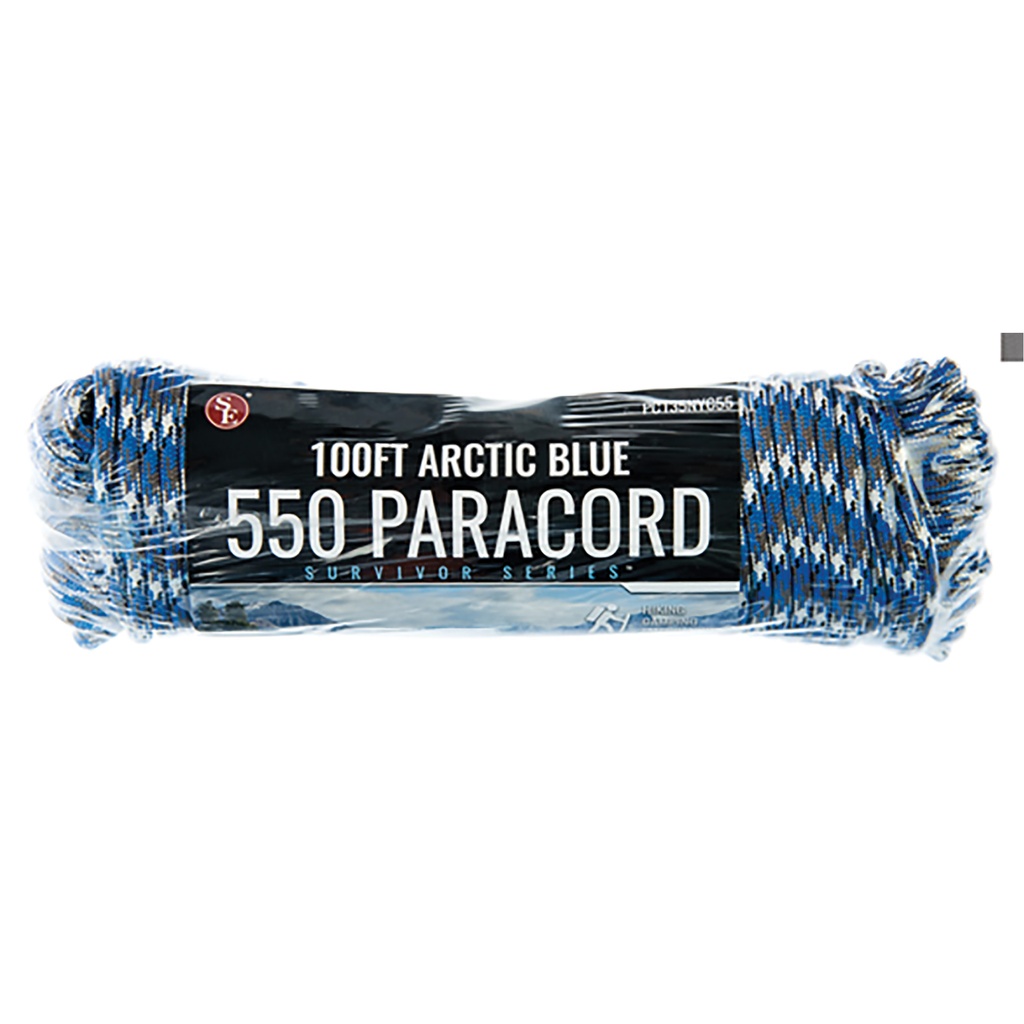
Glacier Weave Cold-Weather Survival Paracord - Arctic Blue Camo
5 sold in last 24 hours
This isn’t hobby cord—it’s Glacier Weave 550 survival paracord built for real work in cold country. Seven nylon core strands inside a tight 5/32" sheath give you a 220 lb working load and 550 lb break strength you can trust for camp lines, field repairs, or improvised lashings. The Arctic Blue Camo pattern disappears in snow and rock but stands out just enough in the gear bin. You get 100 feet of dependable cordage that knots clean, cinches hard, and holds when plans go sideways.
Why Serious Gear Users Reach for 550 Paracord First
Ask anyone who actually lives out of a pack what never leaves their kit, and 550 paracord is always in the first three answers. It’s not romance, it’s math: strength-to-weight, packability, and the simple fact that good cordage solves more backcountry problems than most gadgets. Glacier Weave Cold-Weather Survival Paracord in Arctic Blue Camo is built for that role—real 7-strand 550 cord, not decorative craft line pretending to be survival gear.
Glacier Weave Survival Paracord for Sale: Built on Real 550 Specs
The numbers matter. This 550 paracord runs a 5/32" (about 4 mm) diameter with a 7-strand nylon core, giving you a 220 lb working load and 550 lb break strength. That’s the balance you want: strong enough for serious lashings and field fixes, still supple enough to knot easily and cinch tight without fighting you. The sheath is tightly woven, which means less snagging through hardware, cleaner knots, and better abrasion resistance over rock, bark, and metal.
You’re getting 100 feet in a clean, manageable hank. That’s long enough for a full camp rig—ridgeline, guy lines, gear hang, and a few spare lengths for contingency—without turning your pack into a tangled mess of excess cord.
Cold-Weather Advantages: What Arctic Blue Camo Actually Does for You
The Arctic Blue Camo pattern isn’t just an aesthetic flex. In snow, frost, or on pale rock, the blue/white/gray/black weave breaks up the outline of your lines so your camp doesn’t look like a spider web from 50 yards away. At the same time, the darker strands give you just enough visual contrast to track your cord as you’re tying off in low light or blowing snow.
That’s the sweet spot: subtle in the environment, still readable in the hand. If you’ve ever tried to find plain white cord in patchy snow at dusk, you understand why this pattern exists.
Survival Paracord Mechanics: How 7-Strand Nylon Works in the Field
Core Strands You Can Actually Use
Real 550 paracord earns its reputation because of those seven inner nylon strands. Strip the sheath and you unlock multiple fine cords that can handle tasks your main line would be overkill for: emergency sewing, gear repairs, improvised fishing line, snares, or lightweight lashings inside a shelter. Each strand is twisted nylon—strong, rot-resistant, and less prone to sudden failure than cheap mystery fiber.
Sheath Behavior: Knots, Grip, and Wear
The Glacier Weave sheath is tight and smooth, which matters more than most people realize. A looser, fuzzy weave frays fast and grabs on everything. This cord slides through eyelets and around branches cleanly, bites down firmly when you cinch a trucker’s hitch, and releases knots without having to fight welded nylon after a night under tension. That’s the difference between gear that looks like paracord and cord that behaves like it in the real world.
Field Uses for 550 Survival Paracord That Actually Come Up
On paper, 550 paracord is “multi-use survival cordage.” In reality, it’s the backbone of your camp and emergency improvisation. With 100 feet of Glacier Weave you can:
- Run a primary ridgeline for a tarp shelter with room left over for side tie-outs.
- Split off core strands for repairs—packs, boots, straps, zipper pulls—without compromising your main line.
- Build a gear-hanging line over a fire or away from scavengers.
- Lash together poles for a field-expedient stretcher, tripod, or drying rack.
- Rig snow stakes or deadman anchors where typical tent pegs won’t bite.
And because this is nylon, not cotton or bargain-bin polypropylene, it handles moisture and temperature swings without turning brittle or rotten over a season.
Glacier Weave Paracord for Sale: What Sets This 100 ft Hank Apart
Survivor Series Design: Built to Be Used, Not Admired
This paracord sits in the Survivor Series for a reason: it’s meant to be cut, tied, scraped, and loaded, not hoarded. The hank is bundled tight under clear wrap, so it drops into a pack or drawer without exploding into a bird’s nest. Once you deploy it, the line feeds cleanly—no waxy coating, no flat spots, no stiff, plasticky feel that kinks under tension.
Length and Strength: The Real-World Sweet Spot
At 100 feet, you’re in the most efficient range for serious users. Shorter coils leave you splicing runs together; giant spools belong in the garage, not your daypack. Here, you’ve got enough 550 paracord to rig camp, share a length with a friend, and still keep a dedicated emergency reserve.
What Buyers Ask Before Purchasing an Automatic Knife
Are automatic knives legal?
Under U.S. federal law, automatic knives—sometimes called autos or switchblades—are regulated mainly by the Federal Switchblade Act. That law focuses on interstate commerce and shipping, not simple ownership. Many states now allow some form of automatic knife carry, but the details vary: some restrict blade length, some limit carry to law enforcement or active-duty military, and others still ban autos outright. Before you buy an automatic knife online or try to carry one, check your specific state and local statutes, and remember that crossing state lines can change the legal rules instantly.
What's the difference between an automatic knife, OTF, and a switchblade?
Mechanically, an automatic knife is any folding knife whose blade is deployed by a button, switch, or similar mechanism and powered open by an internal spring. A switchblade is the traditional legal and cultural term for that same broad category—side-opening autos and some OTFs often fall under that label in law. An OTF (out-the-front) knife is a specific automatic where the blade travels linearly through a channel in the handle. OTFs can be single-action (spring deploy, manual reset) or double-action (spring-powered in and out). All OTFs that fire with a button or slider are automatic knives, but not all automatic knives are OTFs.
What makes this automatic knife worth buying?
When you evaluate an automatic knife worth owning, you look past the marketing to the mechanics: lockup, spring tuning, button geometry, and how the blade steel supports actual cutting over time. The autos that deserve a place in your pocket snap open with authority but without frame twist, return to battery without chatter, and use steels heat-treated for real edge retention, not just a spec sheet flex. The right automatic knife is one you can deploy under stress, cut confidently with, and close safely—with an action you never get tired of cycling.
Why Glacier Weave Belongs in the Same Kit as Your Best Automatic Knife
If you care enough to choose a properly tuned automatic knife for EDC or field work, you already understand the logic behind carrying real 550 paracord. Both are about capability per ounce. Your auto handles the cutting; Glacier Weave 7-strand survival paracord handles the tying, hauling, fixing, and improvising. The Arctic Blue Camo pattern keeps you visually in tune with cold-weather environments, and the 100 ft length with true 550 specs means you’re not guessing at what your cord can handle when it matters.
Pair your favorite automatic knife with cordage that respects the same philosophy: equipment matters, and Glacier Weave survival paracord earns its space in your pack.