Metro Response Rapid-Access First Responder Bag - Urban Gray
13 sold in last 24 hours
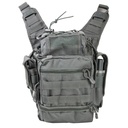
This isn’t a fashion backpack, it’s a Metro Response rapid-access first responder bag built for when the street goes sideways. Seven disciplined compartments, full-wrap MOLLE, and fast-draw mag pouches keep critical gear staged, not buried. A discreet rear concealed carry pocket rides flat against the body, while the padded tuck-away strap lets you run it crossbody or stow it clean. For the responder or prepared civilian who hates rummaging under stress, this is organized readiness in urban gray.
Automatic Knife Enthusiasts Still Need Serious Carry
If you’re the kind of buyer who compares double-action OTF lockup to side-opening automatic timing, you already know one thing: the gear AROUND your blades matters just as much as the knives themselves. A well-built utility bag is the sheath for your whole response kit. The Metro Response Rapid-Access First Responder Bag in urban gray is exactly that — a compact, crossbody tactical utility bag built for people who actually run their gear, not pose with it.
Think of it as your off-body command center: mags, med, light, multitool, backup automatic knife, notebook, gloves — every piece has a lane and you can find it blind. No digging, no fishing past loose junk, no missed beats when seconds count.
First Responder Utility Bag for Sale with True Rapid-Access Layout
Most bags advertised as “tactical” are just hiking packs in a darker color. This first responder utility bag is laid out for real work: seven functional compartments arranged so your primary tools live closest to your draw side, not buried in a top dump pocket.
The front stack gives you tiered zip compartments for staging everyday tools and flat items: tourniquets, pressure dressings, nitrile gloves, notebook, ID, shears. Side-mounted quick-access magazine pouches keep pistol mags or similarly sized tools locked in with elastic retention — you can index and draw them by feel. Behind all of that, a main compartment with mesh and nylon dividers separates bulkier kit, backup light, portable charger, or even a compact trauma insert.
At the body side, a discreet rear concealed carry pocket runs the length of the bag. That panel is where a lot of responders and prepared carriers stage either a compact firearm, a backup automatic knife in a sheath, or sensitive documents they don’t want in an outward-facing pocket. It sits flat, close, and less exposed to casual view.
Why This First Responder Utility Bag Carries Like a Purpose-Built Tool
Carry comfort and draw consistency aren’t luxuries when you’re already juggling duty belt, vest, or a layered EDC. This bag is designed to ride low-profile and predictable.
Padded, Tuck-Away Shoulder Strap That Works Under Stress
The padded shoulder strap is built to ride crossbody, spreading weight along the harness-style structure instead of biting into one point. When the strap gets in the way — vehicle work, tight spaces, or you’re switching to another carry style — it tucks away clean. No wandering webbing, no loose ends wrapping themselves around your seatbelt or snagging on a door handle.
Full-Wrap MOLLE That Actually Adds Capability
Full-wrap MOLLE isn’t just a design flex — it turns this into a scalable platform. You can run it slick and compact, or lace on additional pouches: radio, IFAK, knife sheath, admin panel. Because the MOLLE grid runs across front and around the sides, you can bias the added weight toward your strong side, keeping the draw stroke clean whether you’re going for a tourniquet or a blade.
Built for Urban Environments: Gray PVC That Blends, Not Broadcasts
Tactical doesn’t have to scream for attention. The urban gray PVC construction gives this first responder utility bag a muted, professional profile: it reads like serious gear, not cosplay. In a city environment — hospitals, office buildings, public spaces — that matters.
PVC brings two quiet advantages: durability and weather resistance. Synthetic PVC-backed fabric shrugs off grime, light rain, and the occasional concrete scrape better than fashion-grade textiles. Wipe it down, keep moving. The matte finish avoids shine and reflection under streetlights or interior lighting. Hardware, buckles, and zipper pulls are all spec’d to be worked with gloved hands, which any EMT, LEO, or prepared civilian who drills in cold weather will appreciate.
What Serious Buyers Look for in a Utility Bag for Sale
Intentional Compartment Design
Seven compartments sounds like a spec sheet number — until you realize they’re not random pockets. There’s a logical map: fast-access front, supporting gear mid, protected and discreet rear. It’s the same design discipline you respect in a well-tuned automatic knife: clean path, no wasted motion, no mystery friction point waiting to fail under pressure.
Modularity Without Chaos
Full-wrap MOLLE, hook-and-loop panels, and clean internal dividers give you modularity without turning the bag into a dangling mess. The hook-and-loop front panel takes ID, agency markings, blood type, or morale patches — whatever you use to instantly identify your role or kit type on scene.
What Buyers Ask Before Purchasing an Automatic Knife
Are automatic knives legal?
Under U.S. federal law, automatic knives (including side-opening automatics and OTF knives) are regulated mainly at the point of interstate commerce — the Federal Switchblade Act restricts interstate shipment and certain importation, but it does not outright criminalize ownership for most civilians. The real deciding factor is state and sometimes local law. Some states allow automatic knives for carry with few limits, some allow possession but restrict concealed carry, and others still heavily restrict or ban them.
If you’re pairing this first responder bag with an automatic knife for duty or EDC, you need to check your state and local statutes: blade length limits, concealed vs open carry rules, and any specific prohibitions on "switchblade," "automatic," or "OTF" mechanisms. When in doubt, consult current state code or a qualified attorney — not just a forum post.
What’s the difference between an automatic knife, OTF, and a switchblade?
Enthusiast terms matter. An automatic knife is any knife that opens its blade using a spring or stored energy, triggered by a button, lever, or similar control. Most side-opening autos fall into this category — you press the button, the blade swings out from the side under spring tension.
An OTF knife (out-the-front) is a specific type of automatic where the blade travels linearly out of the front of the handle. Within OTFs, you get single-action (spring deploys the blade, but you manually reset it) and double-action (spring both deploys and retracts the blade via the sliding control). All OTFs that deploy by a button or slide are automatic knives, but not all automatic knives are OTF.
Switchblade is essentially the legacy legal term used in statutes and older writing for automatic knives. In many laws, “switchblade” and "automatic knife" are functionally the same bucket: a blade that opens automatically by button, switch, or similar device in the handle. Enthusiasts tend to prefer the more precise “automatic” and reserve “OTF” for that specific deployment style.
What makes this automatic-knife-ready bag worth buying?
If you carry an automatic knife for duty or serious EDC, this bag respects that mindset. It gives you rapid-access storage that matches the speed and reliability you expect from a good auto: magazine pouches you can hit without looking, a rear concealed pocket that keeps a backup blade or firearm flat and indexed, and a compartment layout that stays predictable under stress.
Instead of tossing your OTF or side-opener into a cluttered backpack, you can anchor a sheath on the MOLLE, stage your med kit where your support hand finds it every time, and still have structured space left for admin and comms. It’s not just a way to carry more — it’s a way to carry smarter, with the same mechanical intent you apply when choosing a double-action automatic knife for EDC.
Built for the Enthusiast-Responder Who Chooses Gear on Purpose
If you’re the type who can explain why one automatic knife’s lock geometry inspires more confidence than another, you’re also the type who will feel the difference between a random sling bag and a purpose-built first responder utility platform. This urban gray, PVC-built carry gives you structure, speed, and modularity without drama.
Whether you’re law enforcement, EMS, security, or a civilian who actually trains, this first responder utility bag for sale slots cleanly into your system. It doesn’t try to replace your belt or your pockets — it supports them, the way a good piece of kit should. Set it up once, drill with it, and every pocket, mag, light, and knife will be exactly where your hands expect it to be when the situation turns real.