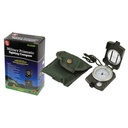
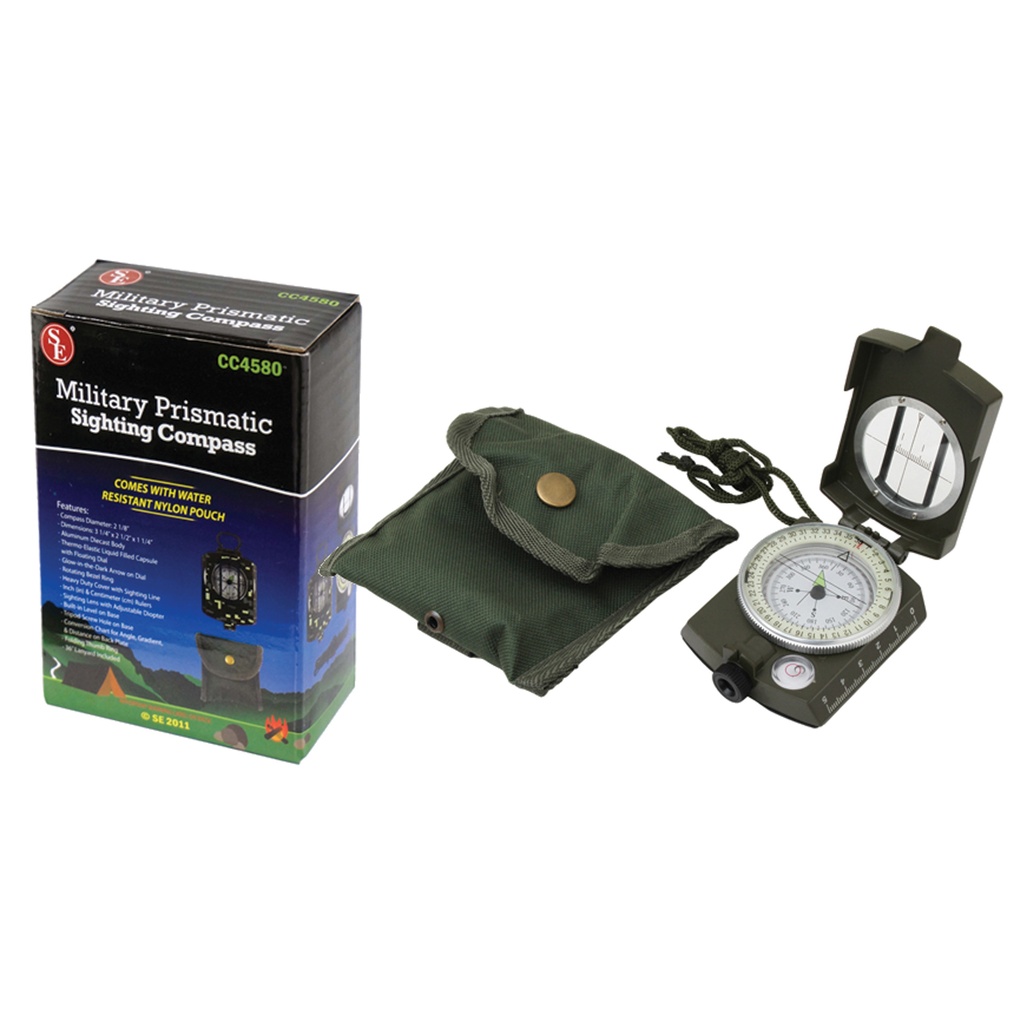
Trailline Prism Sighting Field Compass - OD Green Aluminum
15 sold in last 24 hours
A compass like this isn’t decoration; it’s how you stay found. The Trailline Prism Sighting Field Compass in OD green aluminum is built for real navigation, not keychain duty. The liquid-filled, glow-in-the-dark dial stays readable when the light dies, while the prism sighting lens and adjustable diopter let you lock in precise bearings. Level it on a tripod, read off the integrated rulers, and you’ve got a stable, repeatable reference that doesn’t care if your electronics just quit.
Tripod-Ready Field Compass for Serious Land Navigation
The Trailline Prism Sighting Field Compass - OD Green Aluminum is what you reach for when you actually need to know where you are, not just vaguely point north for Instagram. This is a classic military-style lensatic compass with a tripod-ready base, bubble level, and prism sighting system built for accurate bearings over real terrain.
Die-cast aluminum housing, OD green finish, glow-in-the-dark dial, and a liquid-filled capsule: nothing here is ornamental. Every piece has a job — stability, legibility, or precision — and it earns its place in the kit.
Field-Grade Construction That Survives Real Use
Start with the body. The die-cast aluminum case gives you the right kind of weight — heavy enough to sit solidly on a map or tripod plate, light enough to carry all day. The folding cover protects the dial and prism in transit, and the OD green finish speaks the right language: this is tactical, not toy-store camping gear.
The capsule is liquid-filled to dampen needle swing, so when you pause to read a bearing, the card settles fast instead of wobbling. Paired with the bubble level window on the base, you can level the compass before reading, which is exactly what you want when you’re doing tripod-mounted sighting over distance.
Precision Sighting: Where This Compass Earns Its Keep
The heart of any serious field compass is how you sight, not how pretty the dial looks. Here you get a prismatic sighting lens paired with an adjustable diopter — the same basic architecture used in classic military lensatic designs for a reason. Instead of guessing at degrees from arm’s length, you bring the compass up, focus the prism, and read a sharp bearing while you stay locked on your target.
The glow-in-the-dark dial is there for low-light work. After a charge from any light source, your degree markings stay visible long enough to get your reading without fumbling a flashlight. The rotating bezel lets you set reference directions or work simple resection and intersection problems the way land-nav instructors actually teach them.
Tripod Socket: Stable Bearings Over Distance
Where this model separates itself from commodity compasses is the tripod-ready base. The built-in tripod socket lets you mount the compass, level it using the bubble, and then take steady, repeatable sightings. That’s a meaningful upgrade if you’re working with maps, plotting lines, or training teams — or if your navigation standard is something more demanding than “roughly that way.”
Built-In Rulers for Map Work
The integrated rulers along the base aren’t decoration. They allow quick distance estimation and map work without hunting for an extra straightedge. Combine that with a steady tripod mount and you’ve got a compact field station for plotting, not just a pocket trinket.
Carry-Ready Kit: Pouch, Lanyard, and Field Details
A good tool is one you actually carry. The included OD green, water-resistant nylon pouch rides on a belt or pack strap with a simple snap closure. It’s not overbuilt or overdesigned — it just protects the compass from the usual field abuse. The woven neck lanyard gives you a second carry option if you want fast access while moving.
Folded, the compass is compact enough to disappear into a pocket or pouch, but when opened and leveled on a tripod it behaves like a much larger, more specialized instrument. That size-to-function ratio is what makes it a smart piece of kit for scouts, SAR training, or anyone who still trusts a map and compass more than a blinking arrow on a screen.
Why Enthusiasts Choose a Lensatic Compass Like This
Collectors and serious outdoor users aren’t impressed by shiny plastic bezels. They look for mechanical fundamentals: stable housing, damped movement, clear sighting system, and hardware that interfaces cleanly with the rest of their gear. This tripod-ready lensatic checks those boxes without pretending to be anything it’s not.
The prism sighting lens and diopter adjust like proper field optics. The bubble level turns the base into a stable platform instead of a guesswork operation. The glow dial and rotating bezel work together for quick, no-nonsense navigation tasks. All of that in OD green aluminum with a belt pouch is exactly what experienced users expect from a practical field compass.
What Buyers Ask Before Purchasing an Automatic Knife
Are automatic knives legal?
Under U.S. federal law, automatic knives (often called switchblades) are regulated by the Federal Switchblade Act. It restricts interstate commerce and mailing of automatic knives, but does not outright ban simple possession at the federal level. The real limitations live at the state and sometimes local level. Some states allow automatic knives for almost all adults, some restrict blade length, and others limit carry to law enforcement or active-duty military. Before you buy or carry an automatic knife, you need to check the current knife laws in your specific state and municipality, including whether automatic opening mechanisms are treated differently from manual or assisted-open folders.
What's the difference between an automatic knife, OTF, and a switchblade?
An automatic knife is any knife that opens its blade using a spring or stored energy when you press a button, lever, or switch in the handle. A switchblade is the classic legal term for this same family of knives — side-opening autos, primarily — and that term is what shows up in most statutes. An OTF (out-the-front) automatic is a specific subtype where the blade travels out of the front of the handle instead of pivoting out of the side. OTF models can be single-action (you manually reset the blade) or double-action (the same control deploys and retracts the blade). All OTF automatics are automatic knives, but not all automatic knives are OTF, and in serious discussions "switchblade" is usually reserved for legal language and traditional side-opening autos.
What makes this automatic knife worth buying?
When you evaluate an automatic knife, the same fundamentals that make this compass appealing apply: mechanism integrity, repeatable precision, and hardware that’s built for the job, not the packaging. A worthwhile automatic knife has a reliable, consistent spring drive; tight lockup without blade play; pivot and sear geometry that don’t chew themselves to death; and steel that can take and hold a real edge. The difference between a throwaway auto and one you’ll actually carry is the same gap between a toy compass and this tripod-ready lensatic — repeatable performance when conditions get ugly.
Closing the Loop: Gear for People Who Take Navigation Seriously
If you’re the kind of buyer who reads the spec sheet instead of the slogans, this OD green lensatic compass makes sense. It’s a tripod-ready, prism sighting instrument in die-cast aluminum, with a liquid-filled capsule, bubble level, and integrated rulers — a field tool built on the same principles that separate serious automatic knives from gas-station specials.
Whether you’re teaching land nav, building a backup kit that doesn’t depend on batteries, or you just want navigation gear that works as hard as you do, this compass earns its space in the pack the same way a well-built automatic knife earns pocket time: through precise, dependable mechanics.