Ravenflight Balance-Tuned Throwing Axe - Black Paracord
15 sold in last 24 hours
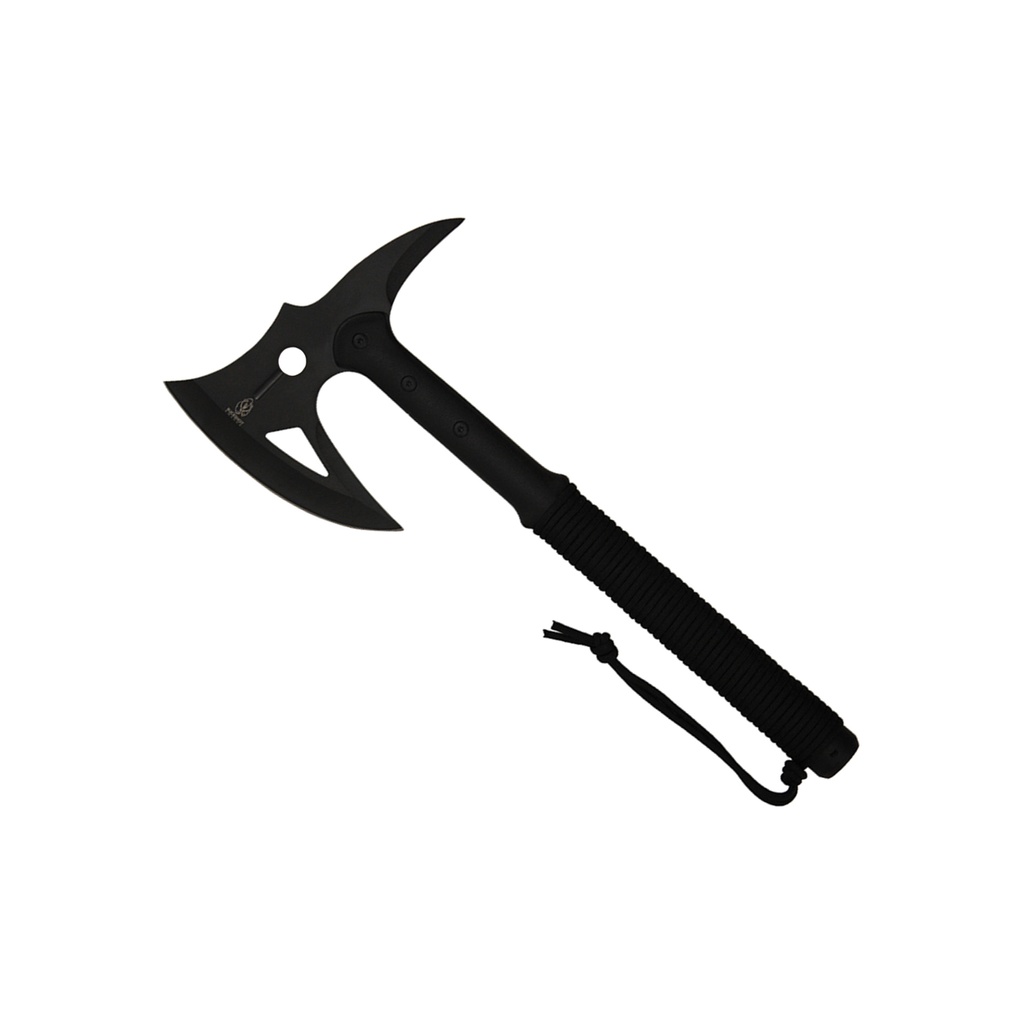
This isn’t a wall-hanger, it’s a purpose-built throwing axe that actually flies right. Ravenflight Balance-Tuned pairs a wide, double-edged head and circular cutout with a straight, 17-inch handle wrapped in black paracord for predictable rotation and secure recovery. The matte black finish holds up to repeated impacts, while the included nylon sheath keeps carry clean between lanes. For backyard sessions, club nights, or field drills, this is the thrower you bring when you care how your axe hits, not how it photographs.
Ravenflight Balance-Tuned Throwing Axe - Black Paracord
Some tools are built to split wood. This one is built to fly. Ravenflight Balance-Tuned is a modern throwing axe with one job: leave your hand clean, track a consistent arc, and hit the target with authority. No gimmicks, no fantasy edges — just geometry, weight distribution, and grip that make sense the moment you start throwing.
Why This Throwing Axe Earns a Spot Beside Your Automatic Knife
If you’re the kind of buyer who cares about action on an automatic knife, you already understand why balance matters on a throwing axe. The Ravenflight’s wide, double-edged head and large circular cutout aren’t just for looks. That cutout pulls mass away from the center, tightening the rotational behavior so you get a smooth, predictable spin instead of a wobbling, tail-heavy flop.
At 17 inches overall with a 7.375 x 6.25-inch head profile, this axe sits in the sweet spot between beginner-forgiving and competition-ready. Long enough to read clearly in the air, compact enough to cycle fast at the line. The straight handle means you don’t fight a flare or palm swell on release — your hand slides off clean, which is exactly what you want if you’re tuning half- and full-rotation distances the way you’d tune deployment timing on a double-action automatic.
Design for Throwers Who Pay Attention to Details
The all-black, matte finish isn’t about tacticool points. It cuts glare under range lights and hides the scuffs you’re going to earn on steel, wood, and rubber targets. The subtle logo is there, but it doesn’t turn the head into a billboard. This is equipment, not cosplay.
The paracord-wrapped handle does two things well: it gives you a consistent, lightly compressible surface to index your grip, and it adds just enough friction to stay put until you choose to let go. Under the cord, the handle is straight and fastened cleanly to the head — no loose scales, no hot spots. The attached lanyard is there for security on carry and retrieval, not as an afterthought.
True-Balance Feel Through the Throw
Balance on a throwing axe is the equivalent of lockup on an automatic knife — if it’s wrong, nothing else matters. The Ravenflight’s double-edged head, circular and triangular cutouts, and straight handle work together to keep the center of mass forward enough for a confident bite, but not so extreme that it yanks out of your hand. You feel the head lead the motion, then rotate around a stable axis. Once you find your distance, that rotation becomes repeatable muscle memory instead of a guessing game.
Impact, Retrieval, and Range Reality
On impact, the curved primary edge wants to dig and stick rather than bounce. The rear spike earns its keep on shorter-distance throws and unconventional targets, giving you more options when you’re working different lanes or improvised backstops. The nylon sheath keeps the edges under control between throws and during transport, so you’re not dragging bare steel around the truck or range bag.
This Throwing Axe for Sale Is Built for Real Practice
Ravenflight wasn’t built to pose with. It was built for backyard leagues, club nights, and field training — anywhere you’re putting steel into targets on purpose. The straight handle and consistent grip surface mean new throwers aren’t fighting the tool while they learn, and experienced throwers can start dialing distances and rotations almost immediately.
If you already buy automatic knives for their action quality, this throwing axe hits that same nerve: you’ll notice the way it leaves your hand, the way it tracks, the way it lands. It feels tuned, not generic.
Steel, Edges, and Maintenance Mindset
This is a throwing axe, not a scalpel. Edge geometry leans toward durability over hair-splitting sharpness, the same way a hard-use automatic knife often trades a bit of pure slicing performance for strength. That’s a good thing — repeated target impacts punish thin edges. Put a working edge on it, keep the bevels true, and resist the urge to over-sharpen. You want clean bites and clean retrieval, not a fragile showpiece.
What Buyers Ask Before Purchasing an Automatic Knife
Are automatic knives legal?
In the U.S., automatic knives (true push-button or lever-deployed blades) are regulated at two levels. Federally, the Switchblade Knife Act restricts interstate commerce and mailing of automatic and switchblade knives, with carve-outs for military, law enforcement, and certain occupational uses. Day-to-day carry and ownership, however, are decided at the state — and often city or county — level. Some states allow automatic knives with few limits, others restrict blade length, opening mechanism, or who can carry them, and a handful still prohibit them outright. Before you buy or carry any automatic knife, check your current state and local laws from a reliable, up-to-date source; regulations change, and “it was legal where I bought it” is not a defense.
What’s the difference between an automatic knife, OTF, and a switchblade?
Mechanically, an automatic knife is any folding knife where a spring drives the blade open when you hit a button, lever, or hidden release — no manual flick required. A side-opening automatic looks like a standard folder, but the blade swings out from the side on a pivot. An OTF (out-the-front) automatic sends the blade straight out of the handle along a track instead of pivoting; double-action OTFs both deploy and retract under spring tension via a sliding switch. “Switchblade” is the older umbrella term used in law and pop culture for many automatic designs, especially side-openers, but enthusiasts use the more precise language: side-opening automatic, single-action OTF, double-action OTF, and so on. All three terms show up in law, which is why understanding the mechanism really matters.
What makes this automatic knife worth buying?
When you shop an automatic knife for sale, you’re paying for action quality: how cleanly it fires, how solid it locks, and how the mechanism holds up after hundreds of cycles. Blade steel and grind determine how long it cuts between sharpenings and how it behaves under real use. Hardware — pivots, springs, button fitment, track machining on an OTF — separates serious tools from novelty. Look for precise lockup with minimal blade play, a deployment that’s fast without feeling violent or gritty, and materials matched to the job: tougher steels for hard-use autos, finer steels and finishes for collection-driven pieces. A good automatic feels tuned, the way a good throwing axe like Ravenflight feels balanced. That’s what makes it worth owning.
Who Buys a Throwing Axe Like This?
Ravenflight speaks to the same mindset that buys a well-made automatic knife: you care how the mechanism behaves. You notice balance, release, rotation, impact. You’d rather own one piece of gear that’s been thought through than five that were just painted black and called “tactical.”
If you spend your nights at the range, at club throw lines, or in the yard working on one more clean stick, this throwing axe fits right beside your favorite OTF or side-opening automatic. It’s gear chosen by someone who actually uses what they buy, and that shows every time it leaves your hand and hits its mark.