Rigid Control Hinged Duty Handcuffs - Nickel Silver
14 sold in last 24 hours
These aren’t toy cuffs; they’re Smith & Wesson hinged duty restraints built for real control. The rigid hinge limits wrist rotation, making it harder to twist, spin, or run once they’re on. Heat-treated internal lockworks, smooth ratchets, and a positive double-lock system deliver the same confidence officers rely on. If you care about professional-grade restraint gear instead of costume props, these nickel-finished hinged handcuffs are the serious, no-nonsense option.
Professional-Grade Hinged Handcuffs for Buyers Who Refuse Toy Gear
When you choose handcuffs, you’re choosing control. Smith & Wesson hinged handcuffs aren’t cosplay hardware or novelty props – they’re duty-built restraints designed to limit movement, resist tampering, and hold up to real-world abuse. The nickel-finished hinged handcuffs on this page are exactly that: professional tools made for buyers who understand the difference.
Why Hinged Handcuffs Matter When You Actually Need Control
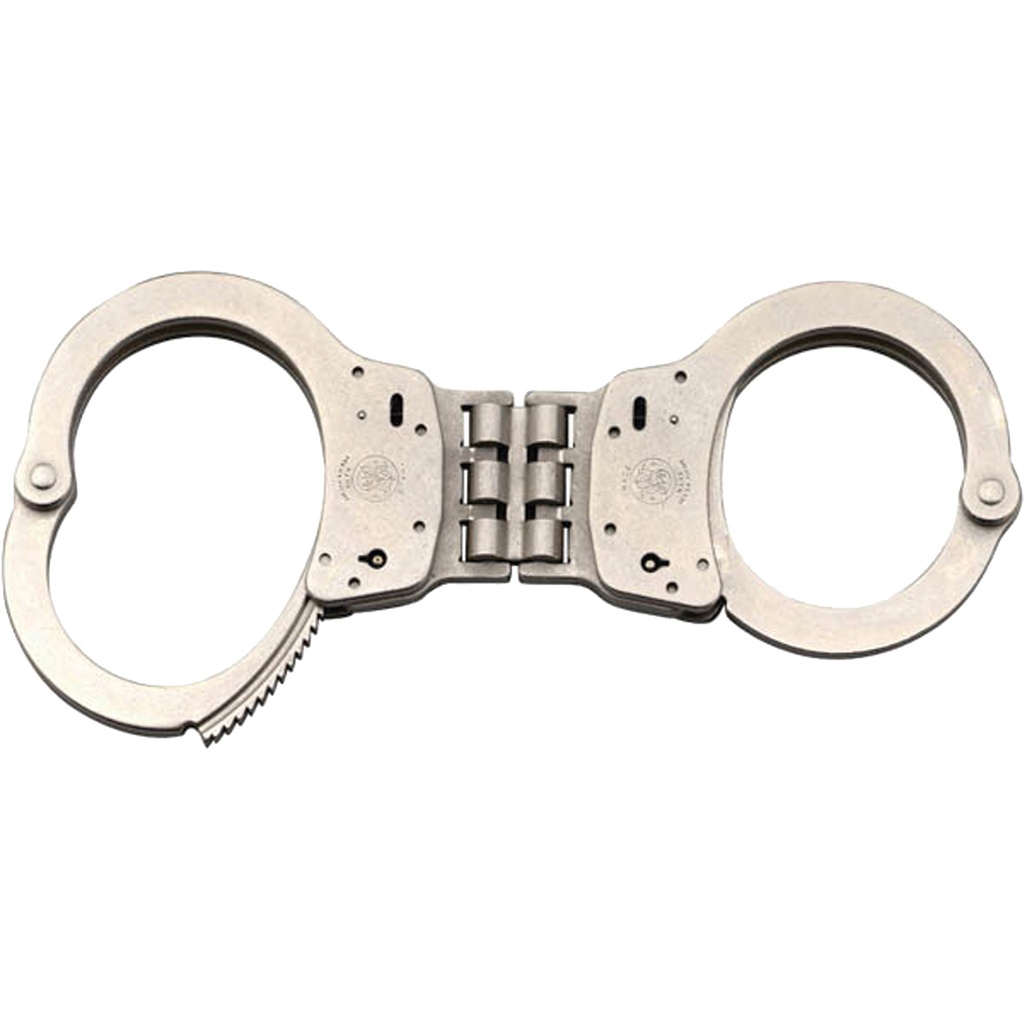
Most people know the classic chain-style cuffs. They’re common because they’re forgiving and allow more wrist mobility. Hinged handcuffs are different by design. The rigid three-link hinge between the bracelets cuts down on wrist rotation and reduces a subject’s ability to torque, spin, or thread the chain under their feet.
On these Smith & Wesson hinged cuffs, that hinge is the heart of the design. The short span and solid links bring the wrists closer together and create a more predictable, controllable body position. In a vehicle, in tight quarters, or during transport, those small mechanical differences translate into fewer surprises and better leverage for the person holding the keys.
Double Locking That Treats Tampering as Part of the Job
Any serious restraint needs a double-lock that’s easy to engage under stress and brutally reliable once set. These Smith & Wesson hinged handcuffs use a proven double-lock slot configuration on each cuff. Slide the double-lock pin or tool into the slot, feel the positive engagement, and you’ve just removed the ability for the bracelet to ratchet tighter on the wrist.
That matters for two reasons: safety and security. Safety, because you’re not sawing into tissue if the subject struggles. Security, because once double-locked, the mechanism resists the classic tricks – tightening against a hard surface to free space, or working on the bow to walk it back a notch.
Internal Lockworks Built for Repetition, Not Display
Inside the nickel shells, the lockworks are heat treated for strength and wear resistance. That’s not marketing fluff – heat treatment is what keeps the pawls and internal components from rounding off or deforming after thousands of cycles. Smooth ratchets are more than a nice feel; they’re faster cuffing, more consistent engagement, and less fumbling when seconds count.
Every set of these hinged duty handcuffs meets or exceeds U.S. National Institute of Justice standards for strength, corrosion resistance, and tamper resistance. That’s the baseline you want: third-party-tested performance, not just a brand stamp.
Nickel Finish, Duty-Ready Construction, Zero Flash
The nickel finish on these handcuffs hits the right balance between corrosion resistance and low-maintenance duty use. It shrugs off sweat, humidity, and daily carry in a patrol bag or duty belt, yet it’s not some mirror-polished showpiece. The aesthetic is simple: light silver, industrial, and built to disappear into a professional kit.
Edges are smooth, pivot points are riveted and clean, and the exposed ratchet teeth are uniform and well-machined. This is Smith & Wesson doing exactly what they’re known for: functional, repeatable restraint hardware that doesn’t get cute with design. Everything you see serves the mechanics first.
Who Buys These Smith & Wesson Hinged Handcuffs?
These are for buyers who want authentic restraint gear, not stage props. Typical owners fall into three groups:
- Law enforcement and security professionals who prefer hinged cuffs for closer control, transport stability, or specific agency standards.
- Training environments that require realistic restraints that behave like duty cuffs, with reliable single and double lock performance.
- Collectors and serious gear enthusiasts who want real, NIJ-compliant Smith & Wesson hardware in their kit instead of pot-metal imitations.
If you’re counting on your handcuffs to actually restrain a human who doesn’t want to be restrained, this is the end of the novelty conversation.
What Buyers Ask Before Purchasing an Automatic Knife
Are automatic knives legal?
Under U.S. federal law, automatic knives (true switchblades) are regulated mainly in terms of interstate commerce and importation, particularly under the Federal Switchblade Act. For individual ownership and carry, the real story is state and sometimes local law. Some states allow automatic knives with few restrictions, others limit blade length, opening mechanism, or where they can be carried, and a handful still prohibit them outright or restrict them to law enforcement and military. Before you buy an automatic knife or consider any automatic knives for sale, you need to check the current knife laws where you live and where you plan to carry – including city or county ordinances. Laws change, so rely on up-to-date state resources or reputable knife law summaries, not rumors.
What’s the difference between an automatic knife, OTF, and a switchblade?
An automatic knife is any folding knife that opens its blade by pressing a button, lever, or hidden actuator in the handle – a spring drives the blade open from a closed and fully retained position. A switchblade is essentially the same class in legal language: a knife whose blade is released automatically by a button or similar mechanism. An OTF (out-the-front) knife is a specific style of automatic where the blade deploys straight out the front of the handle instead of pivoting out from the side. OTFs can be single-action (one-button deployment, manual retraction) or double-action (the same control both deploys and retracts the blade). All OTFs that fire via a spring and button are automatic knives, but not all automatic knives are OTF.
What makes this automatic knife worth buying?
When you evaluate an automatic knife for sale, you’re really judging three things: action, lockup, and materials. A good automatic fires with authority – consistent spring energy, no sluggish deployment, no partial opens. The lock should engage fully with minimal blade play, and the button or actuator should have clear, deliberate engagement rather than a vague, mushy feel. Then look at steel and construction: reputable blade steel with known heat treatment, solid pivot work, and tight machining. The automatic that deserves a place in your EDC or collection combines snappy, reliable action with steel you trust and build quality you won’t be embarrassed to hand to another enthusiast.
Why This Product Fits Beside a Serious Automatic Knife Collection
If your gear drawer already has carefully chosen OTFs, side-opening automatics, and tuned EDCs, a pair of genuine Smith & Wesson hinged handcuffs belongs in the same category: real tools, not replicas. The same mindset that pushes you to learn the difference between a single-action and double-action automatic should push you to recognize the difference between duty-grade restraints and cheap costume metal.
These nickel-finished hinged handcuffs deliver what serious buyers respect: proven mechanics, heat-treated internals, NIJ-compliant strength, and a design that prioritizes control over theatrics. If you build your kit on function first and appearance second, this is the restraint choice that aligns with the rest of your gear.