Ronin Tsukamaki Grip Butterfly Knife - Blue Finish
7 sold in last 24 hours
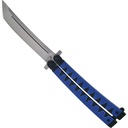
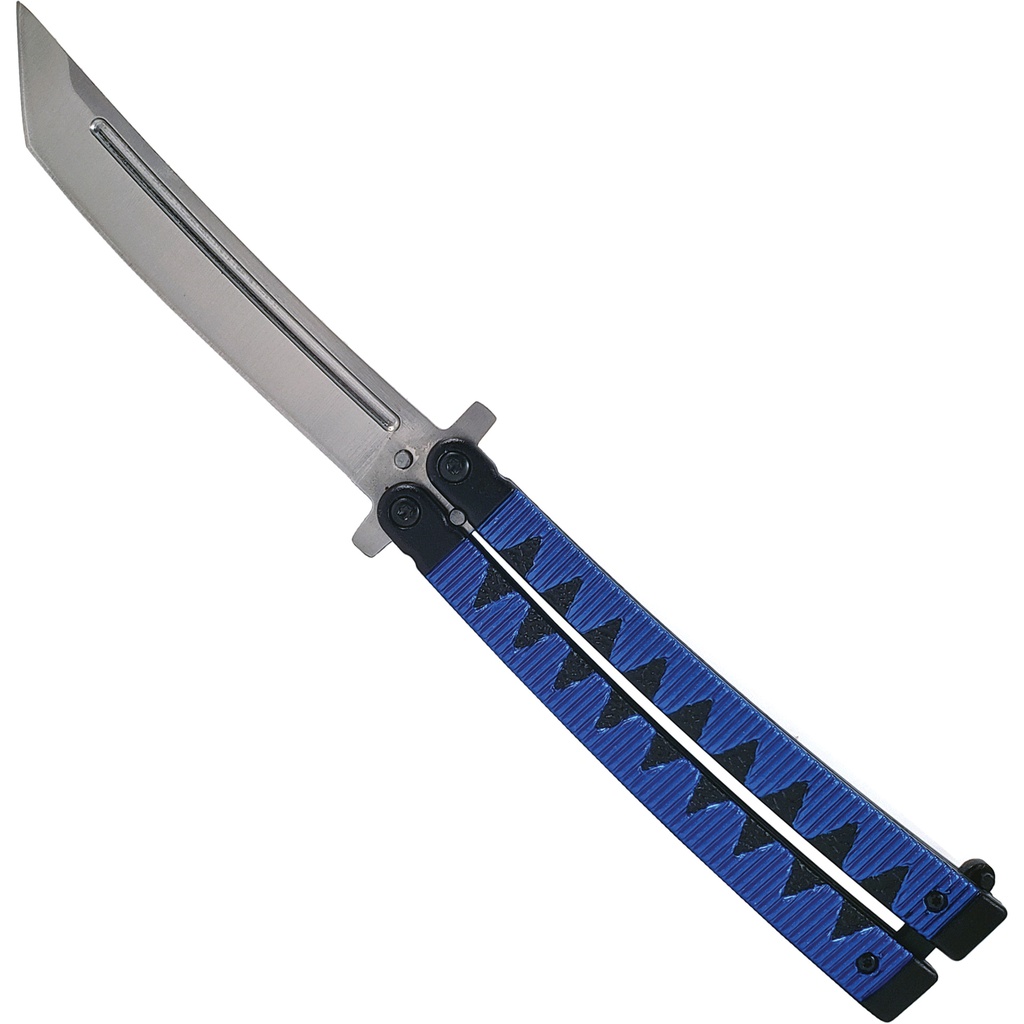
This isn’t another generic flipper. The Ronin Tsukamaki Grip Butterfly Knife brings katana-inspired lines to a full-size balisong, with a 4.25" Japanese tanto blade riding between blue anodized metal handles. The tsuka-style grip pattern gives real purchase when you’re cycling tricks, and the balance point lands right where an experienced flipper wants it. A classic latch keeps it locked down when closed, while the matte stainless blade and fuller deliver serious display presence for anyone who actually cares what their butterfly knife looks and feels like.
Butterfly Knife Precision for Collectors Who Notice the Details
The Ronin Tsukamaki Grip Butterfly Knife - Blue Finish is what happens when a balisong builder actually studies Japanese sword geometry instead of just slapping a tanto label on a blade. This is a true butterfly knife — dual handles rotating around a central pivot, live edge, classic latch — wrapped in a modern samurai aesthetic that holds up under real use, not just Instagram lighting.
Automatic Knife for Sale? No — A Purpose-Built Butterfly for Flippers
Let’s be clear on mechanism. This is not an automatic knife, not an OTF, and not a push-button switchblade. It’s a traditional butterfly knife (balisong): manually opened, rotation-driven, and all about inertia and balance. Enthusiasts who buy an automatic knife for sale are chasing spring-driven deployment. Balisong buyers are chasing fluid transitions, clean rollovers, and a handle/blade relationship that feels tuned instead of thrown together.
At 9.75 inches overall with a 4.25-inch stainless steel Japanese tanto blade, this piece sits squarely in full-size territory. Closed, you’re at 5.75 inches — the sweet spot where you get enough handle length for tricks without turning it into a clumsy baton. At 5.1 ounces, it has enough mass to carry momentum through aerials, but not so much weight that it becomes fatiguing in long sessions.
Why This Balisong’s Action Matters as Much as Any Automatic Knife for Sale
Collectors who buy automatic knives for the crisp snap of a coil spring will recognize a different kind of satisfaction here: tuned rotational action. Because the handles are metal with a matte finish and black hardware, the pivots have a consistent, predictable feel as you cycle the knife. There’s no gritty start-stop, no weird flex where the handles meet the tang — just a smooth, repeatable swing.
Handle Geometry and Balance: Where the Magic Lives
The blue anodized metal handles do more than look good. That tsukamaki-inspired triangular pattern isn’t just cosmetic — it breaks up flat surfaces and gives your fingers reliable indexing points during openings, rollovers, and transfers. The balance sits right around the pivot line, which is where experienced flippers want it for controlled, mid-speed manipulation. Too handle-heavy and you fight the knife. Too blade-heavy and every aerial feels like a gamble. This one lands in that practical middle ground.
Blade Profile: Japanese Tanto with a Working Edge
The blade is a Japanese tanto style with a long, clean primary edge and a defined secondary point, finished in a matte silver that reads more “tool” than “trinket.” The fuller running down the center isn’t just for looks — it takes a touch of weight out of the blade, helping keep the balance from drifting too far forward while giving the profile that sword-like line that katana fans recognize instantly.
What Buyers Think About Before They Buy an Automatic Knife (or Balisong)
If you’re the kind of buyer who compares an automatic knife for sale with a balisong on the same shopping trip, you’re weighing three things: mechanism, control, and satisfaction. An automatic or switchblade gives you instant deployment with a button or lever. A butterfly knife like this demands input — you’re the spring, you’re the timing, you’re the safety. The payoff is that deep mechanical connection every time you run through a combo.
For retailers, this knife does something most budget butterflies don’t: it gets picked up twice. The blue anodized handles, the tsuka-style pattern, and the long tanto blade make it stand out in a case; the way it flips and locks with a classic latch gets it remembered.
Legal Realities: What Buyers Ask Before Purchasing an Automatic Knife
Mechanism matters legally as much as mechanically. Automatic knife and switchblade laws in the U.S. are often more restrictive than laws around manually operated knives like this butterfly. At the federal level, the Switchblade Knife Act targets knives that open automatically by button, spring, or gravity/centrifugal force in certain interstate commerce situations. States then pile on their own rules.
This balisong is manual. There is no coil spring, leaf spring, or push-button release. You physically manipulate the handles to expose the blade. Some jurisdictions still lump butterfly knives in with switchblades or gravity knives, while others treat them as standard folding knives. That’s why the only honest advice is this: check your specific state and local laws before carrying or flipping this in public, and understand that what’s fine in one state can get you in trouble in another.
What Buyers Ask Before Purchasing an Automatic Knife
Are automatic knives legal?
In the U.S., automatic knives (often called switchblades in legal text) sit under a federal umbrella and a patchwork of state laws. Federally, the Switchblade Knife Act restricts interstate commerce in automatic knives that open by a button, spring, or similar device, with exemptions for military, law enforcement, and certain occupational uses. That federal law doesn’t directly tell you what you can carry in your pocket day-to-day — your state and sometimes your city do.
Some states now allow automatic knives for everyday carry with blade-length or concealed-carry limits. Others still ban them outright or restrict them to law enforcement. Butterfly knives like this one are manual, not automatic, but in a few states they’re treated just as strictly. Before you buy an automatic knife, a switchblade, an OTF, or a balisong, run a current check on your local statutes. Knife rights are improving in many places, but you can’t assume yesterday’s ban is gone or tomorrow’s reform is in place.
What’s the difference between an automatic knife, OTF, and a switchblade?
Mechanically, here’s the breakdown:
- Automatic knife / switchblade: In practical use, these terms usually describe the same thing — a knife that opens automatically using an internal spring when you press a button, lever, or slide. The blade pivots out from the side of the handle.
- OTF (out-the-front) automatic: A specific type of automatic knife where the blade travels in line with the handle and exits the front instead of pivoting from the side. It’s still an automatic, just with a different blade path and internal mechanism.
- Butterfly knife / balisong (this knife): Dual handles rotate around the tang of a fixed blade. There’s no internal spring, no button, and no automatic deployment. You supply the motion, the timing, and the control.
Legally, “switchblade” is the word that often appears in statutes, usually targeting automatic knives and sometimes OTFs. Balisongs live in their own gray zone that changes from state to state.
What makes this butterfly knife worth buying?
From a collector or enthusiast standpoint, this piece earns its place in a roll for three reasons. First, the design language is coherent: Japanese tanto blade, fuller, and tsukamaki-inspired handle pattern all pull in the same direction — a modern katana reference that doesn’t feel like a cheap costume prop. Second, the proportions and weight are actually usable for flipping; it’s not just a wall-hanger. Third, the finish choices — matte blade, matte blue handles, black hardware — give it a more serious, tool-forward presence than the usual high-gloss novelty balisong.
If you already own an automatic knife or two and want something that scratches the same mechanical itch but puts you in charge of the action, this is that piece. It adds variety to a collection that’s heavy on springs and light on skill-based mechanisms.
Own It Like a Collector, Flip It Like an Enthusiast
The Ronin Tsukamaki Grip Butterfly Knife - Blue Finish is for the buyer who can tell you exactly why they picked a particular automatic knife for sale last year — and now wants a balisong that shows the same level of thought. It’s visually distinct without being loud, mechanically honest, and built to be handled, not babied. Whether it sits between OTFs and side-opening autos in your case or becomes the knife you reach for when you actually want to practice, it earns its space for reasons that go beyond color and trend.
This is not just another blue butterfly — it’s a deliberate nod to sword heritage in a platform made for flippers, collectors, and anyone who respects a mechanism you have to earn.
| Blade Length (inches) | 4.25 |
| Overall Length (inches) | 9.75 |
| Closed Length (inches) | 5.75 |
| Weight (oz.) | 5.1 |
| Blade Color | Silver |
| Blade Finish | Matte |
| Blade Style | Japanese Tanto |
| Blade Edge | Plain |
| Blade Material | Stainless Steel |
| Handle Finish | Matte |
| Handle Material | Metal |
| Theme | Katana Wrap |
| Latch Type | Latch |
| Is Trainer | No |