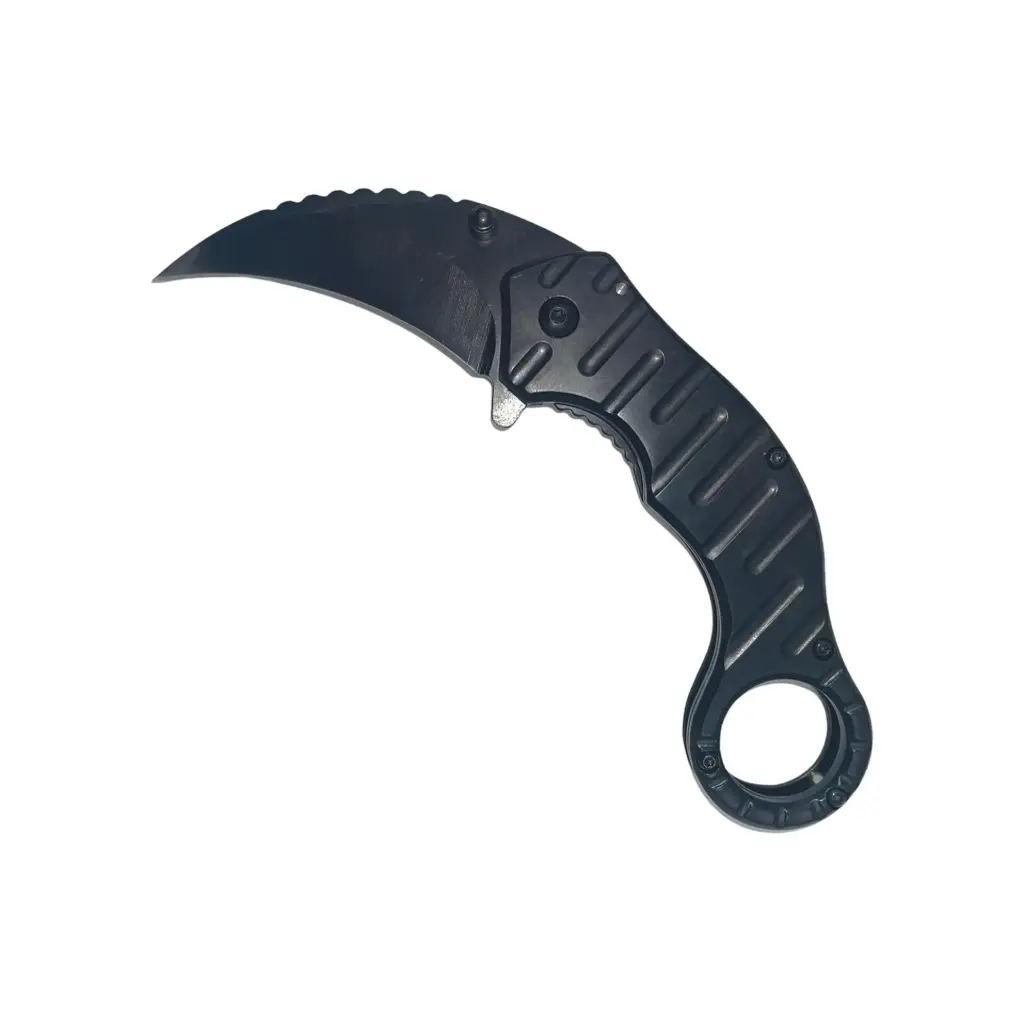
Shadow Hook Rapid Karambit Knife - Midnight Black
8 sold in last 24 hours
This automatic knife for sale is a stealth-focused assisted-opening karambit built for people who care how a blade actually deploys. The Shadow Hook rides slim, then snaps open with a decisive assisted action that locks in with authority. The curved karambit profile gives you controlled pull-cuts and secure retention, while the all-black finish stays discreet. You’re not buying another gimmick folder here—you’re picking up a purpose-driven tool with a fast, repeatable action that earns its pocket space.
Automatic Knife for Sale with Real Tactical DNA
If you’re hunting for an automatic knife for sale that isn’t just another generic folder with a spring slapped in, this assisted-opening karambit is exactly the kind of knife that separates enthusiasts from impulse buyers. The Shadow Hook Rapid Karambit Knife - Midnight Black takes the traditional curved claw profile and marries it to a tuned assisted mechanism that deploys fast, locks solid, and stays ready without screaming for attention in your pocket.
Why This Assisted Karambit Belongs Next to Your Automatics
Mechanism matters. You know it, or you wouldn’t be here. While most people lump everything into “switchblade” and call it a day, serious buyers distinguish between a full automatic knife, an OTF, and an assisted opener. This piece sits squarely in that third camp: a spring-assisted folding karambit. You start the motion manually—thumb stud or flipper, depending on build—and the internal torsion spring takes over, snapping the blade into lockup with authority.
That’s the key difference: this is not a button-fired automatic or double-action OTF. It’s an assisted knife tuned for speed and control, which also keeps it in a friendlier legal category than many true switchblades while still scratching that mechanical itch.
Buying an Automatic Knife: Why This Assisted Karambit Competes
Most people who buy automatic knives are chasing two things: deployment speed and mechanical satisfaction. This assisted karambit checks both boxes. The action is calibrated so that once you overcome the detent, the blade doesn’t lazily drift open—it commits. There’s a clean, predictable handoff from your initial push to the spring drive, giving you a repeatable deployment you can trust under stress.
If you’re used to button-release automatics, you’ll notice something different here: you keep a solid grip through the entire arc of deployment. No shifting for a button, no hunting for a safety. Just hook, press, and the blade is where it needs to be. That mechanical flow is exactly why many collectors who love automatics still keep a few solid assisted karambits in rotation.
Action and Geometry: The Mechanics That Actually Matter
Assisted Action That Snaps, Not Stutters
An assisted knife lives or dies on how the spring engages. Done poorly, you get gritty half-deployments and that embarrassing wrist-flick finish. Done right, like here, you feel a firm detent at the start, then a distinct break point where the spring takes over and drives the karambit blade home. The lock seats with a tactile click you can feel as much as hear—exactly what you want in a tactical build.
Karambit Curve and Midnight Black Profile
The hooked karambit profile isn’t just visual drama. It’s there for controlled pull-cuts, tight work close to the hand, and retention when your grip gets compromised. The ring and curve architecture (if present in the specific build) give you indexing you can find even in the dark. The Midnight Black finish across blade and handle keeps reflections down and turns this into a true low-profile carry, not a pocket peacock.
EDC Reality: Carrying an Assisted Karambit Instead of a Standard Automatic
Plenty of buyers look for automatic knives for sale, then realize what they actually want is a fast, one-hand opening knife they can legally carry and realistically use. This assisted karambit fills that slot. Folded, it rides compact in the pocket while still offering that full claw geometry when deployed. The geometry naturally locks into the hand, so once it’s open, you’re not readjusting your grip to get the edge where it should be.
Where a double-action OTF shines in straight-line thrusts and quick in-and-out work, the karambit excels in arcing cuts, controlled hooking motions, and retention under torque. Different jobs, different tools. Serious enthusiasts know the difference and carry accordingly.
Legal Context: Where Assisted Knives Sit Compared to Switchblades
Any time you look to buy an automatic knife online, the legal question is right behind the action question. Under U.S. federal law, true automatic knives and switchblades—where a button, lever, or switch in the handle fires the blade—sit in a more restricted category, especially for interstate commerce and certain occupations. Many states then add their own layers on top of that.
Assisted-opening knives, like this karambit, operate differently. You start the opening manually, and the spring only completes the motion. In many jurisdictions, that mechanical distinction means an assisted knife is treated more like a standard folding knife than an automatic switchblade. That said, state and local laws can vary widely, and some areas do lump assisted and automatic together. The responsible move is simple: check your state and local knife laws before you carry, and know how your region defines automatic, OTF, and assisted mechanisms.
What Buyers Ask Before Purchasing an Automatic Knife
Are automatic knives legal?
In the U.S., federal law regulates switchblades and automatic knives mainly around interstate commerce and specific restricted recipients, but it does not outright ban ownership nationwide. The real complexity comes from state and local laws. Some states allow automatic knives and OTFs with few limits, others restrict blade length or carry method, and a handful still prohibit them entirely. Assisted-opening knives like this karambit are often treated more leniently because you initiate the opening manually, but that is not universal. Before you buy or carry any automatic, OTF, switchblade, or assisted knife, check your state statutes and local ordinances—don’t rely on rumors or outdated forum posts.
What's the difference between an automatic knife, OTF, and a switchblade?
“Switchblade” is the legal and common term for a true automatic knife: press a button, push a switch, or flip a lever in the handle and the blade deploys under spring power. An automatic knife can be side-opening (like a traditional folder that fires out from the side) or an OTF—out-the-front—where the blade travels straight out of the handle. OTFs can be single-action (button fires, manually reset) or double-action (same control deploys and retracts). An assisted-opening knife, like this karambit, is different: you start the blade moving with a stud or flipper, then the spring completes the deployment. That mechanical nuance is everything—for enthusiasts and for the law.
What makes this automatic knife worth buying?
For a buyer who lives in the automatic knife world, this assisted karambit earns its place by doing three things right. First, the assisted action is tuned: consistent detent, decisive snap, and reliable lockup instead of sluggish half-opens. Second, the karambit geometry gives you capabilities your straight-blade automatics don’t—hooked control cuts and secure retention under load. Third, the Midnight Black, stealth-first design keeps the entire package discreet, more tool than toy. It’s the knife you carry when you want fast deployment and functional geometry without turning every pocket pull into a show.
For Enthusiasts Who Actually Care How a Knife Works
If your idea of buying an automatic knife is just grabbing the cheapest “switchblade” online, this isn’t for you. But if you’re the buyer who can feel the difference between a sloppy spring and a tuned assisted action, who understands why a karambit belongs in the same rotation as your favorite OTF, then this Midnight Black assisted karambit fits your kit. It’s a fast-deploying, mechanically honest tool that respects the same engineering obsession that drew you to automatics in the first place.