
Signal Doctrine Field Survival Manual - Signal Yellow
5 sold in last 24 hours
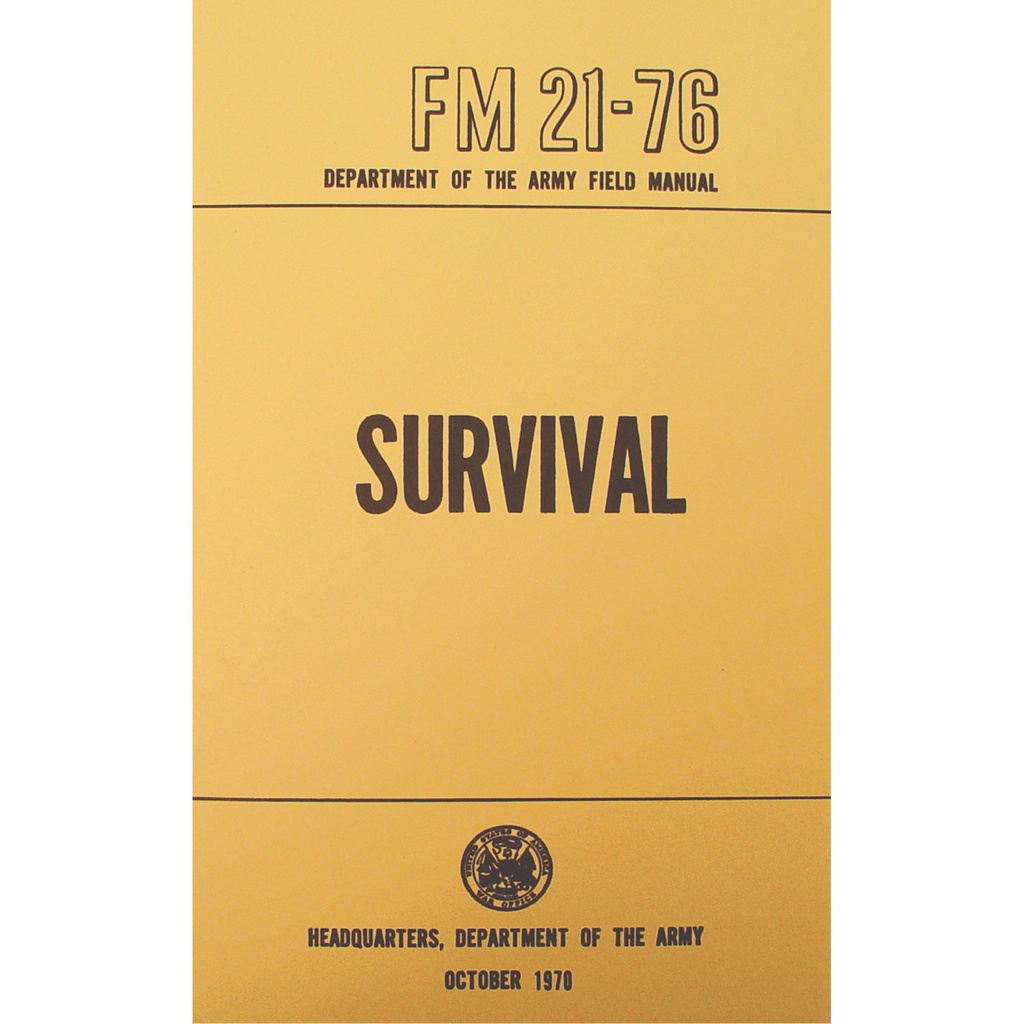
This isn’t a coffee-table reprint—it’s a pocket-sized field brain. Based on the 1970 U.S. Army FM 21-76, the Signal Doctrine Field Survival Manual turns doctrine into straight, usable survival method: navigation, water, food, firemaking, cooking, and special environments. The signal yellow cover is built to be found fast in a pack or truck, then opened and put to work. If you treat your kit like a system, this is the reference that earns its space next to your blades and fire tools.
Why a Serious Knife Kit Deserves a Serious Survival Manual
If you care enough to chase the perfect automatic action, you already understand this: gear is a system. The best automatic knife in the world doesn’t help much if you don’t know how to find water, build shelter, or keep a low fire going in ugly weather. That’s exactly where the Signal Doctrine Field Survival Manual - Signal Yellow earns its slot in your pack.
This is a straight-ahead reprint of the 1970 U.S. Army FM 21-76 survival manual. No marketing fluff, no tactical cosplay. Just doctrine that was written for people whose mistakes had consequences. It’s the same mindset that separates a dialed-in automatic from a gas-station switchblade.
From Doctrine to Dirt: What This Survival Manual Actually Covers
FM 21-76 was built as a field brain for soldiers operating far from support. This reprint carries that same structure, stripped of modern buzzwords and focused on what actually keeps you alive:
- Navigation: Grounded map-and-compass work, terrain association, and practical movement techniques when electronics die or fail.
- Water: Finding, judging, and making water safe in varied environments—where theory becomes drinkable reality.
- Food: Scavenging, trapping, and foraging with the kind of directness you expect from a military manual.
- Firemaking: Methods, materials, and setups that account for wind, rain, and limited resources, not ideal YouTube conditions.
- Cooking: Turning whatever you can get into something edible with minimal kit.
- Survival in Special Areas: Adjusting your plan for desert, jungle, cold weather, and other high-risk environments.
Like a well-tuned automatic knife, this manual is about repeatable function under stress—not looking impressive on a shelf.
Why This Field Manual Belongs Next to Your Automatic Knife
Most people buy a survival book once and never actually train with it. The design of this 1970 doctrine manual fights that tendency. The signal yellow cover is high-visibility on purpose: you don’t dig around for it, you spot it instantly in a ruck, glovebox, or range bag.
The interior layout is pure military: clean headings, logical progression from basic needs to environment-specific problems, and language that assumes you’re here to work, not be entertained. It pairs well with the mindset of an automatic knife owner who appreciates mechanism, not marketing.
Field-Ready Design That Matches a Working Kit
This isn’t a glossy coffee-table edition; it’s built to be a working reference. The paperback format rides easily with your other gear—behind a med pouch, next to an EDC automatic, or in the map pocket of a truck. The matte finish and bold typography are easy to read under bad light, which is when you’ll actually need it.
Authentic U.S. Army FM 21-76 Content
Collectors and instructors will appreciate that this is a doctrine-true reprint. It carries the FM 21-76 designation, the Department of the Army seal, and the original October 1970 date. You’re not getting a paraphrase; you’re getting the actual structure and voice of an era when survival training wasn’t a lifestyle brand.
How Serious Buyers Use This Survival Manual
Automatic knife enthusiasts tend to be systems thinkers. You dial in edge geometry, action tuning, and deployment method because you’re building a complete carry philosophy. This survival manual fits into that same mindset in three specific ways:
- Training Tool: Build drills directly from its navigation, fire, and shelter sections, the same way you’d build deployment reps for a new automatic knife.
- Reference Backbone: Use it as the baseline doctrine to compare against modern survival techniques you pick up from classes or instructors.
- Kit Anchor: Keep one copy in your range bag or truck and another on the shelf as your go-to planning reference.
Where an automatic knife gives you mechanical advantage in the moment, this book gives you mental advantage beforehand.
Legal Context: No Restrictions, Just Responsibility
Unlike an automatic knife, an OTF, or a traditional switchblade, this survival manual doesn’t live in a legal gray area. It’s a book—a training and reference tool. There are no federal or state-level prohibitions on owning or carrying this manual in your pack, vehicle, or checked luggage. That makes it a smart way to level up your capability even if you live in a state with strict automatic knife laws.
For buyers who travel, train, or teach across multiple jurisdictions, this manual is the part of your kit no one is going to question. You can’t say that for every blade in your collection.
What Buyers Ask Before Purchasing an Automatic Knife
Are automatic knives legal?
In the United States, automatic knife legality is a mix of federal and state rules. At the federal level, the Switchblade Knife Act restricts interstate commerce in certain automatic and switchblade knives, with defined exceptions (for example, for military and some government use). The real complexity lives at the state level: some states allow automatic knives and OTFs for everyday carry, others limit blade length, opening mechanism, or carry method, and a few still prohibit them outright. Before you buy an automatic knife for sale online, you need to check your state and local laws—not just a generic summary—and verify both possession and carry rules.
This survival manual itself is unrestricted, but it’s a smart companion for planning a legal, practical kit around the blades you’re allowed to carry.
What’s the difference between an automatic knife, OTF, and a switchblade?
“Automatic knife” is the broad category: you press a button, slide, or hidden release and spring tension drives the blade open. Most side-opening automatics pivot out from the handle like a standard folder, just driven by a coil or leaf spring.
OTF knives—out-the-front—deploy the blade straight out of the spine of the handle instead of swinging out from the side. Many enthusiasts chase double-action OTF models that fire and retract off the same slide, while single-action OTFs usually require manual reset.
“Switchblade” is a legal and cultural term that usually refers to automatic knives in general, but statute language can be specific. Serious buyers pay attention to how their state defines a switchblade versus an automatic or OTF because wording can decide what’s legal to carry.
What makes this survival manual worth buying?
For the same reason you don’t buy the cheapest automatic knife and call it done: doctrine matters. This FM 21-76 reprint gives you a coherent survival framework tested by generations of soldiers and instructors. Instead of random tips scattered across the internet, you get a structured approach to navigation, water, food, fire, and shelter, plus environment-specific adjustment.
The high-visibility signal yellow cover is a functional advantage—this isn’t disappearing at the bottom of a pack—and the official 1970 U.S. Army formatting makes it valuable both as a working manual and as a piece of survival training history. If you’re the kind of buyer who tunes an automatic’s action until it’s right, you’ll recognize the same no-nonsense design ethic here.
For Enthusiasts Who Treat Their Kit Like a System
Owning a finely tuned automatic knife is about more than the snap of the action—it’s about having the right tool in a well-thought-out system. The Signal Doctrine Field Survival Manual - Signal Yellow is the quiet piece of that system that pulls the rest together. It won’t catch eyes like a new double-action OTF, but when conditions turn against you, this is the item you’ll be glad you packed.
If you’re the kind of buyer who chooses steel, action, and geometry on purpose, this is the survival manual that matches that mindset.