Trail Sentinel Full-Tang Tracker Knife - Black Blade Leather
15 sold in last 24 hours
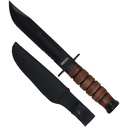
This isn’t a wall-hanger; it’s a working blade. The Trail Sentinel Full-Tang Tracker Knife pairs a 7" matte black clip point with partial serrations and a stout guard for real field control. The stacked leather handle locks into your palm, spreading full-tang impact across the entire grip. From carving tent stakes to breaking down game, it behaves like the classic military-style field knife it visually echoes — dependable, simple, and ready to ride your belt sheath into actual use.
Trail Sentinel Full-Tang Tracker Knife - Black Blade Leather
The Wilderness Edge Full-Tang Tracker is built in the lineage of real field knives — the kind that see dirt, sap, and blood, not glass display cases. A 7" matte black clip point, partial serrations, stacked leather handle, and full tang running end to end tell you exactly what this knife wants: to live on your belt and get used hard.
Why This Fixed Blade Tracker Earns a Place on Your Belt
On paper, it’s simple: 7" blade, 12" overall, leather handle, nylon sheath. In hand, it feels like the knives that taught a generation how to baton wood and dress game. The full-tang construction means the steel doesn’t stop where the handle starts — the tang runs the length of the grip, so every hammer grip, every pry, every twist loads into the spine of the blade, not into a weak joint.
The matte black clip point gives you a fine enough tip for controlled work — not a needle, but a solid point for piercing, starting cuts, or working into joints when breaking down an animal. The partial serrations near the handle add honest utility where it matters: push-cutting cord, nylon strap, or rough bark when a plain edge would skate.
Steel, Grind, and the Work This Knife Actually Wants To Do
Is this a boutique powdered steel showpiece? No — and that’s its strength. This is basic high-carbon or carbon-alloy steel done in a classic field pattern, which means it’s tuned for service sharpening, not babying. Expect solid toughness, easy touch-ups on a basic stone, and an edge that can be reset after a weekend of abuse around camp.
Full-Tang Confidence and Leather Control
The stacked leather handle is old-school for a reason. Leather compresses, conforms, and keeps traction even when wet, without the cold, dead feel of bare metal. Those stacked rings create micro-ridges under your fingers, so the knife indexes the same way every time you draw it. Combined with the double guard, it gives you grip security for power cuts and thrusts, even if your hands are sweaty or gloved.
The rounded pommel closes that full-tang profile, giving you a solid anchor point. It’s not a dedicated impact tool, but it’s absolutely capable of light hammering, tapping in tent stakes, or persuading a knot to loosen.
Blade Geometry: Clip Point with Partial Serrations
The clip point profile walks the line between utility and field-ready aggression. You get a belly long enough for slicing and food prep, plus a clipped spine that brings the point down where you can actually control it. The fuller (often lazily called a “blood groove” by people who should know better) is there to lighten the blade slightly and shift balance back toward the hand — subtle, but noticeable in use.
The partial serrations live where they should: near the handle. That’s where your leverage is best for powering through fibrous material. They’re not there to look tactical; they’re there for the day you’re cutting stubborn rope, pack straps, or nylon webbing in the wet.
Carry Reality: A Field Knife That Wants To Be Used
The included black nylon sheath is belt-ready from day one. No complicated straps, no novelty carry systems — just a straightforward belt loop and snap-retention that keeps the knife locked down until you need it. On the hip, the 12" overall length rides like a standard field knife: present, but not obnoxious, especially if you’re used to traditional military-style belts or hiking rigs.
Balance sits just forward of the guard, which is exactly where you want it for power cuts and general camp tasks. The knife feels blade-forward enough to bite into wood but not so heavy it becomes a chore to carve with for longer sessions.
What Buyers Ask Before Purchasing an Automatic Knife
Even though this is a fixed blade, a lot of buyers cross-shop it with an automatic knife for sale, especially when they’re building a complete kit with a belt knife plus an auto folder or OTF riding in the pocket. So let’s address the automatic knife questions that always come up alongside a serious field knife like this.
Are automatic knives legal?
In the United States, automatic knife legality is a mix of federal baseline and state-level specifics. Federally, the Switchblade Act restricts interstate commerce in automatic knives and classic switchblades, but it does not outright ban ownership. Where things get real is at the state and local level: some states fully allow automatic knives and OTF designs, some restrict blade length, some limit carry to law enforcement or military, and some still treat switchblades as prohibited weapons.
The only honest answer: before you buy an automatic knife or switchblade, check your current state and local laws from an official source. Look up whether an automatic knife is legal to carry concealed, open, or at all, and whether there are blade length caps or specific prohibitions on OTF or double-action automatic knife mechanisms. Laws change, and what’s fine in one state can be a charge in the next.
What’s the difference between an automatic knife, OTF, and a switchblade?
Mechanically, the categories are clear once you stop lumping everything under “switchblade”:
- Automatic knife: A folding knife where the blade is held closed under spring tension and deploys when you hit a button, lever, or hidden release in the handle. The blade swings out from the side on a pivot.
- OTF knife (out-the-front): A specific type of automatic knife where the blade travels linearly, exiting the front of the handle. Single-action OTFs fire out and are manually reset; double-action OTFs use the same control to extend and retract the blade.
- Switchblade: Technically, the older legal term that covers side-opening automatics and, in many statutes, OTF designs as well. In collector and enthusiast conversation, we usually reserve “switchblade” for classic side-opening autos, but the law may not be that precise.
The knife on this page is none of those — it’s a fixed blade tracker. No springs, no pivots, no automatic mechanism at all. That’s exactly why many serious users pair a belt-mounted fixed blade like this with an automatic knife for fast, one-handed deployment in the pocket.
What makes this automatic knife worth buying?
When buyers ask this while looking at the Wilderness Edge Tracker, what they really mean is: “Why buy this fixed blade when I’m also shopping for an automatic knife for sale?” The answer is simple: an auto gives you instant one-handed access; a full-tang tracker like this gives you the leverage, durability, and blade length an automatic folder or OTF simply can’t match in the same footprint.
You buy an automatic knife for deployment speed. You buy this Wilderness Edge Tracker for the jobs where speed doesn’t matter as much as strength: batoning kindling, prying, rough carving, processing game, and every chore where a locking mechanism is a liability compared to a solid piece of steel running from tip to pommel.
Why This Wilderness Edge Tracker Belongs in a Serious Kit
Strip away the marketing, and you’re left with what counts: full-tang steel, a 7" matte black clip point with partial serrations, a stacked leather handle that actually works when wet, and a nylon sheath that makes belt carry boringly dependable. It’s a classic tactical-outdoor pattern that still exists because it still works.
If you’re the enthusiast who keeps an automatic knife in your pocket but knows a fixed blade belongs on your belt when the terrain gets real, this Wilderness Edge Full-Tang Tracker fits that mentality. It doesn’t try to out-tacticool the market. It just does the fundamental jobs well, day after day, season after season.
Own it because you want a field knife that feels like the knives that built the reputation in the first place — not a costume prop. In a collection, it balances nicely against your OTFs and side-opening autos. On the trail, it reminds you why a straightforward full-tang tracker still matters more than deployment gimmicks when the work gets heavy.
For the buyer who values real use over hype, this Wilderness Edge Full-Tang Tracker knife is the quiet backbone of the kit — the one that keeps working long after your automatic knife needs a clean, a tune, or a rest.
| Blade Length (inches) | 7 |
| Overall Length (inches) | 12 |
| Blade Color | Black |
| Blade Finish | Matte |
| Blade Style | Clip Point |
| Blade Edge | Partial-Serrated |
| Blade Material | Steel |
| Handle Finish | Matte |
| Handle Material | Leather |
| Theme | Tactical |
| Handle Length (inches) | 5 |
| Tang Type | Full Tang |
| Pommel/Butt Cap | Rounded pommel |
| Carry Method | Belt carry |
| Sheath/Holster | Nylon sheath |